
Nemotron-TwoTower: Rethinking LLM Throughput via Decoupled Diffusion
Nemotron-TwoTower: Diffusion Language Modeling with Pretrained Autoregressive Context
NVIDIA researchers introduced Nemotron-TwoTower, a 30B parameter block-wise diffusion language model that decouples context representation from denoising. By pairing a frozen autoregressive Context Tower with a trainable Diffusion Denoiser, it maintains 98.7% of the original Nemotron-3-Nano's quality while achieving a 2.42x speedup in generation throughput.
TL;DR
NVIDIA has unveiled Nemotron-TwoTower, a 30B-parameter hybrid model (Mamba + Transformer + MoE) that breaks the sequential bottleneck of autoregressive decoding. By splitting the model into a frozen Context Tower and a trainable Denoiser Tower, it achieves a 2.42x wall-clock speedup while retaining over 98% of the original performance.
Problem & Motivation: The Conflict of Interest in Weights
Standard Large Language Models (LLMs) are "token-by-token" processors. This sequential nature is the primary killer of inference throughput. While Discrete Diffusion Models offer a parallel alternative, most implementations force a single network to perform two contradictory tasks simultaneously:
- Context Encoding: Managing long-range causal history (requiring stable, unidirectional representations).
- Iterative Denoising: Refined, bidirectional filling of corrupted tokens.
This "entanglement" creates an optimization conflict. Nemotron-TwoTower solves this by decoupling these roles, allowing each "tower" to focus on what it does best.
Methodology: The Two-Tower Blueprint
The architecture is built upon the Nemotron-3-Nano-30B-A3B, a sophisticated hybrid model.
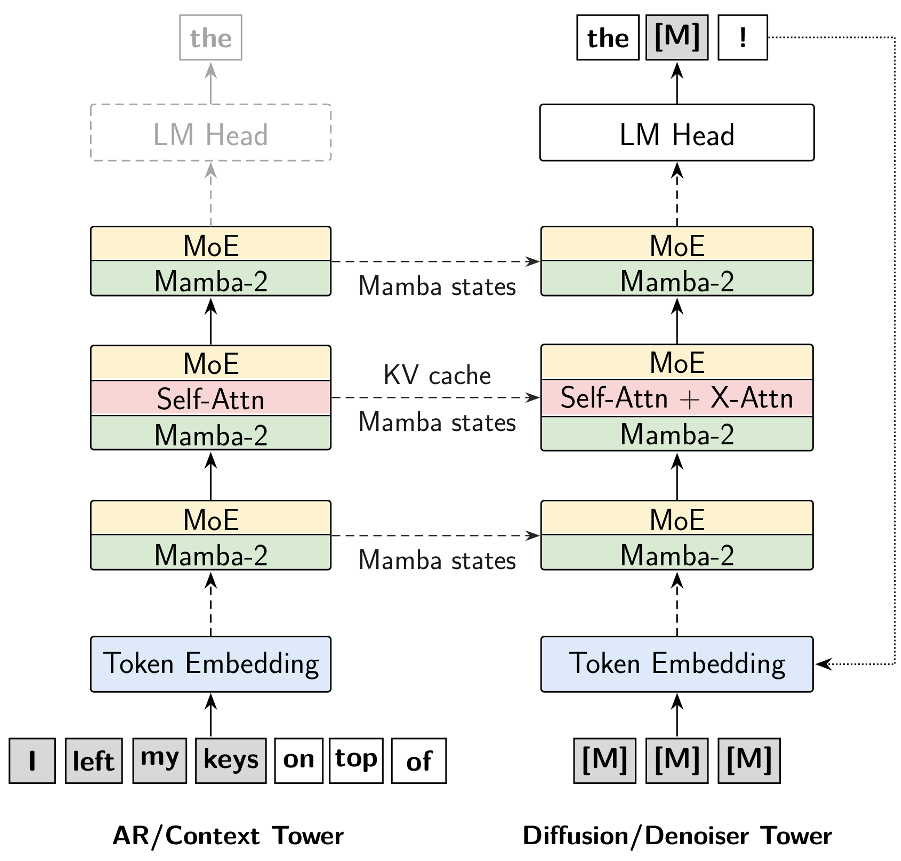
1. The Decoupled Architecture
- AR Context Tower (Frozen): This is the "brain." It processes previous clean tokens and generates KV caches and Mamba states. Being frozen, it preserves the high-quality priors learned during pretraining.
- Diffusion Denoiser (Trainable): This is the "editor." It takes noisy blocks and refines them. Crucially, it uses bidirectional attention within the block to let tokens "talk" to each other horizontally, while using cross-attention to look back at the Context Tower.
2. Adaptive Step-wise Generation
The model generates in blocks (default size S=16). Unlike standard diffusion that takes a fixed number of steps, TwoTower uses Confidence Unmasking. At each step, the denoiser predicts all tokens; tokens that meet a confidence threshold () are committed immediately. This allows the model to "fast-track" easy tokens and spend more time on complex ones.
Experiments: Performance vs. Efficiency
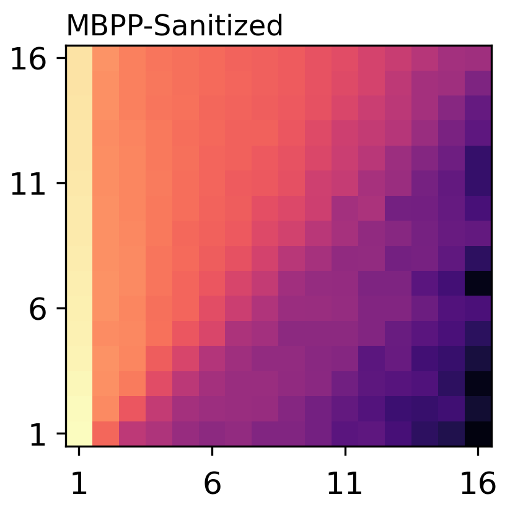
The researchers benchmarked the model against its Autoregressive counterpart. The results represent a new Pareto frontier for efficiency:
- Throughput: 2.42x higher wall-clock speed.
- Quality: 98.7% aggregate benchmark recovery.
- Data Efficiency: The denoiser was adapted using only 2.1T tokens—a fraction of the 25T used for the original backbone.
Key Insights from Ablations
- Fixed Context is Key: Letting the Context Tower drift during training actually hurt performance. Keeping it frozen acts as a stable anchor.
- Time Matters: Using
adaLN(adaptive layer normalization) to feed the diffusion "time" (noise level) into the denoiser significantly improved math and code reasoning. - Mamba's Role: Interestingly, the study found that bidirectional Mamba provided negligible gains, so the final architecture sticks to causal Mamba layers, relying on bidirectional attention for "editing" power.
Critical Analysis & Future Outlook
Nemotron-TwoTower demonstrates that we don't necessarily need to "throw away" our expensive AR models to achieve parallel generation.
Limitations:
- Memory Footprint: Keeping two towers resident in memory doubles the weight storage (though KV cache memory scales identically to AR).
- Inductive Bias: The model still shows a "left-to-right" bias in commitment, likely inherited from the Mamba layers and the frozen tower.
The Takeaway: As we move toward 2026, the industry is shifting away from "pure" architectures. NVIDIA's approach shows that the future of fast LLMs likely involves heterogeneous roles—specialized modules for understanding and specialized modules for fast, iterative drafting.
For developers and researchers, this provides a clear recipe for adapting existing open-weights models into high-speed production engines without massive retraining.