
This is How the Neocortex Learns: Bridging the Gap Between AI and Biology
This is how the Neocortex Learns
The paper presents a unified theory of neocortical learning based on temporal derivative error-driven predictive learning. It proposes that the brain approximates the powerful Error Backpropagation algorithm through corticothalamic circuits and a competitive kinase-based synaptic plasticity mechanism, implemented in the Axon spiking lizard framework.
TL;DR
Randall O'Reilly's latest work provides a "grand unified theory" of neocortical learning. By proving that the brain uses temporal derivatives—the difference in neural activity over short time windows—to approximate Error Backpropagation, this paper reconciles the massive computational power of AI with the messy reality of biological synapses. It validates this via a novel competitive kinase mechanism (CaMKII vs. DAPK1) and demonstrates SOTA-level learning in spiking neural simulations.
Problem & Motivation: The Biological "Backprop" Enigma
For decades, the neuroscience community has been split. On one side, AI researchers know that Error Backpropagation is the only algorithm that scales to human-level intelligence (as seen in LLMs). On the other, biologists argue that Backprop is "unbiological" because it requires a "Global Teacher" signal and distinct "Error Neurons" that don't seem to exist in the cortex.
Existing alternatives like Hebbian learning are biologically simple but computationally "weak"—they cannot train deep, hierarchical networks effectively. The author's insight is that we don't need a separate error signal if the error is hidden in the flow of time.
Methodology: The Temporal Derivative Algorithm
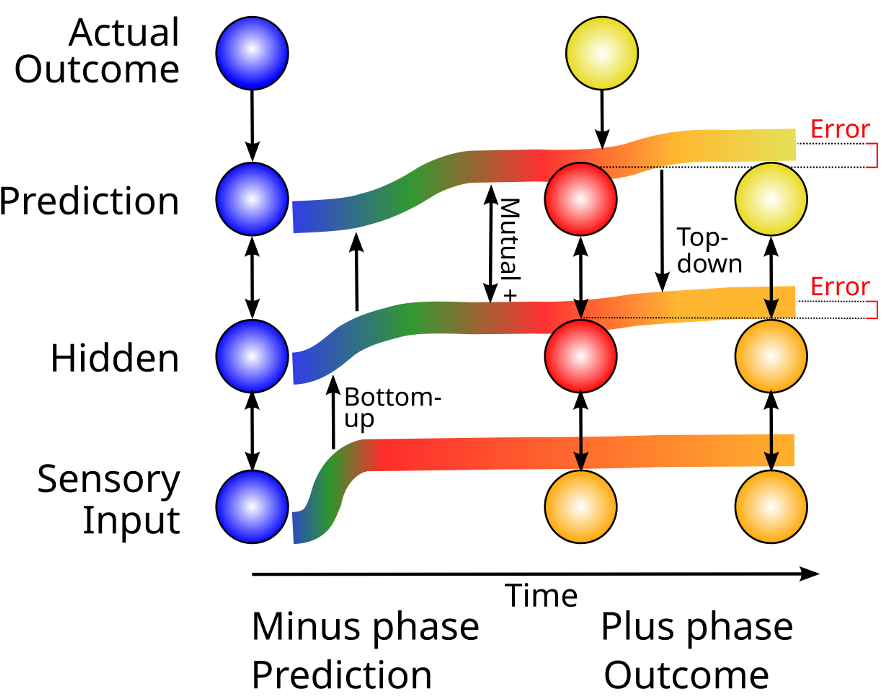
The core idea is that the neocortex is a predictive engine. It constantly produces a Prediction (Minus Phase) and then receives an Outcome (Plus Phase).
1. The Circuit Level
Corticothalamic circuits—specifically the pulvinar and mediodorsal nuclei—orchestrate this. They receive weak "prediction" signals and strong "driver" inputs that provide the ground truth. Instead of computing a subtraction explicitly, the circuit simply exists in two different states 100ms apart.
2. The Molecular Level: Kinase Competition
How does a single synapse "subtract" the past from the present? The paper proposes a competition between two enzymes:
- CaMKII (Fast Integral): Responds quickly to the "Outcome."
- DAPK1 (Slow Integral): Retains a trace of the "Prediction."
The resulting synaptic change (Weight update) is proportional to the Fast - Slow difference, which is mathematically equivalent to a temporal derivative—a local approximation of the backprop gradient.
Experiments & Results: Debunking Hebbian Myths
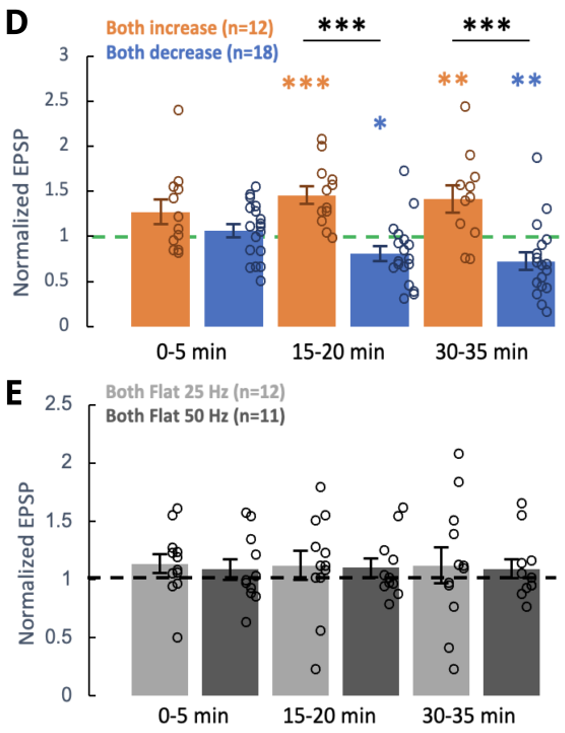
The most striking evidence comes from in vitro synaptic plasticity tests. Traditional Hebbian theory suggests that "Cells that fire together, wire together." However, O'Reilly's team showed:
- 25Hz → 50Hz (Rising): Leads to LTP (strengthening).
- 50Hz → 25Hz (Falling): Leads to LTD (weakening).
- 50Hz → 50Hz (Stable High): Leads to NO CHANGE.
This last point is crucial. If the brain were purely Hebbian, the 50-50 case should show massive strengthening. The fact that it doesn't proves the brain is specifically looking for changes (derivatives), not just activity.
Deep Insights & Critical Analysis
Why it Works
This framework solves the Weight Transport Problem. In artificial backpropagation, the feedback weights must perfectly match the feedforward weights. In O'Reilly's model, bidirectional connectivity (a known feature of the cortex) naturally ensures that the error signal "leaks" back through the same pathways that carry the data, ensuring the gradient is always relevant.
Limitations
While the theory accounts for the "slow" statistical learning of the neocortex, it relies on later mechanisms like Behavioral Timescale Synaptic Plasticity (BTSP) to explain "fast" one-shot learning. The integration between these two systems—the slow gradient descent and the fast eligibility traces—remains a frontier for future research.
Conclusion: A Unified Path for AGI
This paper suggests that the path to Artificial General Intelligence (AGI) may not require reinventing the wheel, but rather refining our understanding of how the brain implements the wheel. By moving away from "Explicit Error" models toward "Implicit Temporal" models, we can build AI that is not only more efficient but also more closely aligned with the only known proof-of-concept for high-level intelligence: the human brain.
For more technical details or to run the simulations yourself, visit the Axon Framework at compcogneuro.org.