
Nestedness Temperature: Decoding the Ecosystemic Hierarchy of Innovation
Nestedness Temperature in the Agent-Artifact Space: Emergence of Hierarchical Order in the 2000–2014 Photonics Techno-Economic Complex System
The paper proposes a novel statistical framework to analyze the hierarchical structure of techno-economic systems using the "Agent-Artifact Space" model. By combining Multilayer Network (MLN) community detection with LDA topic modeling, it measures the "Nestedness Temperature"—a concept borrowed from ecology—to quantify emergent order in the photonics industry from 2000 to 2014.
TL;DR
Is the evolution of technology a chaotic explosion of ideas or a structured biological growth? This paper applies ecological "Nestedness" theory to the photonics industry (2000–2014), revealing that techno-economic systems organize themselves into a strict hierarchical order. Using Multilayer Networks and NLP, the authors find that technological subdomains (artifacts) and institutional clusters (agents) interact in a way that minimizes "system temperature," indicating a highly ordered, emergent structure.
Problem & Motivation: The Missing Link in Techno-Economic Complexity
Innovation doesn't happen in a vacuum; it occurs in the Agent-Artifact Space. Historically, researchers have looked at either the social networks of inventors (the agents) or the semantic evolution of patents (the artifacts). However, they rarely look at the intertwining of the two.
The authors argue that techno-economic systems are "complex adaptive systems" where order emerges from the bottom up. The challenge is: How do we statistically prove that this order exists and isn't just a byproduct of random chance? To solve this, they look toward Ecological Nestedness—a phenomenon where specialist species are only found in habitats where generalists also thrive.
Methodology: Mapping the Multi-Dimensional Space
The authors construct a sophisticated two-pronged pipeline:
-
Agent Dimension (Multilayer Network): They build a network of agents (firms, universities) based on three layers:
- Processes: Co-participation in patents.
- Structures: Geographical proximity (sub-regions).
- Functions: Semantic similarity in technological keywords.
- Algorithm: They use Infomap to detect communities, simulating information flow to find groups that "talk" to each other most intensely.
-
Artifact Dimension (NLP): Using Latent Dirichlet Allocation (LDA), they digest patent texts to identify 15 distinct technological "topics" within photonics.
Bridging the Gap: The Interaction Matrix
The core innovation is the matrix , which records the involvement of each community in each topic. By sorting this matrix, they calculate the Nestedness Temperature (). A low temperature means the system is highly ordered (nested).

Experiments & Results: Photonics as a Living Organism
The study analyzed 4,926 patents over 15 years, divided into 3-year chunks.
The Hierarchical "Heat" Map
The results were striking. As shown in the binary matrices below (where red indicates high involvement), the "temperature" of the photonics system was significantly lower than random models.
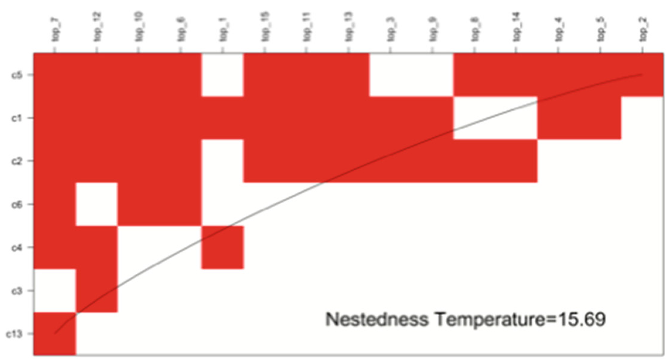 (Visual representation of communities vs. topics showing the characteristic nested "curve".)
Statistical Rigor
To prove this wasn't a fluke, they calculated Z-scores by comparing the real system to 1,000 randomized "homogeneous" versions.
| Period | h=0.01 | h=0.05 | h=0.1 |
|---|---|---|---|
| 2003–2005 | -8.282 | -6.493 | -5.984 |
| 2009–2011 | -13.512 | -6.686 | -4.121 |
Note: A Z-score below -2 indicates statistical significance. The scores here (reaching as low as -13) signify an extremely unlikely level of order if the system were random.
Critical Analysis & Conclusion
Takeaway
The study confirms that technological subdomains are not distributed randomly. Instead, there is a "backbone" of generalist communities that support a wide array of technologies, while specialized technological "artifacts" only emerge in environments that are already technologically diverse.
Limitations & Future Work
While the "Nestedness Temperature" captures the state of the system, it doesn't explain the transition. The authors acknowledge that this is a static analysis of five time-slices. Future research needs to investigate the innovative dynamics—how a community "moves" from a low-diversity state to a high-diversity state in the Agent-Artifact space.
In conclusion, by treating the photonics industry like a biological ecosystem, the authors have provided a robust tool for policymakers to monitor the "health" and maturity of technological domains.