
NetExtractor: Bridging Network Science and Education through Literary Analysis
NetExtractor. A Semi-automatic Educational Tool for Network Extraction Conceived to Differentiate by Student Interest
The paper introduces NetExtractor, a semi-automatic web application designed to extract social networks from novels (ePub) and movie scripts. It aims to bridge the gap in network science education by providing a browser-oriented tool for students and educators to visualize and analyze complex character interactions without requiring programming skills.
TL;DR
NetExtractor is a web-based educational tool that allows students to transform their favorite novels and movie scripts into complex social networks. By combining automated extraction with a manual "human-in-the-loop" interface, it simplifies the transition from storytelling to high-level mathematical analysis—covering centralities, community detection, and role identification—without requiring a single line of code.
The "Century of Complexity" and the Educational Gap
As Stephen Hawking famously noted, the 21st century is the "century of complexity." We are surrounded by intricate networks—social media, power grids, and biological systems—yet the formal tools to understand them remain locked behind technical barriers. In many educational settings, students view mathematics as mere calculation rather than a tool for abstract thinking.
The authors identify a critical challenge: How do we make Network Science accessible to diverse, multicultural classrooms? The answer lies in Differentiation by Interest—letting students study the networks of the characters they love, whether from Game of Thrones, Frozen, or local cultural literature.
Methodology: From Script to Graph
NetExtractor solves the "Black Box" problem of automated extraction. While Natural Language Processing (NLP) has advanced, "Coreference Resolution" (understanding that 'Jon Snow' and 'Aegon Targaryen' are the same person) remains a major hurdle.
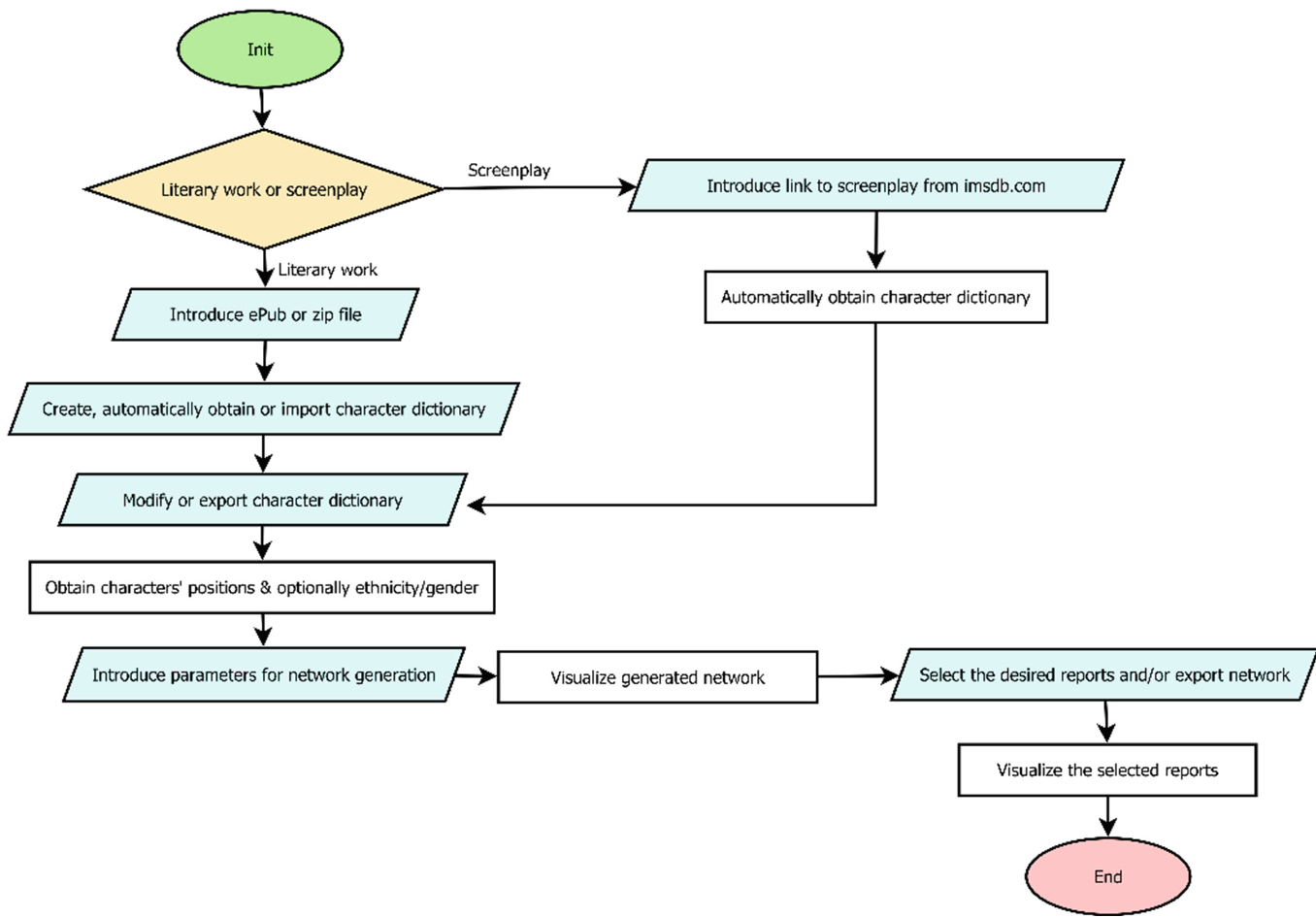
The Extraction Workflow
- Input: Users upload an ePub or an IMDB script URL.
- Entity Recognition: The system identifies character names.
- Human Intervention: To ensure 100% accuracy, the user manually resolves aliases and merges duplicate nodes.
- Interaction Mapping:
- Novels: Characters interact if their names appear within a specific word "radius" of each other.
- Scripts: Interactions are defined by appearing in the same scene.
Deep Dive: Beyond Visualization
Unlike simple charting tools, NetExtractor is a full-featured analytical suite. Once a network is generated, students can dive into:
- Centrality Measures: Who is the "main character"? Is it the person with the most connections (Degree), the person who bridges different groups (Betweenness), or the one connected to other influential people (PageRank)?
- Community Detection: Using algorithms like Louvain or Girvan-Newman, the tool can automatically find "cliques" or factions within a story.
- Role Detection: Based on the research of Guimerà & Amaral, the tool classifies characters into roles like "Hubs" or "Connectors," providing a scientific basis for narrative analysis.
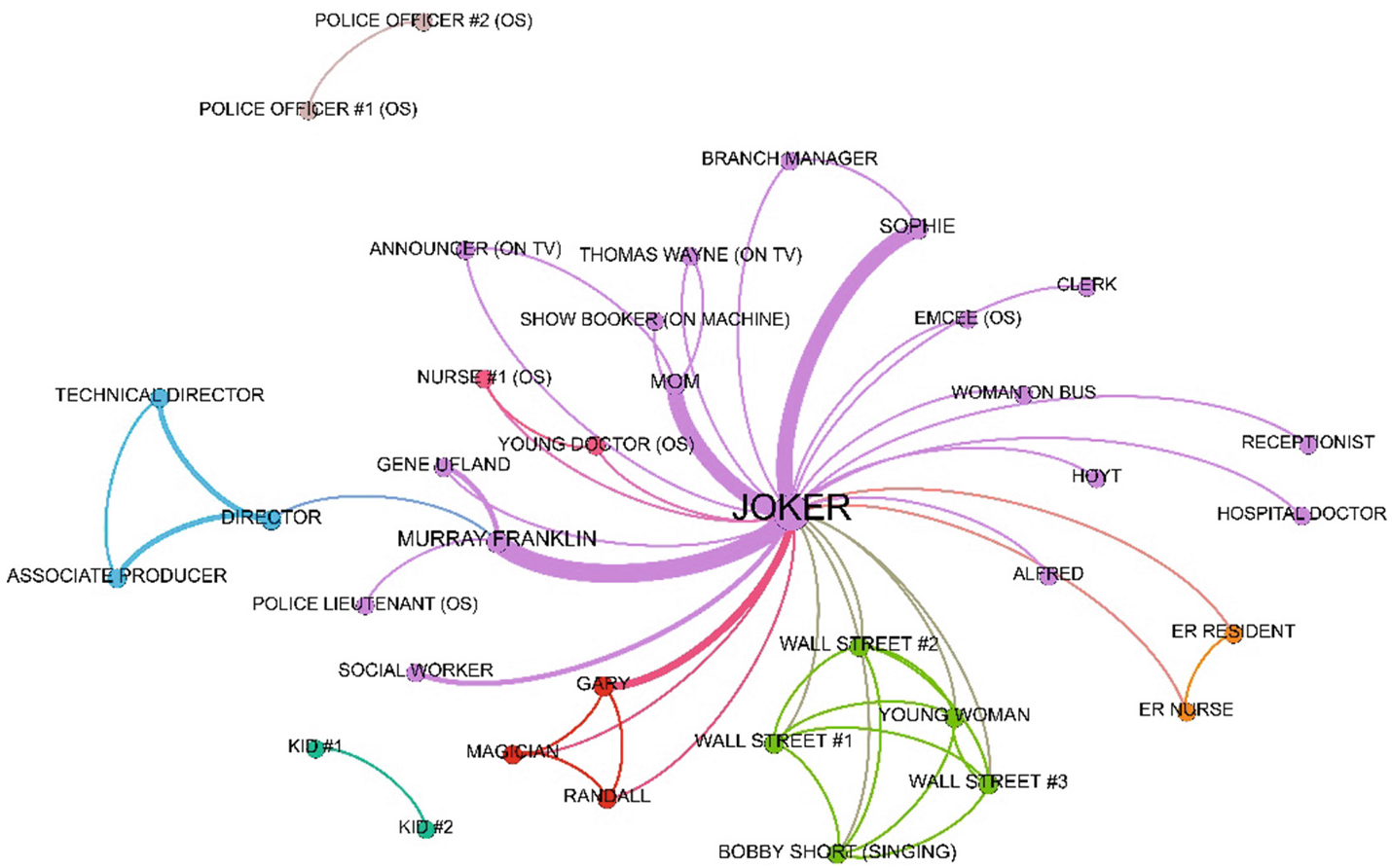 Figure: The interaction network of the film "Joker," illustrating how nodes represent characters and edge thickness represents interaction frequency.
Critical Insight: Education in a Multicultural Context
The most profound contribution of NetExtractor isn't the code—it's the inclusive pedagogy. By allowing students to bring their own cultural "assets" (literature from their home countries) into the classroom, NetExtractor acts as a bridge for Transnational Education. It moves away from a teacher-centered approach to a student-centered one, where the "data" is the student’s own interest.
Conclusion & Future Outlook
NetExtractor successfully democratizes network science by removing the programming hurdle. However, the authors acknowledge that stories are not static. Future iterations aim to include dynamic network analysis, allowing students to see how the social graph evolves chapter by chapter, capturing the "rise and fall" of characters in real-time.
For educators and researchers, NetExtractor serves as a blueprint for how AI and Network Science can be "humanized" for the next generation of complex thinkers.
Source: NetExtractor software is available at netextractor.herokuapp.com with open-source code on GitHub.