
NETPerf Trace: Anticipating the Unpredictable in Internet Routing
NETPerfTrace: Predicting Internet Path Dynamics and Performance with Machine Learning
This paper introduces NETPerf Trace, a machine learning-based system designed to predict Internet path changes and performance metrics. Utilizing Random Forest models and features derived from traceroute measurements, it achieves SOTA results in forecasting path lifetime, frequency of changes, and future latency.
TL;DR
Predicting when an Internet route will change is a "holy grail" for network operators. NETPerf Trace utilizes Random Forest models and advanced feature engineering to forecast path changes and latency. Compared to previous benchmarks (DTRACK), it improves the accuracy of predicting daily route changes from a meager 10% to over 70%, while remaining computationally efficient enough for real-world deployment.
Background: The High Cost of Network Flux
Internet paths are not static; they shift due to BGP updates, traffic engineering, or hardware failures. For giants like Amazon, a 100ms latency increase—often caused by these hidden path shifts—can result in a 1% drop in sales. Existing tools were either too slow or lacked the predictive "foresight" to warn operators before a performance degradation occurred. NETPerf Trace addresses this by treating path dynamics as a supervised learning problem.
The Methodology: Turning Traceroute into Features
The core innovation of NETPerf Trace lies in its Feature Engineering and Model Selection. Instead of just looking at the current state, the authors extract 69 features categorized into:
- FA (Residual Life Time): Statistical properties of route duration and current route age.
- FB (Route Changes): Historical frequency and distribution of path shifts.
- FC (Path Latency): Percentiles and current values of RTT (Round Trip Time) metrics.
Interestingly, the authors found that the best predictors for path lifetime aren't just temporal; they include stability metrics from the FB set.
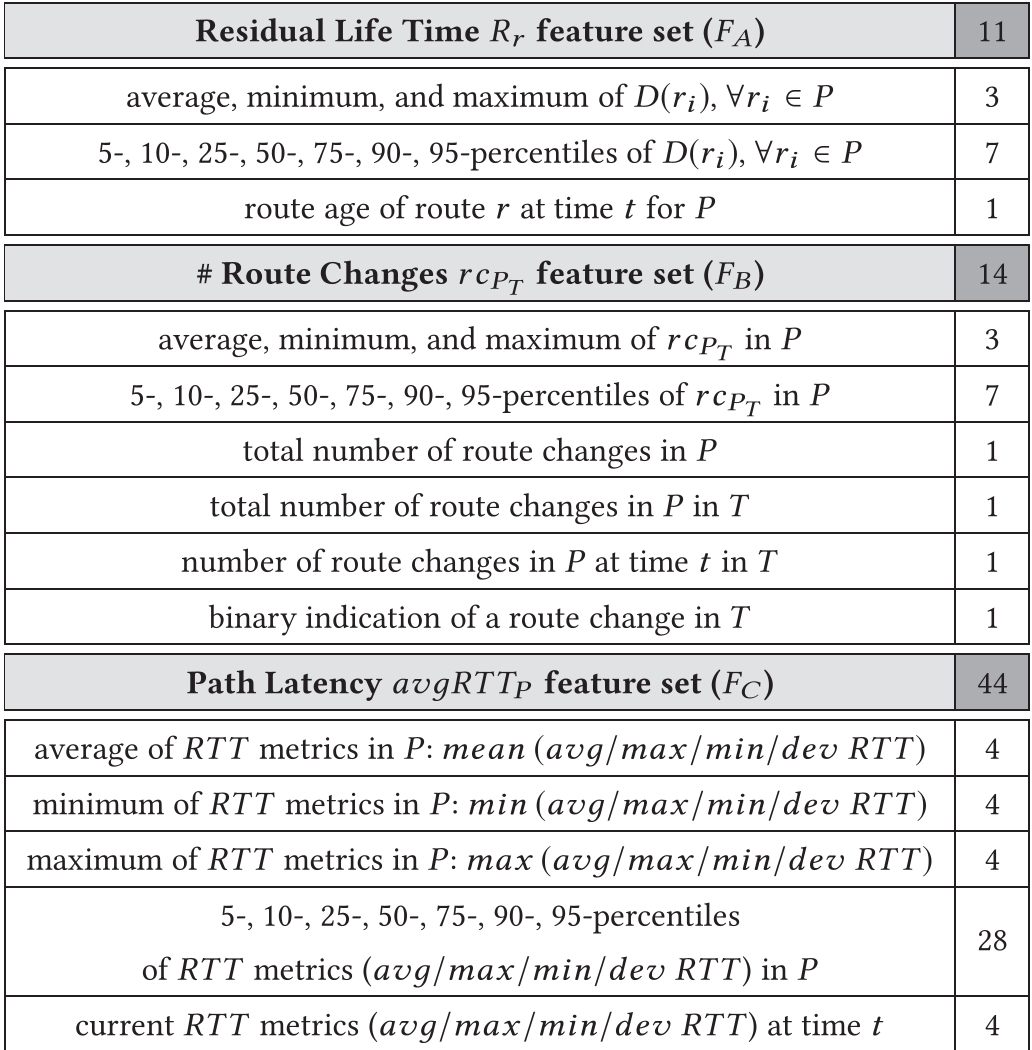
Table 1: The granular feature sets used for training the Random Forest models.
The system employs a Random Forest with 10 trees (RF10). This ensemble approach provides a non-linear mapping between path history and future behavior without the heavy computational cost of deep learning or the high bias of k-NN.
Experiments & Results: Crushing the Baseline
The authors evaluated NETPerf Trace using a massive dataset from M-Lab, involving over 550,000 traceroute measurements across 2,346 global paths.
1. Accuracy vs. DTRACK
The most striking result is the comparison with the previous SOTA, DTRACK. While DTRACK only managed to predict the correct number of daily route changes in 8-10% of cases, NETPerf Trace achieved an 80% accuracy rate when using the full feature set.
2. Feature Importance
Through wrapper-based selection, the study revealed that "Route age" and "Number of changes in the current time slot" are the most critical signals for predicting when a path will die.
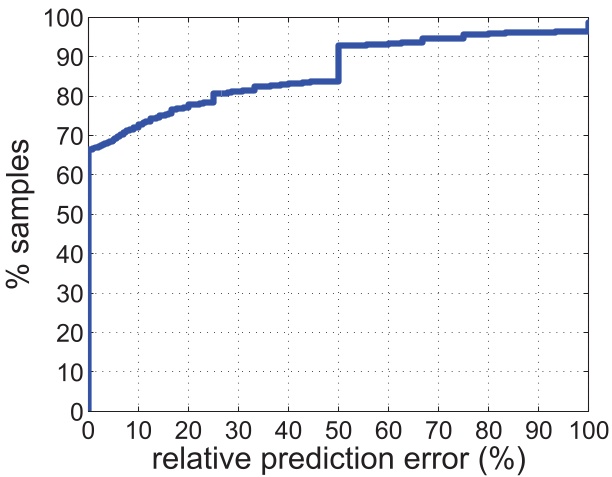
Figure 2(b): Distribution of relative prediction errors for the number of route changes.
Critical Analysis & Future Outlook
NETPerf Trace proves that "network stability" is not just noise; it has recognizable patterns. By predicting (Remaining Life Time), the system allows for Adaptive Sampling:
- When the path is predicted to be stable, reduce traceroute frequency to save bandwidth.
- When a change is imminent, increase sampling to capture the exact moment of transition and its RTT impact.
Limitations: The system still struggles with very short-lived routes (high error rates for short residual lifetimes). Future work could integrate BGP feed data to provide the model with "external" signals regarding inter-domain shifts that traceroute alone cannot see.
Conclusion
NETPerf Trace represents a significant leap from reactive monitoring to proactive forecasting. By releasing the tool as open software, the authors have provided the networking community with a robust foundation for building self-healing and self-optimizing networks.