
NetSpam: Decoding Deception through Heterogeneous Information Networks
NetSpam : A Network-Based Spam Detection Framework for Reviews in Online Social Media.
This paper introduces NetSpam, a novel framework that models review datasets as Heterogeneous Information Networks (HIN) to detect spam reviews. By utilizing metapaths to represent relationships between reviews through shared features, NetSpam effectively maps spam detection to a network classification problem, achieving state-of-the-art performance on Yelp and Amazon datasets.
TL;DR
Online review fraud is a multi-million dollar problem. NetSpam is a breakthrough framework that moves away from analyzing reviews in isolation. Instead, it treats the entire dataset as a Heterogeneous Information Network (HIN). By defining "metapaths" (connections based on shared spammy traits), it effectively identifies fake reviews with higher accuracy and lower complexity than traditional graph-based methods.
The Core Challenge: Why is Spam Hard to Spot?
Existing systems often fall into two traps:
- Feature Blindness: They treat all features (linguistic, behavioral) as equally important, even though a user's rating pattern is usually more revealing than their vocabulary.
- Camouflage: Professional spammers write "normal" reviews to hide their identity.
The authors of NetSpam realized that while a single review might look innocent, its relational footprint within the network—how it connects to other reviews via shared behaviors—tells a different story.
Methodology: The Power of HIN and Metapaths
The innovation of NetSpam lies in its transformation of a classification problem into a network topology problem.
1. Metapath Definition
A metapath is a sequence of relations between nodes. NetSpam defines four categories:
- Review-Behavioral (RB): e.g., Early Time Frame (ETF).
- User-Behavioral (UB): e.g., Burstiness (BST).
- Review-Linguistic (RL): e.g., Use of exclamation marks (RES).
- User-Linguistic (UL): e.g., Content Similarity (ACS).
2. The Weighting Mechanism
Unlike previous works that required ground truth to determine feature importance, NetSpam introduces a formula that calculates weights by observing how reviews cluster around specific metapaths. This allows the model to prioritize high-signal features like Rate Deviation (DEV) and Negative Ratio (NR).
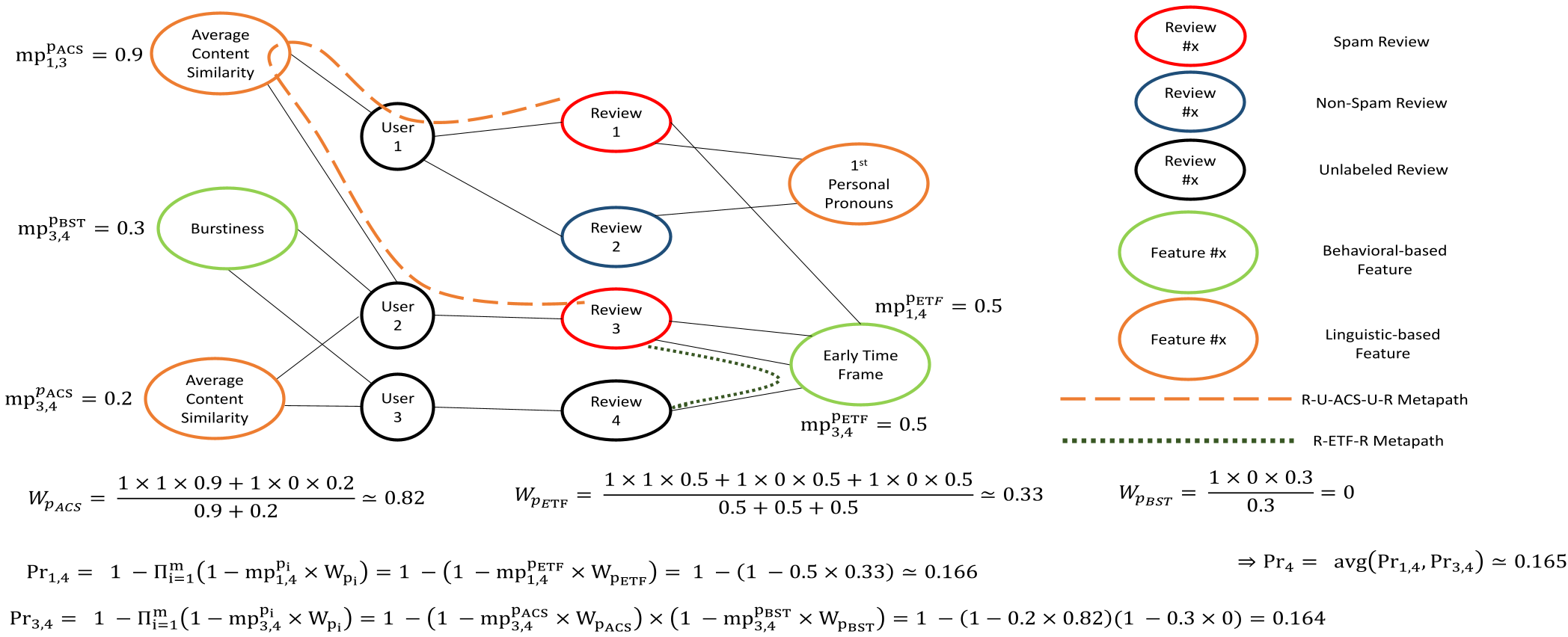 Figure 1: The NetSpam workflow, from HIN construction to feature weighting and final labeling.
Experimental Insights: What Actually Works?
The authors tested NetSpam on massive datasets from Yelp (over 600k reviews) and Amazon.
Key Findings:
- Behavior beats Linguistics: Behavioral features (RB and UB) consistently received higher weights than linguistic ones. Spammers can change their tone, but their temporal and statistical footprints are harder to mask.
- Superior Accuracy: As shown in the ROC curves, NetSpam consistently stays above SPeaglePlus, particularly as more features are integrated.
- Efficiency: By identifying the most "weighted" features, NetSpam can achieve top-tier accuracy using only the 2-3 most important features, significantly cutting down compute time.
 Figure 2: AUC comparisons across different datasets (Review-based, Item-based, User-based) show NetSpam's resilience.
Critical Analysis & Conclusion
NetSpam's ability to operate in an unsupervised mode while maintaining a high correlation with ground truth is its most impressive feat. However, its time complexity of for the offline mode remains a bottleneck for real-time processing of billion-scale networks without further optimization (like localized graph sampling).
The Takeaway: If you are building a trust-and-safety system, stop looking for "spammy words." Look for relational anomalies. The way a review connects to the network is the most honest signal of its intent.
Future Outlook
The metapath approach is ripe for expansion into community detection. In the future, we could use this framework to identify "Spammer Farms" where entire groups of users coordinate to pump or dump a product's reputation.