
CAS2VEC: Predicting Virality Without Knowing the Social Network
Network-Agnostic Cascade Prediction in Online Social Networks
The paper introduces CAS2VEC, a network-agnostic cascade prediction model that uses Convolutional Neural Networks (CNN) to forecast if social media posts will become viral. By treating information cascades as discrete time series rather than graph-based structures, it achieves SOTA results on Twitter and Weibo datasets without requiring expensive network topology data.
TL;DR
Researchers have developed CAS2VEC, a deep learning model that predicts whether a social media post will go viral using only the timestamps of early interactions. By treating cascades like sentences in a document and applying 1D Convolutional Neural Networks (CNNs), the model ignores the complex (and often hidden) social graph, yet still outperforms traditional network-aware methods by up to 20%.
The Problem: The High Cost of "Knowing" the Network
Most existing models for predicting content popularity depend on the underlying social graph. They ask: How many followers does the user have? What is the density of their community? However, this approach has two fatal flaws:
- Data Inaccessibility: Outside of companies like X (Twitter) or Meta, social graph data is incredibly hard to get due to API limits and privacy settings.
- Structural Blindness: Two hashtags might have identical network starting points (similar follower counts and clusters) yet exhibit completely different spread patterns.
The authors of CAS2VEC argue that the reaction time—how fast people respond in the first few minutes—is a much more potent signal than who is connected to whom.
Methodology: From Timestamps to "Sentences"
CAS2VEC's core innovation lies in its "network-agnostic" philosophy. It views a cascade simply as a sequence of timestamps .
1. Preprocessing with Slices
The model discretizes time into "slices." It generates two types of sequences:
- Counter Sequences: An array showing the number of retweets/shares in each time block.
- Discrete Sequences: Mapping each event to a specific time-slice index.
2. The CNN Architecture
The authors noticed that the distribution of events in these time slices looks remarkably like the distribution of words in human language. They adopted a CNN architecture originally designed for sentence classification.
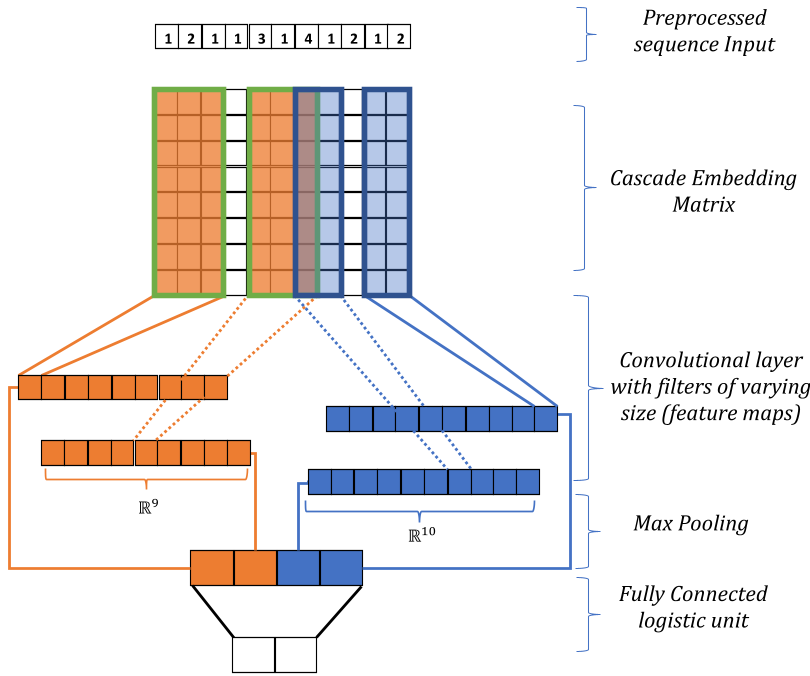
The CNN uses various filter sizes (analogous to n-grams in text) to capture "temporal patterns"—for example, a sudden burst followed by a steady flow, or a slow burn that suddenly accelerates.
Experiments & Results: Robustness in "Early" Prediction
CAS2VEC was tested on massive datasets from Twitter and Weibo.
Key Performance Metrics:
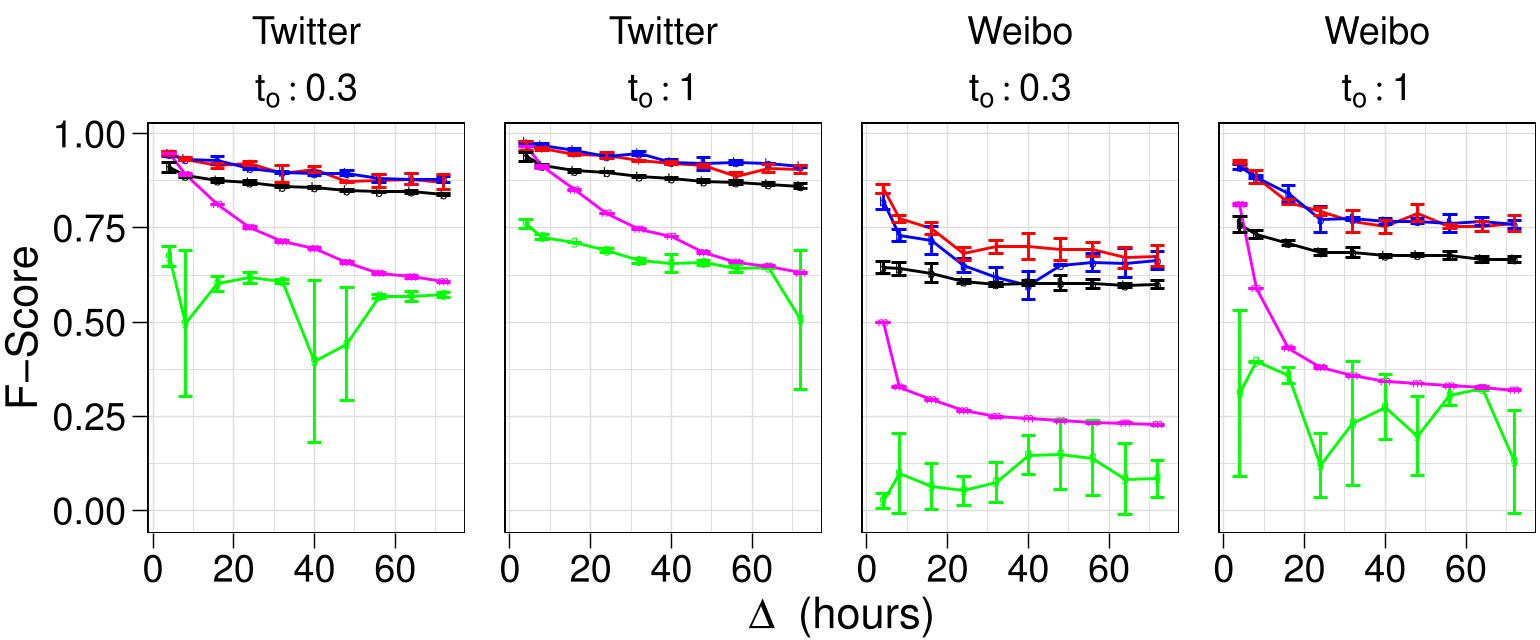
- Accuracy Boost: In the Weibo dataset, CAS2VEC achieved F-scores between 76% and 92%, outperforming the strongest baseline (LOR) by over 15%.
- Early Detection: The model is exceptionally robust when the "observation window" is short. Even with only 1 hour of data, it could predict virality 15 hours into the future with high recall.
- Break-out Coverage: When tasked with identifying the "Top-K" most viral events (the true outliers), CAS2VEC maintained a 95% coverage rate, while baselines struggled to exceed 80%.
Deep Insight: Why Why Does It Work?
The success of CAS2VEC boils down to Conjecture 1 in the paper: viral cascades demonstrate a massive density of events in their earliest stages compared to non-viral ones. By using a CNN, the model doesn't just count events; it identifies the rhythm of the spread. This temporal "signature" is a proxy for how much the content resonates with a general audience, regardless of the specific social links it travels through.
Conclusions & Future Work
CAS2VEC proves that for virality prediction, time is more important than topology. This is a major win for privacy-preserving AI, as it allows for high-quality trend forecasting without needing to map out individual user relationships.
Limitations: The model is currently a binary classifier (viral vs. non-viral). Future iterations could benefit from a regression head to predict the exact final size of the cascade, and perhaps incorporate "low-cost" features like the sentiment of the text to further refine early-stage accuracy.
Main Takeaway: If you want to know if something will go viral, watch the clock, not the map.