
NetP-Score: Why Your Friends' Privacy Settings Matter More Than Your Own
Network-aware privacy risk estimation in online social networks
The paper introduces NetP-Score, a network-aware privacy risk estimation model for Online Social Networks (OSNs). By adapting the Pagerank algorithm, it quantifies a user's privacy risk based on both their intrinsic sharing attitude and the privacy behaviors of their social circle, achieving a more realistic estimation of data leakage potential than traditional policy-based metrics.
TL;DR
Even if you hide every post, your privacy is compromised if your friends are "leaky." This paper introduces NetP-Score, a network-aware metric that uses a Pagerank-style algorithm to quantify privacy risk. By analyzing 75,000 Facebook nodes, the researchers proved that your position in the social graph and your friends' behavior are better predictors of data leakage than your own privacy settings.
The "Herd Immunity" of Privacy
In the world of Online Social Networks (OSNs), we often suffer from a "privacy paradox." We think we are safe because we set our posts to "Friends Only." However, this study argues that privacy is an ecological factor.
If you are surrounded by privacy-aware friends, your sensitive data is less likely to spread (a form of herd immunity). Conversely, if you are at the center of a "careless" subnetwork, a single interaction from a friend can trigger a viral leak. Current SOTA metrics fail because they treat users as isolated islands; NetP-Score treats them as interconnected nodes.
Methodology: Pagerank for Privacy
The core innovation is the transition from Importance (Pagerank's original goal) to Risk.
1. The Intrinsic Risk ()
The authors first define a baseline risk. Through a survey of Facebook users, they discovered a fascinating sociological trend: privacy risk follows a Gamma Distribution relative to the number of friends.
- New Users: Low risk (low activity).
- Average Users: High risk (high engagement, moderate awareness).
- Super-connectors: Lower risk (often celebrities or professionals who are highly conscious of their public image).
2. The Network-Aware Calculation
The researchers redefined the Pagerank iterate: In this model, "authority" flows from careless users to their friends. If your friends are risky (), your own NetP-Score () rises, regardless of your personal settings.
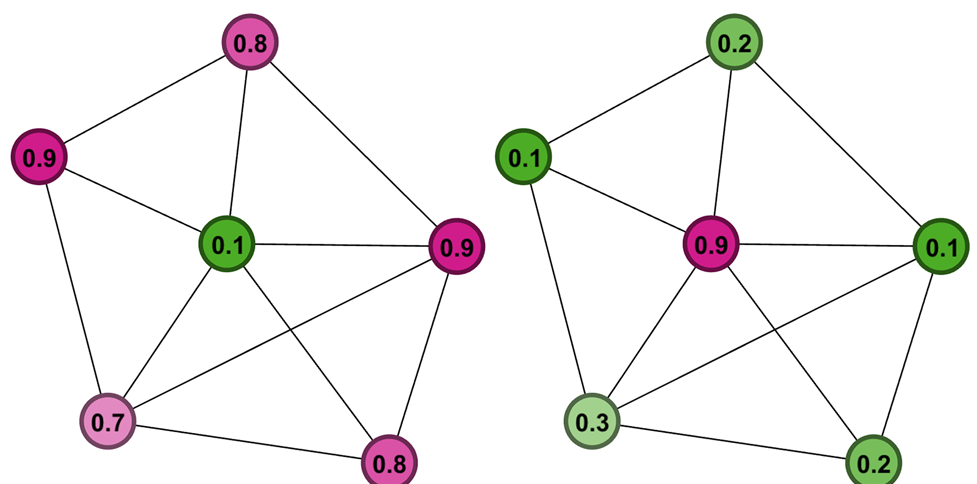 Figure 1: Comparison of intrinsic risk vs. network-adjusted risk. Notice how the central node's risk changes based on its neighbors.
Experiments: Validating the Leak
The authors tested their theory using SIR (Susceptible-Infectious-Recovered) epidemic models to simulate how information spreads.
Key Findings:
- Correlation with Reality: NetP-Score had a significantly higher Spearman correlation with actual information "prevalence rates" than traditional intrinsic scores.
- The Critical Window: In the first few steps of an information leak, NetP-Score was nearly twice as accurate at identifying at-risk users in real Facebook graphs.
- The Centrality Trap: Users frequently underestimate how their "Eigenvector Centrality" (being the "hub" of a group) makes them a target for data harvesters.
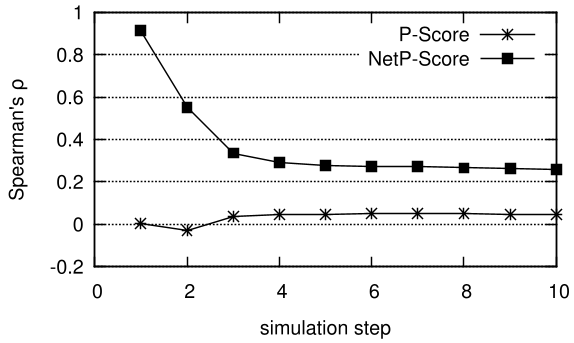 Figure 2: Performance of NetP-Score vs. SOTA (P-Score) in simulating information propagation on Facebook data.
Critical Insight: The Dunbar Connection
A striking byproduct of this research is the validation of the Dunbar Number. The scale parameter () found in their Gamma distribution closely matches the theoretical cognitive limit of human social relationships (~150). This suggests that our privacy behaviors are deeply rooted in our biological capacity to manage social circles.
Conclusion & Future Outlook
The NetP-Score provides a blueprint for future social media features. Instead of a simple "Public/Private" toggle, platforms could implement a "Privacy Battery" or gauge that drains if you move into a risky subnetwork or add "leaky" friends.
Limitations: The current model relies on the social graph being visible. In an age of increasing platform "walled gardens," inferring these networks without API access remains the next great challenge for privacy researchers.
Final Takeaway: Your privacy is only as strong as your weakest (and most central) friend.