
NARs: Bridging the Gap Between Multi-Networking and Network Awareness
Network-aware references for pervasive social applications
The paper introduces Network-Aware References (NARs), a novel distributed object-oriented programming abstraction designed for pervasive social applications. NARs unify multiple networking technologies (e.g., Bluetooth, Wi-Fi, 3G) into a single remote object reference, enabling seamless multi-networking and high-level context awareness in mobile environments.
TL;DR
The paper introduces Network-Aware References (NARs), a programming abstraction that simplifies how mobile apps handle multiple simultaneous network connections (Bluetooth, Wi-Fi, 4G/5G). It allows developers to write communication code once while maintaining the power to adapt application behavior—like resizing images when on a slow connection—automatically.
Background Positioning: This work sits at the intersection of Distributed Systems and Mobile Computing. It specifically addresses the limitations of "transparent" networking by introducing a hybrid model of Network Awareness that doesn't sacrifice the ease of object-oriented programming.
Problem & Motivation: The Multi-Network Paradox
Modern smartphones are equipped with a "cocktail" of networking hardware. However, building a social app that switches gracefully between these technologies is a developer's nightmare.
Prior work usually falls into two extremes:
- Low-level Multi-homing: (e.g., Mobile IP) Successfully hides network switches but makes the app "network-blind." The app doesn't know if it's on a high-cost 3G link or a free Bluetooth link.
- Explicit Management: The developer manually handles every socket and connection state, leading to massive code duplication and fragile error handling.
The authors’ insight is that for pervasive social apps, the network is not just a pipe; it is context. Knowing Bob is reachable via Bluetooth isn't just a technical detail—it’s a social signal that Bob is physically nearby.
Methodology: The Architecture of NARs
The core innovation is the Network-Aware Reference (NAR). Instead of one reference per link, a NAR acts as a "container" for all available links to a remote object.
1. Unified Mailbox & Far References
NARs use a Far Reference model. Unlike Java RMI, where a lost connection throws an exception, NARs are "connection-resilient." If all links fail, messages are buffered in a unified mailbox. Once Alice moves back into range, the NAR automatically flushes the mailbox.
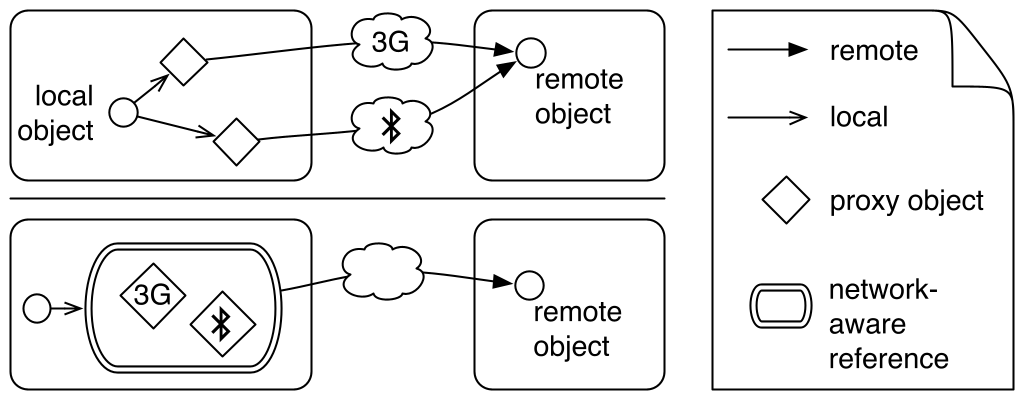 Figure 1: A NAR encapsulates multiple remote references (Bluetooth, Wi-Fi, 3G) into one logical entity.
2. Programmable Network Behaviors
The system allows developers to "steer" traffic using annotations. Developers can specify policies like:
@Only(Bluetooth): Useful for high-bandwidth local sharing.@Prefer(WiFi, 3G): Cost-saving logic.- Custom Adapters: A behavior can intercept a message and transform it (e.g., compress a photo) if the system chooses a low-bandwidth link.
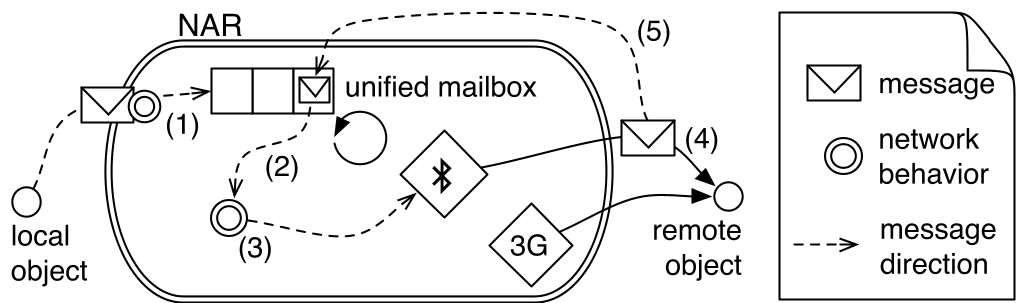 Figure 2: The Network Behavior selects the best available reference based on programmer-defined constraints.
Experiments: The "Pixee" Social App
The authors validated NARs using Pixee, a photo-sharing application. The application demonstrated:
- Context-Triggered UI: The "Share" button only appears when a high-speed local link (Bluetooth) is detected.
- Resilient Handover: When a user leaves the Bluetooth range of a friend, the NAR seamlessly switches to 3G.
- Dynamic Adaptation: The
PictureResizerbehavior successfully reduced data usage by 3G links by automatically downscaling images before transmission.
Critical Analysis & Conclusion
Takeaway
NARs prove that "Network Transparency" is often a false idol in mobile development. By providing a high-level API for Network Awareness, NARs allow apps to be smarter about the environment without becoming bogged down in socket-level complexity.
Limitations
- Static Metadata: Currently, attributes like "Speed" or "Cost" are hard-coded for technology types (e.g., all Wi-Fi is "Fast"). In reality, a congested Wi-Fi network might be slower than 5G.
- Ordering Latency: The strict "at-most-once" delivery and message ordering through a unified mailbox might introduce head-of-line blocking if one link is significantly slower than others.
Future Outlook
This work lays the groundwork for intent-based networking in mobile apps. As we move toward 6G and more complex ad-hoc "mesh" socials, the ability to attach behavioral policies to object references will be a critical building block.