
Beyond Keywords: Decoding Patient Sentiment through Network Dynamics and SOMs
Network-Based Modeling and Intelligent Data Mining of Social Media for Improving Care
The paper introduces a two-step framework for mining oncology forums to gauge consumer sentiment regarding the drug Erlotinib. It combines Self-Organizing Maps (SOM) for text clustering with a novel network-based stability optimization method to identify influential users (information brokers) and statistically significant side effects.
TL;DR
In the era of "Patient 2.0," social media is a goldmine for pharmacovigilance. This paper presents a sophisticated dual-layer framework that uses Self-Organizing Maps (SOM) and Complex Network Analysis to extract more than just sentiments. It identifies the high-density "information brokers" who shape community opinion and validates real-world side effects of the cancer drug Erlotinib with statistical precision.
The Gap in Digital Pharmacovigilance
Pharma companies have long monitored the web, but most tools treat every post as an isolated data point. This "bag-of-words" approach misses the social topology:
- Contextual Nuance: Patients often use sarcasm or complex negations (e.g., "No side effects, so I'm happy").
- Influence: Not all posts are equal. One "information broker" can sway the sentiment of hundreds.
- Clinical Mapping: Translating "slang" into the Medical Subject Headings (MeSH) used by doctors and researchers.
Methodology: The Analytical Architecture
The researchers deployed a two-stage pipeline to bridge text mining and structural social analysis.
1. Semantic Clustering with SOM
The team first preprocessed forum data using a custom NLP pipeline that included TF-IDF scoring and contextual tagging (e.g., flipping the polarity of words based on nearby negatives). They then fed these vectors into a Self-Organizing Map.
- The Insight: SOMs allowed for the visual grouping of high-dimensional text data into a 2D grid, clearly separating "satisfied" patients from those struggling with drug costs or side effects.
2. Community Detection via Partition Stability
Instead of just looking at who replied to whom, the authors modeled the forum as a Directed Network. They used a "Stability" measure to find the optimal network partition.
- Physics Intuition: By treating the network as a Markov chain, they calculated how long a "random walker" would stay trapped within a specific group of users. This identified the most cohesive patient communities.
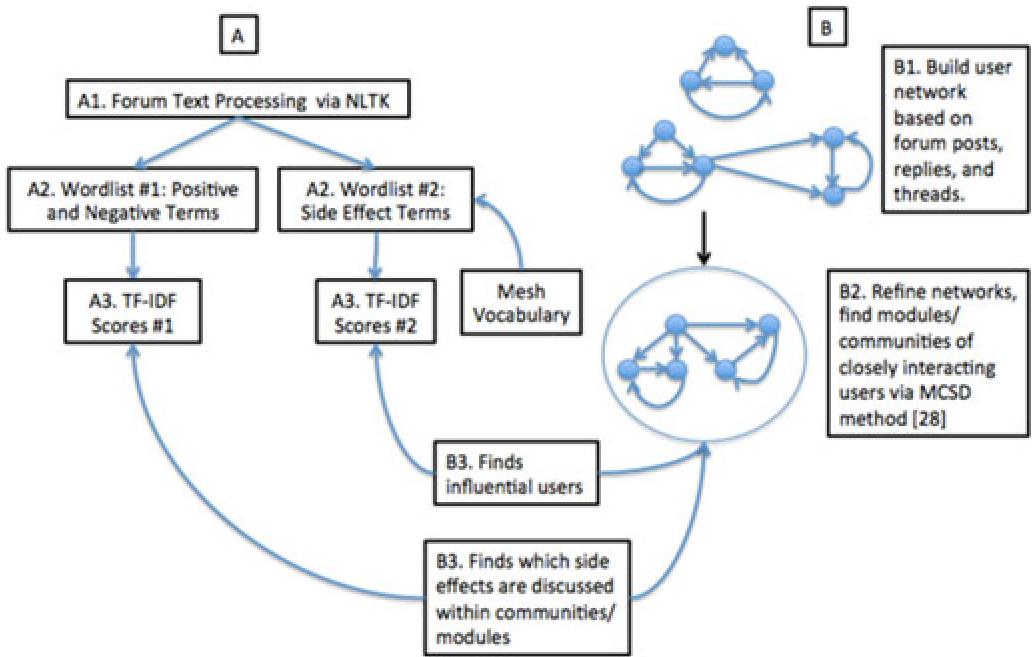 Figure 1: The dual-layer workflow, combining text frequency vectors with relational network graphs.
Key Findings & SOTA Comparison
By applying this to Cancerforums.net, the study provided a granular view of the lung cancer drug Erlotinib (Tarceva).
- The Satisfaction Paradox: While 70% of users were generally satisfied, the network analysis revealed that specific sub-communities were hyper-focused on dermatological issues.
- Validation: Statistical t-tests within these modules highlighted "rash" and "itching" as significant concerns. This perfectly aligns with clinical literature stating that 70% of Erlotinib patients experience these effects.
- Identifying Brokers: The model isolated 10 "Information Brokers"—users with high nodal degrees whose sentiment (UAO) matched the overall module sentiment (MAO). Targeting these users is far more efficient for public health outreach than mass-monitoring.
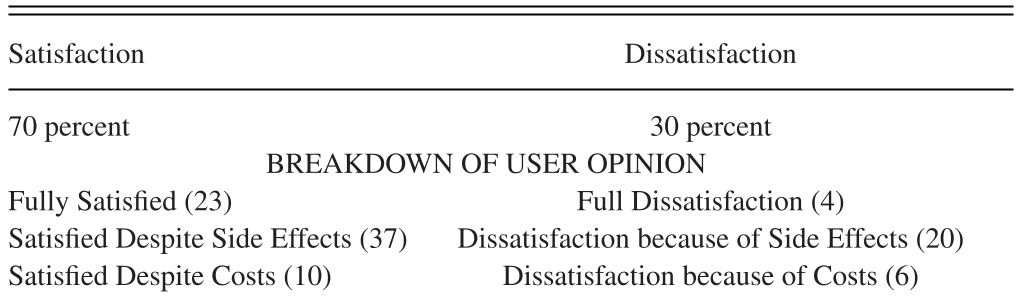 Table 1: Quantitative breakdown of user opinion regarding Erlotinib.
Critical Insight: Why This Matters
The true value of this work lies in its structural validation. Many NLP models hallucinate or misinterpret clinical signals. By verifying text-mined "side effects" against the structural density of specific user modules, the authors provide a "sanity check." If a side effect is mentioned frequently within a highly stable community, it is likely a systemic clinical issue rather than an isolated outlier.
Future Outlook and Limitations
While powerful, the approach relies on manual dictionary building and TF-IDF, which are being superseded by Transformer-based embeddings (like BERT or GPT). However, the network stability component remains a robust way to identify "super-users" and community bubbles—essential for fighting medical misinformation or conducting targeted post-marketing surveillance.
For the pharmaceutical industry, this framework offers a roadmap to move from passive listening to intelligent data mining, creating a real-time feedback loop between the patient's living room and the hospital's oncology ward.