
Social Mobile Clouds: Turning Selfish Devices into Cooperative Super-Nodes via Network Coding
10882_Implementation of Network Coding for Social Mobile Clouds [Applications Corner].
The paper introduces a framework for Social Mobile Clouds that leverages Network Coding (NC) and social incentives to facilitate resource sharing among mobile devices. It proposes transforming the "store-and-forward" paradigm into "compute-and-forward" using the KODO library, achieving constant overhead even as the number of cooperating users increases.
TL;DR
This research tackles the inefficiency and psychological barriers of mobile resource sharing. By introducing Network Coding (NC), the authors reduce communication overhead to a constant factor, regardless of cluster size. Furthermore, they propose a social incentive layer (connecting to platforms like Facebook) to motivate selfish users to act as "donors" in exchange for social capital, effectively bridging the gap between technical feasibility and human behavior.
Background: The Evolution of Cooperation
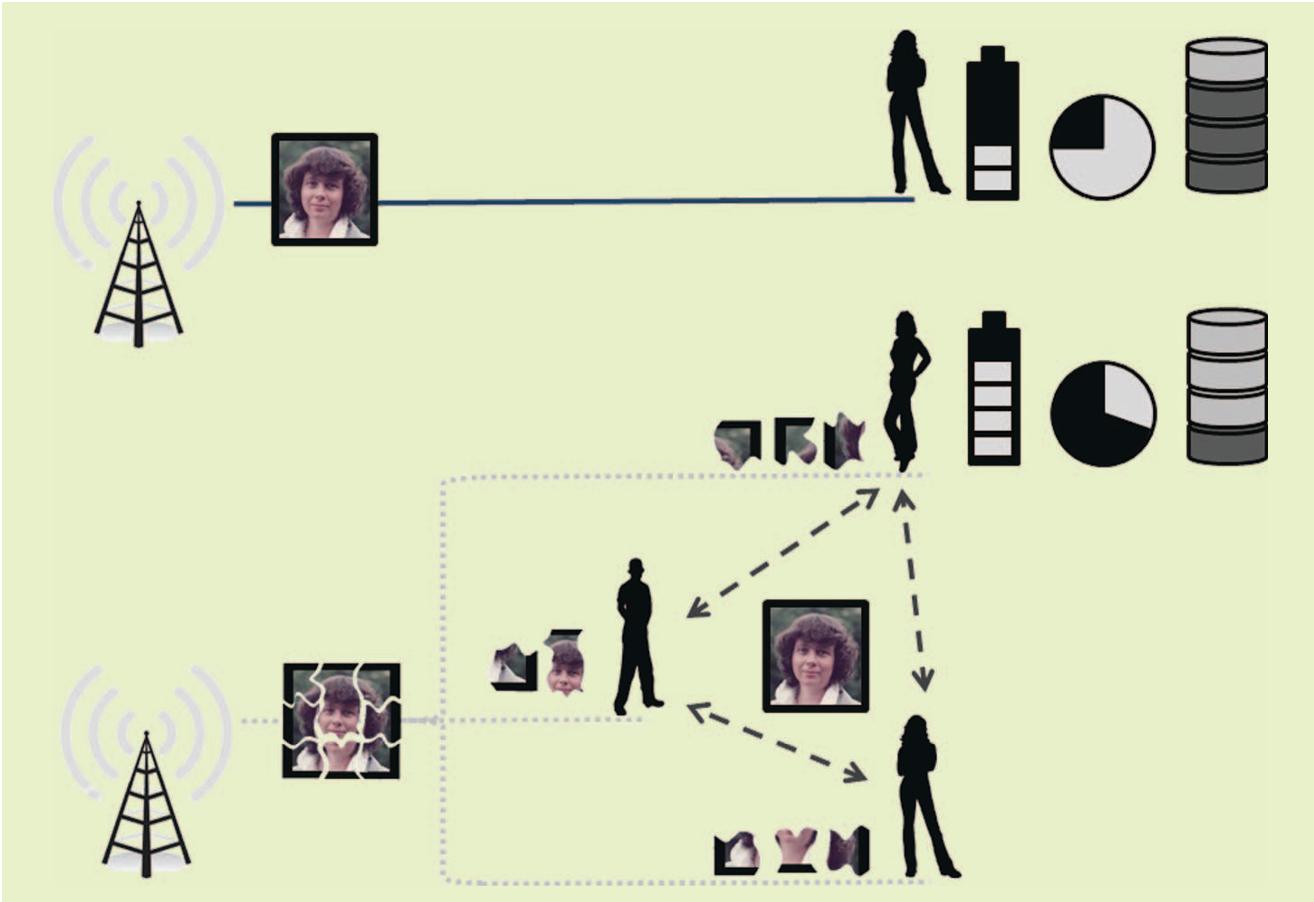
In nature, cooperation allows weaker individuals to outperform stronger ones. In the mobile world, "User Cooperation" mimics this by allowing phones to form a Mobile Cloud. Instead of every phone downloading a file individually over a slow/expensive 3G link, they download unique pieces and exchange them locally via high-speed, low-energy Wi-Fi or Bluetooth.
However, two hurdles remain:
- The Technical Hurdle: Standard exchange protocols (Unicast/Broadcast) are highly inefficient in meshed, lossy networks.
- The Social Hurdle: Why would a user drain their battery to help a stranger?
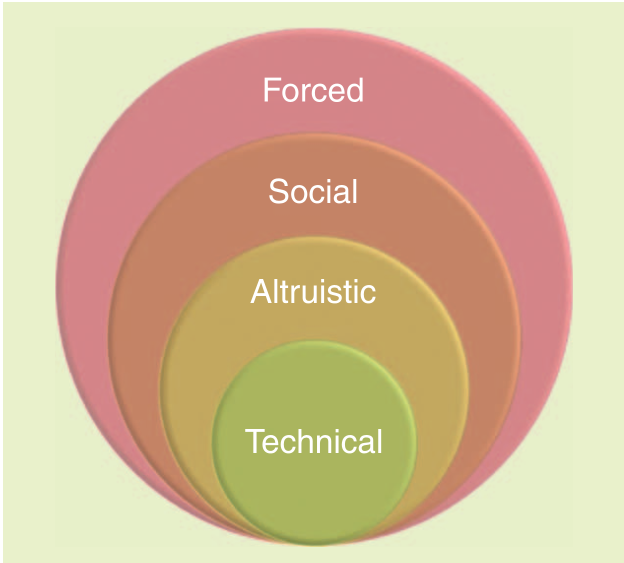
The Four Pillars of Cooperation
The authors categorize cooperation into a quadrant based on Cost (C) and Benefit (B):
- Forced Cooperation: (e.g., Sensor networks) Nodes have no choice; B=0 for the node.
- Altruism: (Hamilton's Rule) Helping friends or family based on relationship (r).
- Technologically Enabled: The primary focus—where NC makes the process so efficient that everyone wins (B > C).
- Socially Enabled: Rewarding "Resource Donors" in the social domain (likes, status, notifications) when a technical benefit isn't immediate.
Methodology: From "Store-and-Forward" to "Compute-and-Forward"
The core technical innovation is the application of Random Linear Network Coding (RLNC).
Why Network Coding?
In a standard broadcast, if a packet is lost, it must be retransmitted. In a large group, different users miss different packets, leading to massive redundancy. With NC, nodes do not just forward packets; they send linear combinations of all packets they possess.
- Mathematical Intuition: Instead of sending "Packet A," a node sends "2A + 3B." As long as the receiver gets enough linearly independent equations, they can solve the system and recover the original data.
- The Result: Every packet received is "novel" and useful, eliminating the need for complex tracking of who has what.
Overcoming the "Embedded Limitation"
Initially, RLNC was considered too computationally heavy for mobile CPUs (like the ARM11 332MHz). Early tests showed speeds of only 20 kB/s.
The authors' breakthrough, encapsulated in the KODO library, involved:
- Binary Field Operations: Using GF(2) allowed the CPU to perform "coding" using simple XOR operations rather than complex table look-ups.
- Systematic Codes: Transmitting the original data first and coding only for repair, pushing decoding speeds to 29 MB/s on 2008-era hardware—more than enough for wireless data rates.
Experimental Results: Constant Overhead
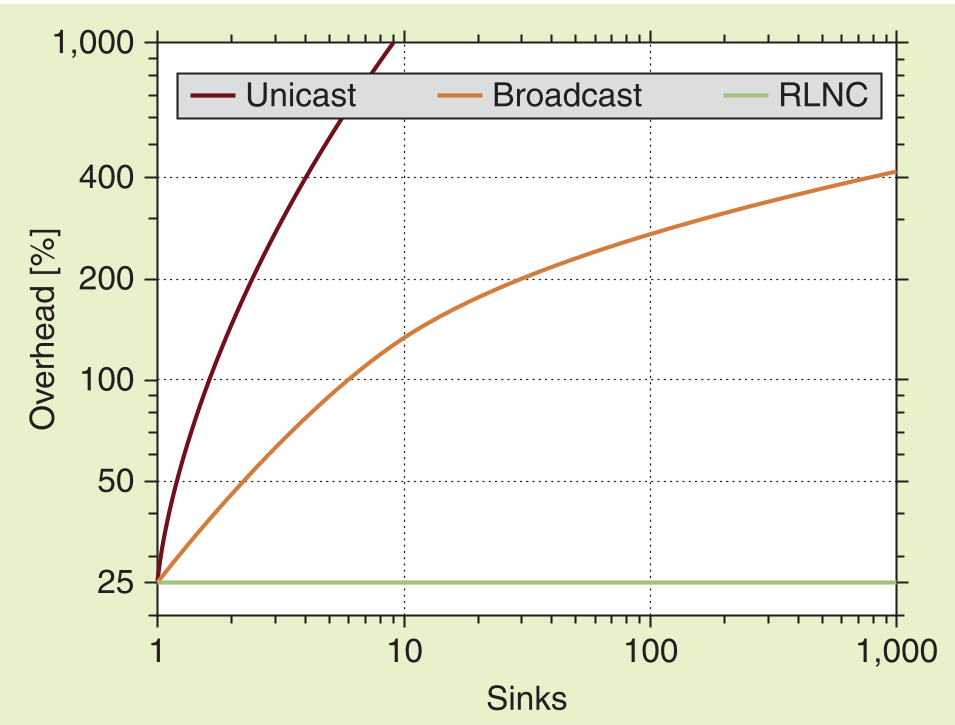
The most striking result is the comparison of overhead. In a environment with a 20% erasure (loss) rate:
- Unicast: Overhead explodes as users increase.
- Broadcast: Better, but still scales with user count.
- Network Coding: Maintains a flat ~25% overhead regardless of how many users join the cloud. This proves NC is perfectly suited for large-scale social mobile clouds.
Critical Insight & Conclusion
This work shifts the focus of network design from purely physical/link-layer metrics to include social psychology. By using the KODO library to make cooperation "cheap" and social networks to make it "rewarding," the authors provide a blueprint for a future where our devices are no longer isolated islands, but a collective, efficient resource pool.
Limitations: While the social domain rewards (e.g., Facebook ID exchange) are innovative, they raise significant privacy concerns that would need modern encryption and anonymization (perhaps via Zero-Knowledge Proofs) to be viable in today's privacy-conscious landscape.