
Targeted Graph Discovery: Leveraging Homophily to Defeat the Exponential Noise Floor
Network discovery using content and homophily
This paper introduces a targeted graph sampling approach that integrates vertex classification and sampling by exploiting content-based homophily. Using a trained logistic regression classifier that considers both local and neighborhood content, the method significantly improves the discovery of relevant subgraphs in social media networks, achieving a 30% Precision-Recall improvement over standard baselines.
TL;DR
In the world of social media analytics, the sheer volume of data is a double-edged sword. Standard graph exploration methods like Breadth-First Search (BFS) suffer from exponential growth, pulling in millions of irrelevant nodes for every few relevant ones. This paper from MIT Lincoln Laboratory proposes a targeted sampling algorithm that uses a classifier to "prune" the search space in real-time. By leveraging content-based homophily—the idea that you are likely interested in what your neighbors are interested in—the researchers achieved a 30% improvement in finding relevant communities while significantly reducing data noise.
The "Dunbar Problem" in Big Data
Most real-world social graphs grow at a rate that breaks traditional analytics. As shown in the paper's motivation, as you move hops away from a seed user, the graph size explodes. However, human social structures are naturally limited (the "Dunbar result" suggests stable communities of about 150 people).
The gap between exponential graph growth and constant community size is where noise lives. If we sample indiscriminately, we are looking for a needle in a haystack that grows ten times larger with every step.
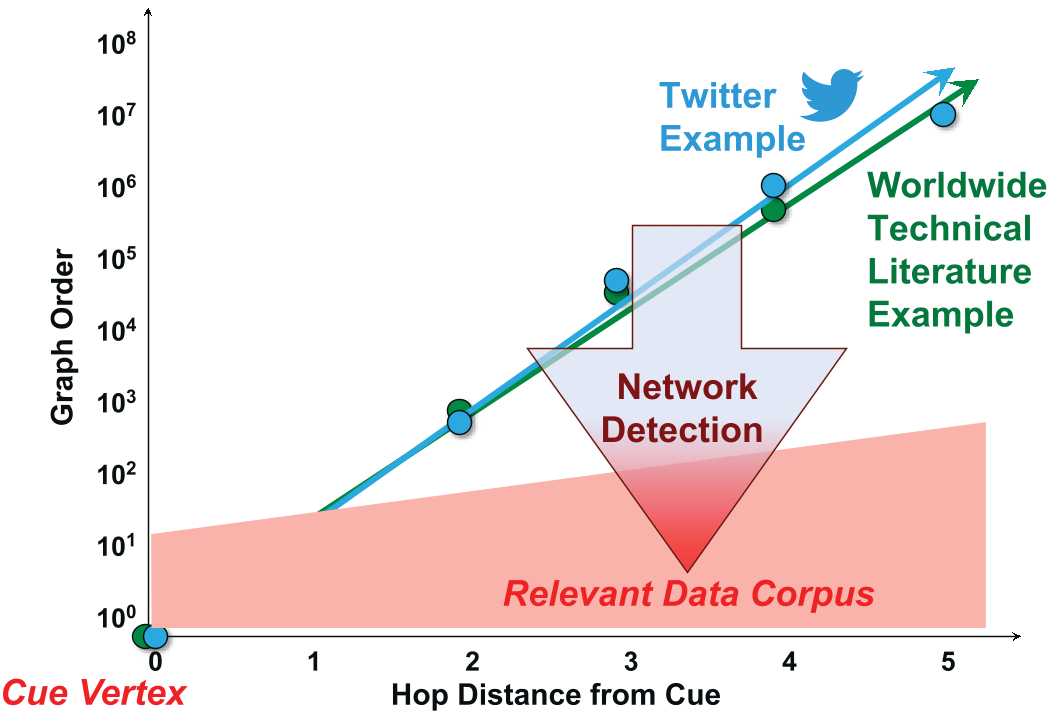 Fig 1: The exponential explosion of unprioritized graph exploration vs. the small fraction of relevant vertices.
Methodology: Classification as a Compass
Instead of sampling and then classifying, the authors argue we should classify to sample.
From Local to Neighborhood Context
The core innovation lies in how the classifier "sees" a vertex.
- Baseline (Algorithm 1): Looks only at the content of a node (e.g., its tweets).
- Proposed (Algorithm 2): Explores a node's neighbors and aggregates their content into the "context" of the target node.
Why does this work? In social networks, a node might not post much relevant content, but if it is embedded in a cluster of cybersecurity experts, the "neighborhood context" provides the missing signal. This is Content-Based Homophily.
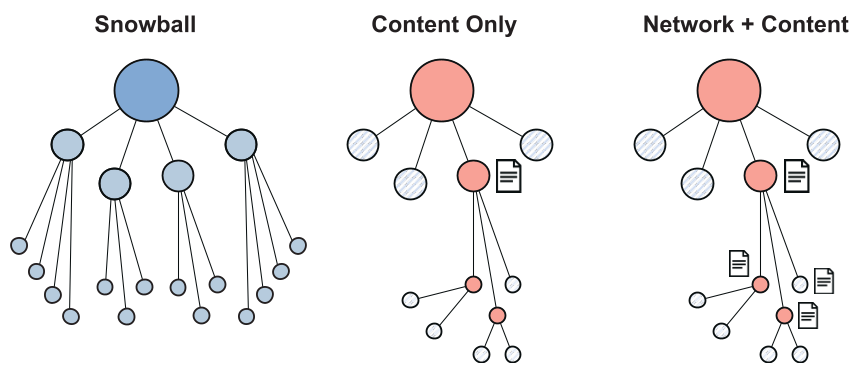 Fig 2: Comparison of sampling strategies. Our approach (right) uses neighborhood context to decide whether to continue the crawl.
Mathematically Grounding the Intuition
The authors adapt Neyman-Pearson optimal network detection. They model the transition probability between vertices and as: This turns the graph traversal into a biased random walk where relevance acts as a diffusion process. If a vertex is surrounded by relevant content, it "absorbs" more relevance probability (), guiding the sampler to stay within that topical cluster.
Experimental Results: The Cybersecurity Case Study
The team tested this on a real-world Twitter crawl focused on the cybersecurity domain.
- Scale: 34 million tweets, 100 million interactions.
- Performance: By including just a few neighboring timelines (10–50), the Precision-Recall curve shifted significantly higher.
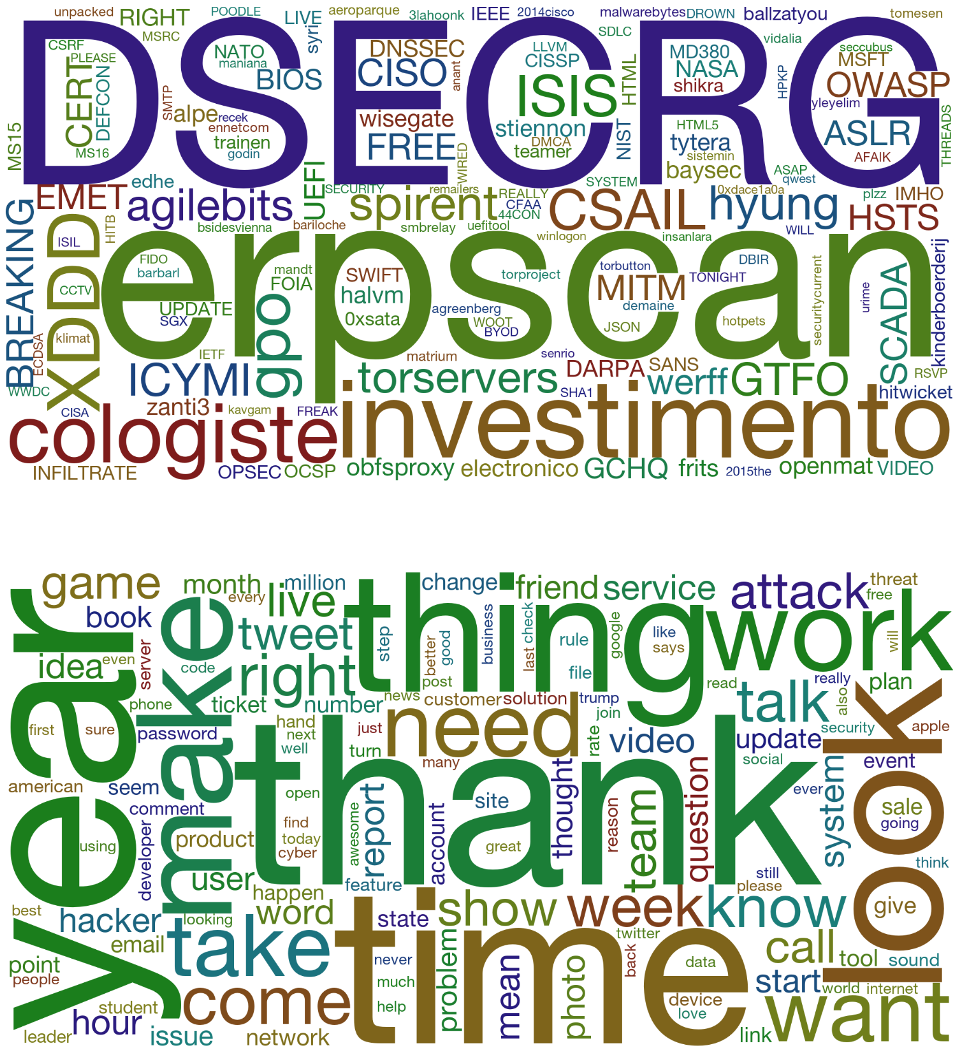 Fig 3: The clear performance gain (20-30%) when neighborhood content (green/purple) is added versus local-only content (dashed blue).
One of the most interesting findings is the "Diminishing Returns" of neighbor content. You don't need to look at every friend of a user; looking at a random subset of 10-50 neighbors provides nearly all the predictive power needed to identify a community.
Critical Insight & Conclusion
The value of this paper isn't just in the accuracy boost; it's in the resource efficiency. In modern cybersecurity or threat detection, we cannot ingest the whole internet. By using homophily as a filter, we can:
- Reduce API costs by only crawling promising nodes.
- Increase Analyst Efficiency by presenting higher-density relevant subgraphs.
- Improve Detection of stealthy actors who might follow relevant targets even if they don't tweet relevant content themselves.
While the researchers used simple tf (term frequency) vectors, the framework is agnostic. Future iterations replacing logistic regression with Transformer-based embeddings (like BERT or RoBERTa) would likely push these gains even further into the SOTA territory.