
Decoding the Pulse of Mobile Social Networks: An ISP-Level Perspective
Network dynamics of mobile social networks
This paper presents an in-depth empirical study of Mobile Social Network (MSN) user behavior by analyzing a large-scale transaction log from a major Chinese ISP. It characterizes user activities across four popular platforms (Qzone, Kaixin001, 51, and Renren) using metrics like request patterns, session duration, and inter-arrival times, identifying Power Law and Lognormal distributions as fundamental traits.
TL;DR
By analyzing transaction logs from over five million mobile subscribers, this research uncovers the hidden mathematical patterns of how we use social media on our phones. It reveals that mobile social networks (MSNs) command higher user "stickiness" than their desktop counterparts and that user behaviors—from how often we click to how long we stay online—follow strict Power Law and Lognormal distributions.
Background: Why the ISP Perspective Matters
Most social network research happens at the application layer (what we see on the screen). However, for Internet Service Providers (ISPs), the reality is a constant battle for resource allocation. Understanding how users interact with the network—rather than just the content—is the "Holy Grail" for optimizing wireless links and reducing latency.
The authors argue that previous work lacked scale or missed the "network dynamics" (e.g., DNS resolution, IP assignment) that only an ISP-side analysis can capture.
The "Morning and Bedtime" Rule
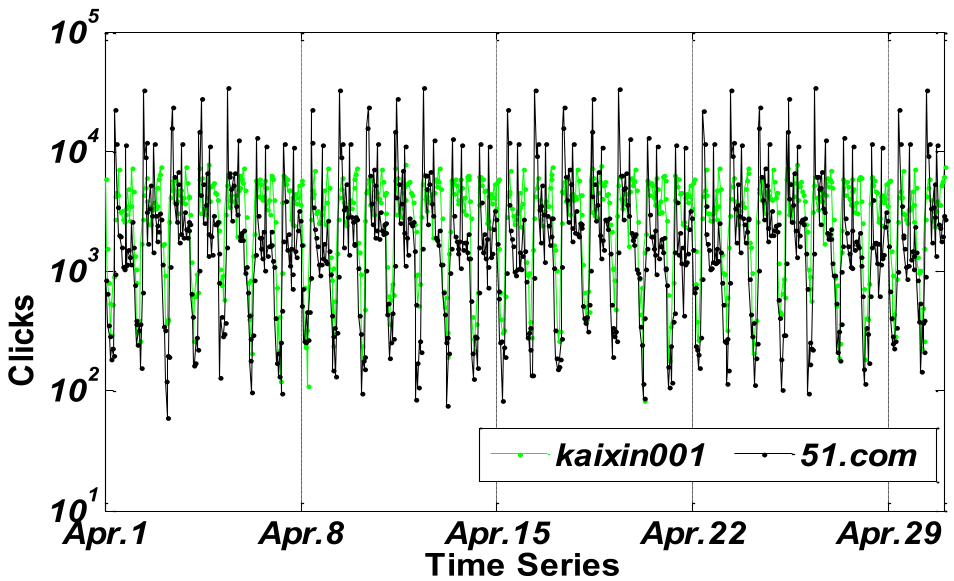
One of the most striking findings is the temporal regularity of high-volume MSNs like Qzone. The researchers identified two distinct daily peaks:
- 8:30 AM: Users commute to work via bus or subway.
- 10:00 PM: Users interact with social media in bed before sleeping.
Interestingly, this regularity only emerges when the volume of clicks is high enough. Smaller platforms show more "bursty" and unpredictable behavior, suggesting a threshold where aggregate human behavior stabilizes into a predictable pattern.
Methodology: The Three-Level Interaction Model
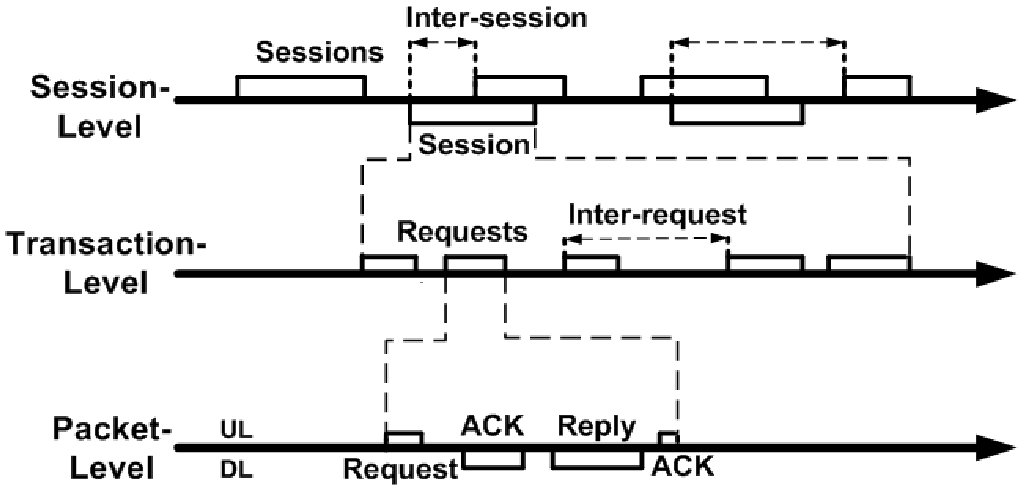
To break down complex user behavior, the study proposes a hierarchical model:
- Session Level: Defined by the duration from the first request to a 15-minute period of inactivity.
- Transaction Level: Focusing on "inter-request" times—the gap between your clicks within a single session.
- Packet Level: The raw uplink and downlink data flowing through the GGSN/PDSN gateways.
The Mathematical DNA of Social Media
The study proves that mobile behavior isn't random; it follows specific statistical "laws":
1. The Zipf Power Law (Quantity)
The number of sessions per user and the number of requests within a single session both follow a Power Law (). This means a small number of "heavy users" generate a disproportionately large amount of network traffic, while the vast majority of users are relatively quiet.
2. Lognormal Distribution (Timing)
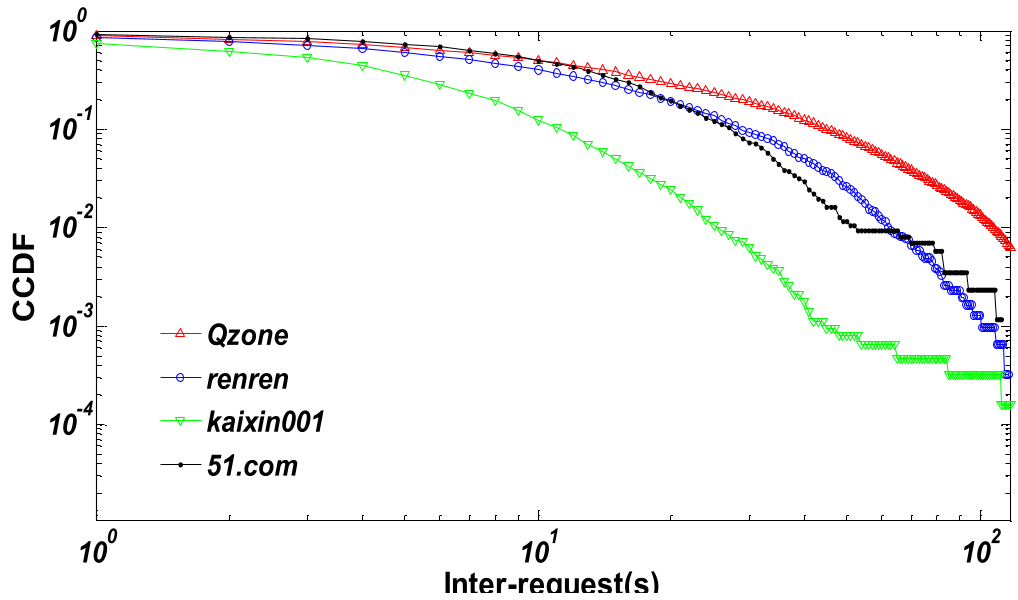
The "Inter-session" (time between opening the app) and "Inter-request" (time between clicks) intervals fit a Lognormal Distribution.
- Insight: Shorter inter-request times indicate higher "interestingness" of the content, as users click rapidly through the interface.
Deep Insight: MSN Stickiness
A highlight of the study is the comparison between Mobile (MSN) and Online (OSN) social networks. Qzone users averaged 138 minutes of active online time per month, significantly outperforming the benchmarks of traditional desktop-based social networks from the same era. This confirmed early on that the "smartphone era" would create much deeper user engagement (and network strain) than the PC era.
Critical Analysis & Conclusion
While this study provides a robust foundation for modeling MSN traffic, it has its limitations:
- Encrypted Traffic: Modern HTTPS/TLS encryption (more prevalent today than in the study's period) makes URL-based request identification more difficult for ISPs without deep packet inspection.
- App vs. Web: The study relies heavily on WAP/xHTML protocols; today's native app behaviors might show different "in-app" dynamics.
Takeaway for the Future: For developers and ISPs, the message is clear: user behavior is mathematically predictable. By leveraging these Power Law and Lognormal models, we can build smarter, more "social-aware" networks that pre-allocate resources before the 10:00 PM rush hits the gateway.