
PMR: Revolutionizing Message Routing in Opportunistic Social Networks via Network Embedding
Exploring Network Embedding for Efficient Message Routing in Opportunistic Mobile Social Networks
This paper introduces the Personalised Message Routing (PMR) framework for Opportunistic Mobile Social Networks (OMSNs). It combines an Inductive Network Representation Learning (INRL) model with an attention-based mechanism to optimize message relay by capturing higher-order structural and content-based social proximities.
TL;DR
The Personalised Message Routing (PMR) framework addresses the inefficiency of data dissemination in Opportunistic Mobile Social Networks (OMSNs). By leveraging Inductive Network Representation Learning (INRL) and Attention Mechanisms, PMR enables mobile devices to look beyond their immediate "friends" to select optimal relay nodes. It dramatically improves delivery ratios and lowers latency compared to traditional epidemic and community-based protocols.
Background & Motivation: The Chaos of Decentralization
Opportunistic Mobile Social Networks (OMSNs) are self-organizing, infrastructure-less networks where communication happens via "store-and-forward" techniques through Bluetooth or WiFi. Unlike Facebook, there is no central server to map out the shortest path.
The Problem:
- Limited Horizon: Most mobile nodes only know their immediate contacts (first-order proximity).
- Interest Mismatch: Just because User A is a "friend" of User B doesn't mean they share the specific interests required to deliver a message effectively.
- High Overhead: Epidemic-based methods (flooding) waste massive bandwidth and storage.
Methodology: Higher-Order Intelligence
The core of PMR lies in its ability to transform high-dimensional social features into a compact, low-dimensional vector space.
1. Inductive Network Representation Learning (INRL)
Instead of just looking at who is next to whom, the INRL model uses a higher-order proximity profiling algorithm. It aggregates features from a user's ego network (up to hops) using an LSTM-based aggregator. This allows the model to capture the "hidden" patterns of how information flows through layers of friends.
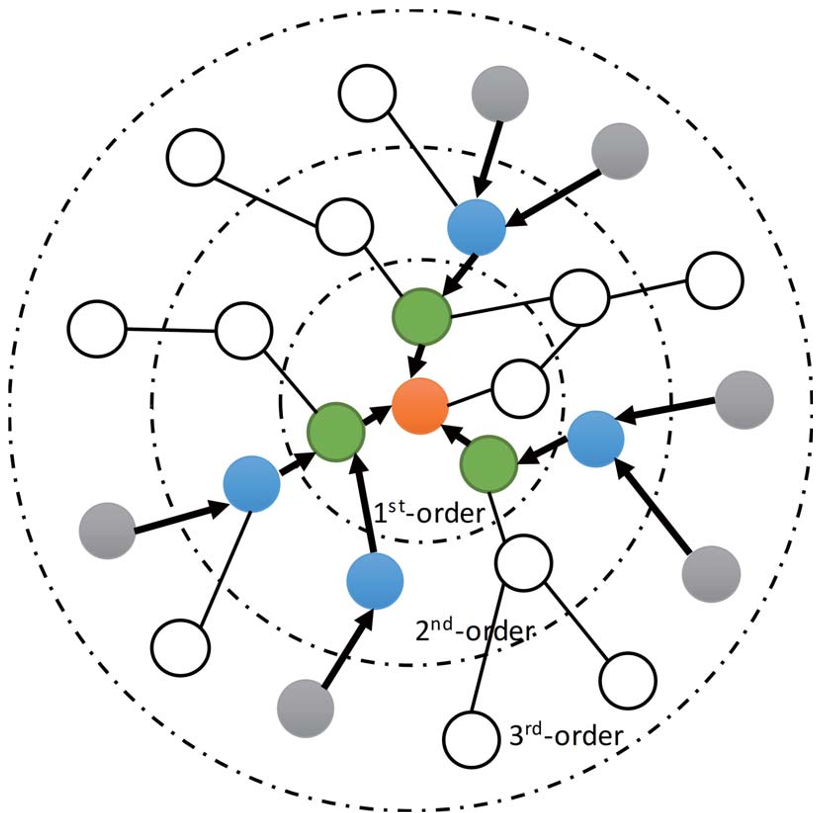 Fig 1: The feature aggregation process showing how features from distant nodes (blue/grey) are sampled and compressed into the central node's representation.
2. Attention-based Interest Modeling
Not all social ties are equal. PMR uses an Attention Mechanism to calculate the "Attention Score" between a user and their potential relay friends. By comparing the message's interest category with the learned embeddings, the model identifies which friend is most likely to encounter a target user for that specific topic.
Experiments and Results
The authors validated PMR using three real-world datasets: Infocom-2005, Infocom-2006, and Cambridge-city.
Performance Highlights:
- Delivery Ratio: PMR showed a significant upward trend as simulation time increased, effectively "learning" the network structure better than static methods like PF or WVGSR.
- Latency & Overhead: By using low-dimensional embeddings, PMR facilitates faster similarity calculations, leading to the lowest end-to-end delay among all baseline methods.
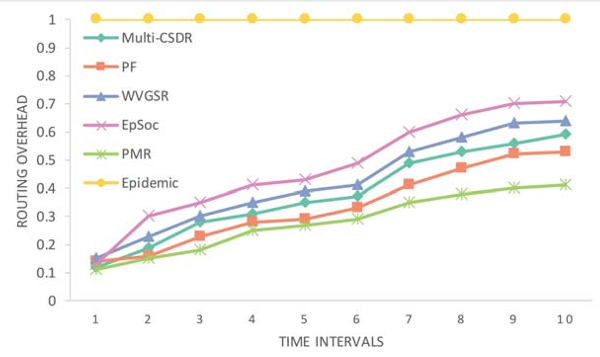 Fig 2: Comparison of delivery ratios highlighting PMR's consistent lead over Multi-CSDR and EpSoc.
Critical Analysis & Conclusion
PMR represents a paradigm shift from heuristic-based routing to representation-based routing.
Key Contributions:
- Inductive Nature: The model can generate embeddings for previously unseen nodes by aggregating features, which is critical for highly dynamic mobile environments.
- Semantic Awareness: Integrating interests via attention avoids the trap of "blind" social routing.
Limitations & Future Work: Currently, the model relies on pre-defined interest labels. Future iterations could benefit from NLP-based dynamic interest extraction (e.g., using BERT or GPT embeddings) and incorporating temporal mobility patterns to account for how social ties change depending on the time of day.
Ultimately, this work proves that even in a decentralized, chaotic mobile environment, deep learning can help us find the needle in the haystack.