
Deciphering the Digital Silk Road of Rural China: The Evolution of Taobao Village Networks
Network evolution analysis of e-business entrepreneurship: big data analysis based on taobao intelligent information system
This paper utilizes Social Network Analysis (SNA) and Gephi to examine the evolution of e-business entrepreneurial networks in China's "Taobao Villages" (2007–2016). By analyzing big data from the Taobao intelligent information system, it reveals how rural entrepreneurship transitions from isolated shops into organized, decentralized clusters.
TL;DR
This research dives into the "Taobao Village" phenomenon—a cornerstone of China's rural revitalization. By applying Social Network Analysis (SNA) to nearly a decade of big data (2007–2016) from Lin’an, the study uncovers how informal "acquaintance networks" evolve into sophisticated digital clusters. The key finding? The network’s success relies on a few "Alpha" entrepreneurs who drive imitation and resource sharing, eventually leading to a decentralized but highly efficient economic structure.
Problem & Motivation
Why do some villages transform into e-commerce hubs while others stagnate? Traditional rural entrepreneurship is often limited by the "location" factor and high costs. The authors argue that e-business virtual clusters overcome these barriers. However, the existing literature lacks a quantitative view of how these networks actually grow over time. The paper aims to bridge this gap by looking at the topology of entrepreneurship—treating every new shop not just as a business, but as a node in a living, breathing social organism.
Methodology: Mapping the DNA of Entrepreneurship
The study focuses on Lin’an, a famous pecan-producing area. Using Gephi, the authors visualized three distinct snapshots of the network (2007, 2012, 2016).
1. The Power of "Leader Nodes"
The research tracks Betweenness Centrality—a measure of how much a single shop controls the flow of information. In the early stages, 1-2 shops held all the "power," acting as the primary source of knowledge for the entire village.
2. From "Clustering" to "Decentralization"
Contrary to intuition, a "denser" network isn't always better. The authors observed a significant downward trend in Network Density (from 1.0 to 0.026), suggesting that as the village matures, shops stop relying on a single source and begin seeking heterogeneous resources, which prevents "incestuous" competition and fosters innovation.
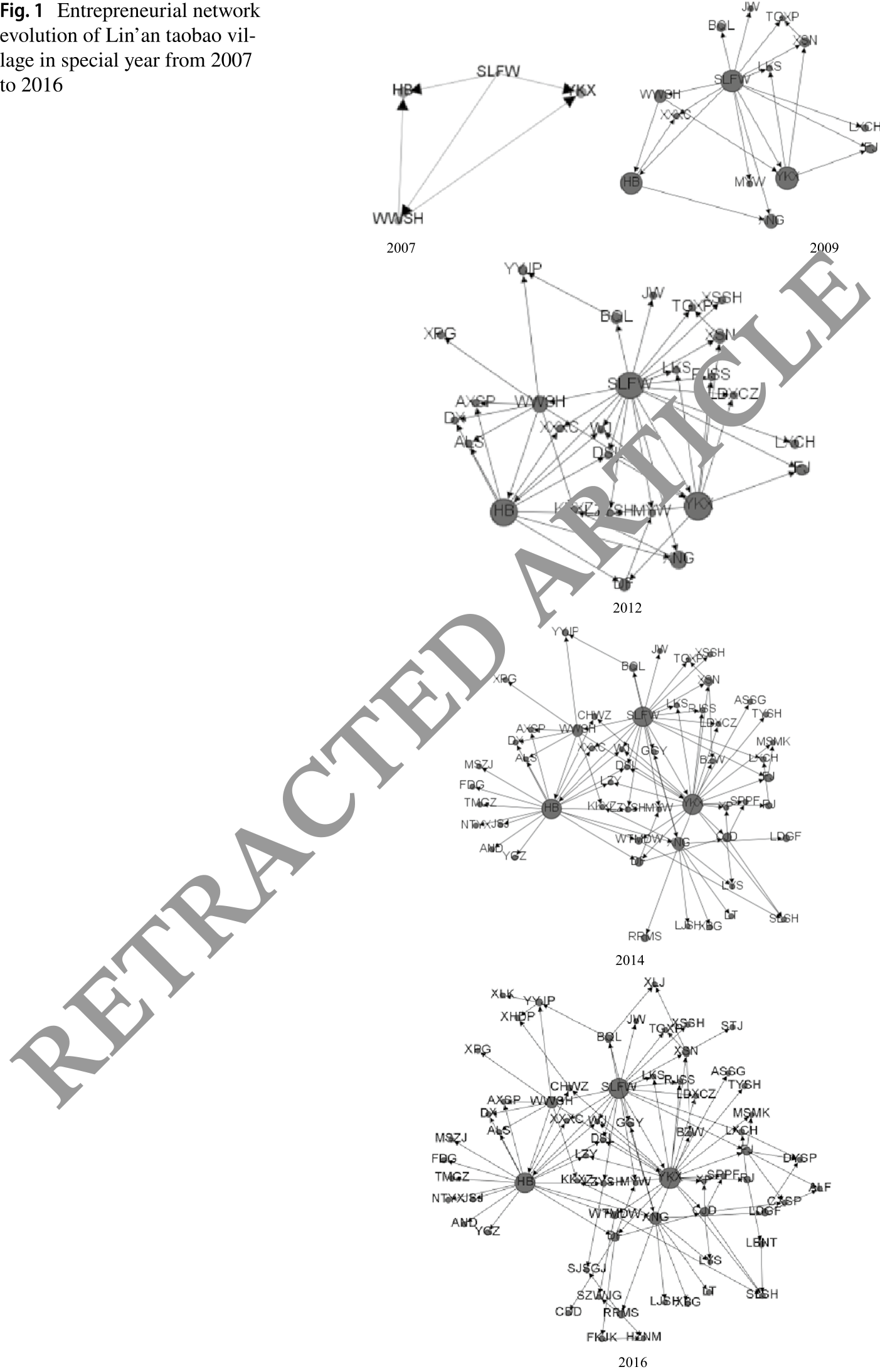 Figure 1: Visualization of the entrepreneurial network across key years, showing the expansion and modularization.
Experiments & Key Results
The data reveals a clear structural shift:
- Expansion & Modularization: The number of "groups" (sub-communities) increased from 1 to 6. This indicates an optimized division of labor where different groups focus on different niches (logistics, packaging, sales).
- The Transmission Effect: In 2016, three specific shops emerged with high Out-degree (influencing 19-20 other shops), acting as "Master" nodes that catalyzed the success of newcomers.
- Efficiency: The Average Path Length remains remarkably low (1.72), meaning knowledge of a new market trend can travel through the entire village in fewer than two steps.
 Table 1: Network measurement indexes showing the rise in Modularization and the decline in Density.
Critical Analysis & Takeaways
The "Acquaintance" Paradox
The study confirms that rural China is an acquaintance society. While these tight-knit bonds are great for initial "imitation" (getting a cousin to open a shop), they can become a trap if everyone sells the same product. The transition toward a "Modular" structure in 2016 shows that Lin’an successfully navigated this trap, allowing for specialization.
Limitations
One notable limitation is the focus on a single product category (Pecans). Whether this network evolution model holds for more complex industries (like electronics or fashion) remains an open question.
Future Outlook
For policymakers, the message is clear: don't just provide internet access. Find and support the "Network Leaders." These individuals provide the "Inductive Bias" necessary for the rest of the community to follow. As rural e-commerce moves into the "Big Data" era, these networks will likely become more integrated with global supply chains, further reducing the gap between the rural periphery and the urban center.