
Who Truly Benefits? Unpacking Faith-Based Network Interventions via TERGM
Who benefits from network intervention programs? TERGM analysis across ten Philippine low-income communities
This study utilizes Temporal Exponential Random Graph Models (TERGM) to evaluate the "Transform" program, a faith-based network intervention across ten low-income Philippine communities. It identifies that while the program successfully increased perceived social support links from an average of 12 to 19 per person, the benefits were disproportionately captured by individuals with higher baseline social engagement.
Executive Summary
TL;DR: By analyzing the "Transform" program in the Philippines, this research reveals that while faith-based interventions can significantly expand social support networks (increasing average ties by nearly 60%), they often favor the "socially wealthy." Those already active in the community see the most growth, while the impact of religious alignment varies wildly by local context.
Academic Positioning: This work moves beyond simple individual-level regressions to a sociocentric longitudinal analysis. It sits at the intersection of Development Economics and Network Science, providing a rare multi-network comparison that challenges the "one-size-fits-all" assumption of standardized NGO programs.
The Problem: The "Black Box" of Community Strengthening
Governments and NGOs invest billions in programs designed to "build social capital." However, we often treat the community as a monolith. The core irony? Those who are most socially isolated—and thus in greatest need of the program—may face the highest barriers to entering the new social structures created by these interventions.
The authors identify a critical gap: most studies look at isolated dyads. They don't see the global architecture of the community. Without sociocentric data, we cannot tell if we are helping the marginalized or simply providing a fresh platform for local elites to consolidate power.
Methodology: Seeing Through the TERGM Lens
The researchers tracked 10 communities over 16 weeks, using Temporal Exponential Random Graph Models (TERGM). Unlike standard models, TERGM acknowledges that a network tie today is heavily dependent on the network tie yesterday (path dependency) and the intricate dance of reciprocation.
1. The Model Specification
The model conditioned post-intervention ties () on:
- Pre-existing structure (): "Memory" of who knew whom.
- Nodal Attributes (): Baseline health, wealth, and faith.
- Attribute Dynamics (): How changes in health or faith during the program triggered new connections.
2. Physical and Social Interaction
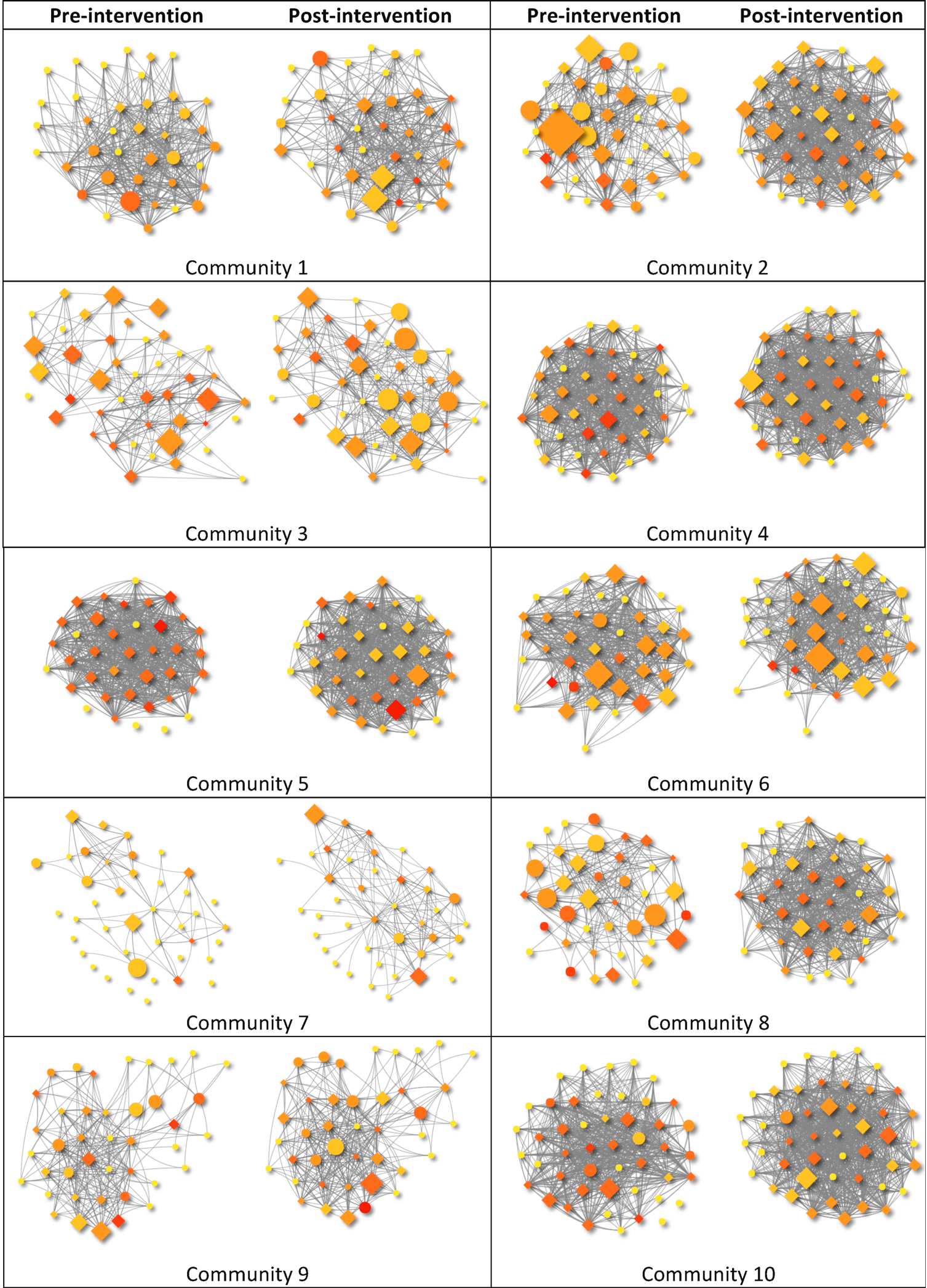 Figure: The visualization shows a clear densification of ties. Red nodes (worse health) and node sizes (income) illustrate how resources and vulnerabilities are distributed across the community structure.
Key Results: The Social Engagement Paradox
The findings strike a blow to the idea of "automatic" social inclusion.
- Consistent Winners: "Social visits to others" was the strongest predictor of success. If you were already a "visitor," the program magnified your reach. This suggests a preferential attachment mechanism where the intervention tracks existing social skills.
- The Health Buffer: Interestingly, in some communities, those perceiving worse health gained more connections. This suggests the program successfully functioned as a "safety net" where vulnerability triggered communal support.
- The Faith Wildcard: In a faith-based program (FBO), one might expect religious alignment to be a universal door-opener. It wasn't. Religiosity was a polarized factor—highly beneficial in some villages and a social barrier in others, emphasizing that local culture trumps global program design.
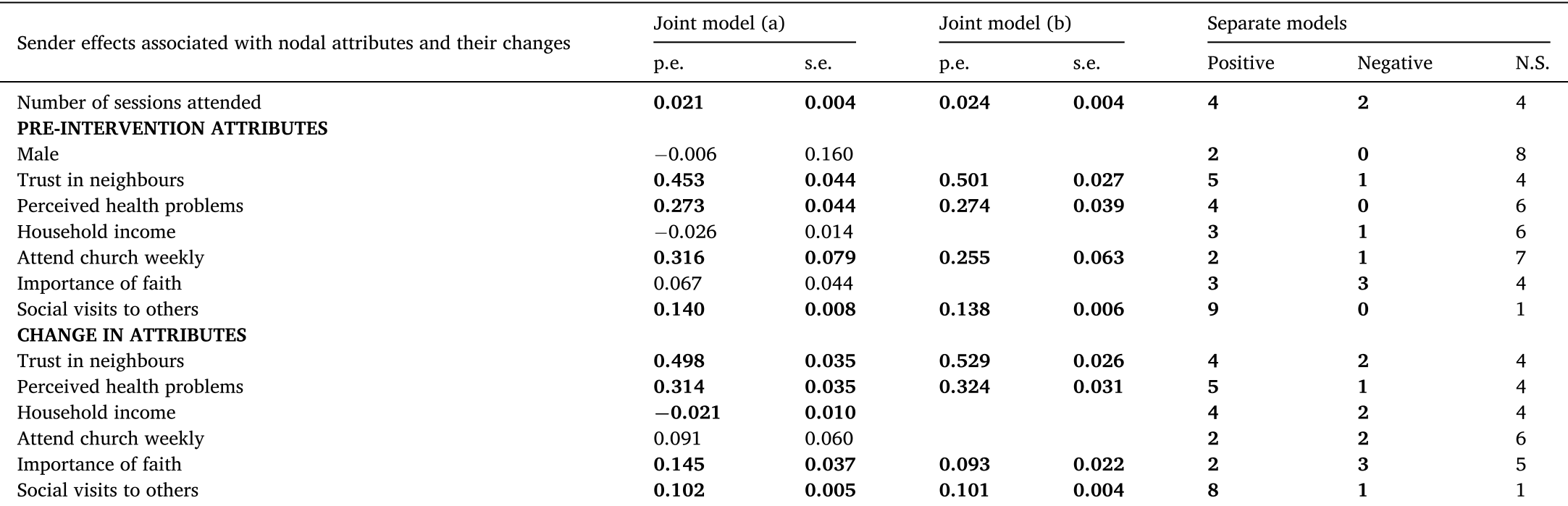 Table: Note the "Separate Models" column—the high count of "N.S." (Not Significant) and the split between positive/negative results for faith variables highlight the extreme heterogeneity across communities.
Critical Insight: The "Matthew Effect" and Future Design
The study concludes with a sobering reality for policy makers: Network interventions are not neutral.
- Inductive Bias of Programs: By bringing people together for 16 weeks, you aren't just teaching "Health and Values"; you are creating a high-frequency trading floor for social capital. Those with the "currency" (extroversion, trust, health) trade more effectively.
- Limitations: The model struggled to fit "outdegree stars"—the outliers who report massive numbers of ties. This suggests there are hidden sociological traits (perhaps charisma or local political status) that our current surveys fail to capture.
Conclusion (Takeaway)
To reach the truly isolated, "Transformative" programs cannot rely on group sessions alone. There must be an explicit strategy to bridge the gap for the "low-visit" individuals who remain on the periphery. Faith-based programs are powerful because they leverage existing trust, but they must be wary of creating "echo chambers" that benefit only the most devout.