
The Universal Grammar of Adaptation: Unified Modeling via Temporal-Causal Networks
The Ins and Outs of Network-Oriented Modeling: From Biological Networks and Mental Networks to Social Networks and Beyond
This paper introduces "Network-Oriented Modeling" (NOM) using Temporal-Causal Networks as a unified framework for modeling biological, mental, and social systems. By representing nodes as time-varying states and connections as causal relations with explicit combination functions and speed factors, the author provides a rigorous numerical foundation for simulating and analyzing complex adaptive behaviors.
TL;DR
In this profound synthesis of network science and causal modeling, Professor Jan Treur presents Network-Oriented Modeling (NOM). By extending traditional graph theory into the realm of Temporal-Causal Networks, the paper provides a mathematical bridge between biological metabolic paths, mental cognitive processes, and social contagion. It moves beyond "What is the structure?" to "How does the structure drive emerging intelligence and adaptation?"
Problem & Motivation: Beyond "Dumb" Graphs
In many scientific disciplines, a "network" is often just a static map of connections. However, in biological or social systems, networks are not static objects—they are dynamic processes. Prior work often suffered from two major gaps:
- Underspecification: Standard graphs don't tell us how a node processes multiple incoming signals (is it an AND gate, an OR gate, or a weighted average?).
- Dynamic Isolation: Models for "interaction within a network" (like virus spread) and "evolution of the network" (like growing friendships) were often handled by different mathematical toolsets.
The author’s insight is that by treating every connection as a causal temporal link and every node as a state variable, we can represent practically any complex system—from a bacterium's DNA to a political campaign's spread—using a single, unified numerical language.
Methodology: The Temporal-Causal Framework
The core of NOM is the transformation of a graph into a system of differential equations. To do this, Treur defines four fundamental pillars for every node :
- State Value : A value in representing activation or intensity.
- Connection Weights ( ): The strength of impact from neighboring nodes.
- Combination Function (): The "brain" of the node that aggregates incoming impacts (e.g., Logistic Sum, Euclidean, or Identity).
- Speed Factor (): How fast the state reacts to its environment.
The Governing Equation:
The transition of any state is governed by:
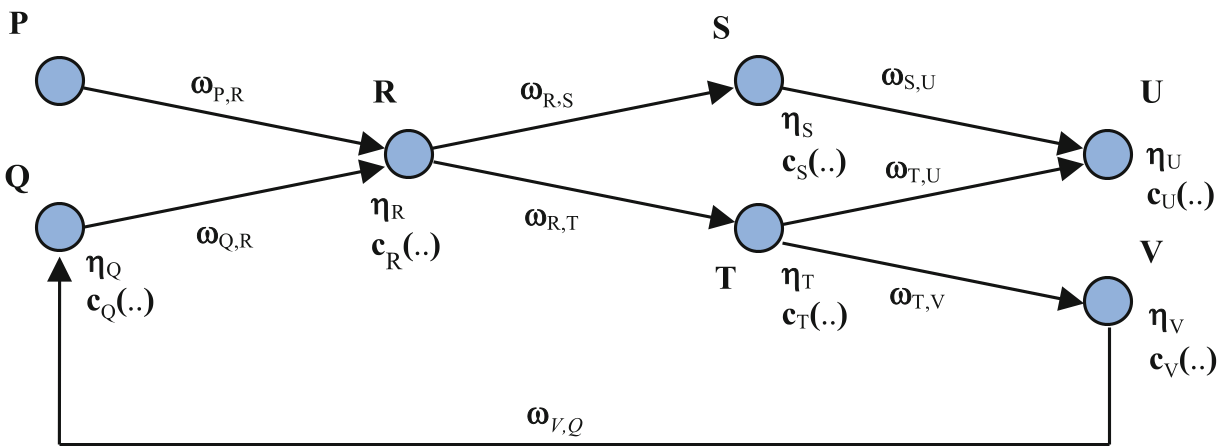 Fig 1. Conceptual representation of a Temporal-Causal Network as a labeled graph.
Experiments: Predicting Emergent Behavior
One of the most powerful sections of the paper involves identifying when a network will reach a consensus. Using three distinct simulations of social contagion, the author shows that convergence isn't random; it’s a property of the Network Structure.
- Scenario A: Using "Logistic Sum" functions (Non-scalar-free) No convergence, clustering occurs.
- Scenario B: Using "Normalized Scaled Sum" functions Convergence to a unified equilibrium.
- Scenario C: Introducing "Source Nodes" (No incoming connections) Convergence is broken unless the source is unique.
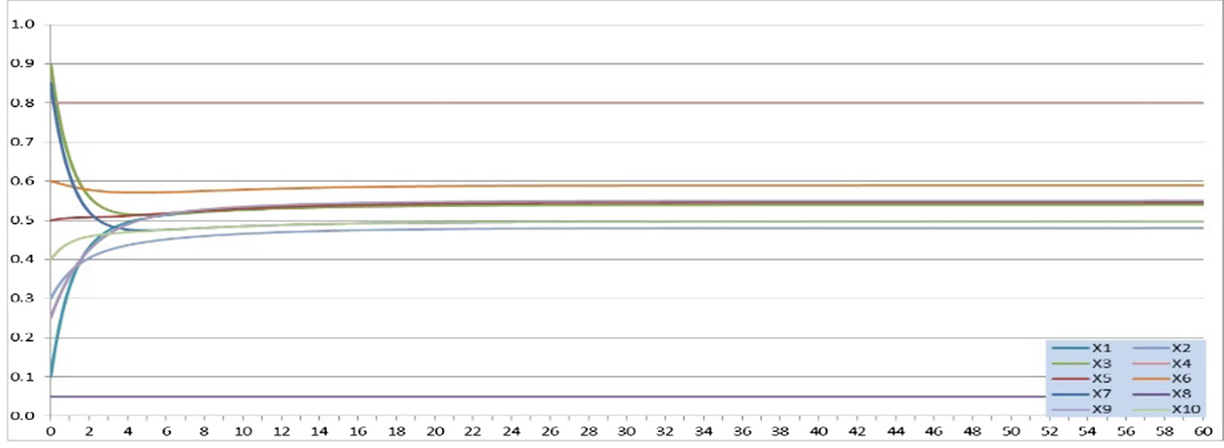 Fig 2. Comparison of simulation outcomes based on different combination functions and connectivity constraints.
Adaptive Networks: Modeling Growth and Learning
Perhaps the most "future-proof" aspect of this work is its handling of Adaptive Networks. Instead of using external rules for how connection weights change, the paper uses Reification.
In this view, a connection weight is itself a node in a higher-order network. This allows principles like Hebbian Learning ("cells that fire together, wire together") and Social Homophily ("birds of a feather flock together") to be modeled using the exact same differential equation format as the base network.
Critical Analysis & Conclusion
The Takeaway
Jan Treur’s work suggests that "Intelligence" is not a human-exclusive trait but a mathematical property of specific network topologies and dynamics. Whether it's a microbe anticipating a nutrient shift or a social group forming an opinion, the underlying temporal-causal logic remains isomorphic.
Limitations
While the framework is mathematically robust, the curse of dimensionality remains a challenge. For massive social networks with billions of parameters, choosing the "correct" combination function for every node requires significant domain expertise or automated parameter tuning, which is still an evolving area of research.
Future Outlook
The concept of Multilevel Network Reification—networks that monitor and change how they change—opens the door to designing AI systems with higher-order meta-learning capabilities, moving us closer to systems that can autonomously "re-wire" their logic based on causal feedback.