
Beyond the Friend Count: How Network Topology and Personality Shape Your Social Capital
Network, personality and social capital
This study investigates the interplay between Facebook ego-network structures, personality traits, and social capital. Utilizing network metrics like structural holes and transitivity, the authors demonstrate that bridging and bonding social capital are not merely functions of friend counts but are significantly shaped by network topology and moderated by Big Five personality traits.
TL;DR
Is your Facebook friend count a true measure of your social wealth? According to this research, the answer is a resounding no. While we often equate a large "friends" list with influence, this study reveals that Social Capital—the actual value derived from relationships—depends far more on where your friends are positioned in your network and who you are as a person. Specifically, "structural holes" drive new opportunities (bridging), while "transitivity" supports emotional health (bonding), with personality traits like introversion and conscientiousness acting as critical gatekeepers.
The "Quantity vs. Quality" Fallacy
In the early days of Social Network Analysis (SNA), success was often mapped to simple metrics like degree centrality (the number of ties). However, this paper argues that this view is reductive. The authors identify a missing link: the structural configuration of the ego-network and the psychological makeup of the individual.
The core tension lies between two types of Social Capital:
- Bridging: Creating bonds across diverse groups to access new information and "weak tie" opportunities.
- Bonding: Deep, emotional support found in closed, homogeneous groups.
Methodology: Mapping the Ego
The researchers didn't just look at how many friends participants had; they mapped the connections between those friends. This allowed them to calculate:
- Structural Holes (Constraint/Betweenness): Does the user act as a bridge between groups that don't know each other?
- Transitivity: Are the user's friends also friends with each other?
- Isolated Friends: Friends who have no other connection to the user's circle.
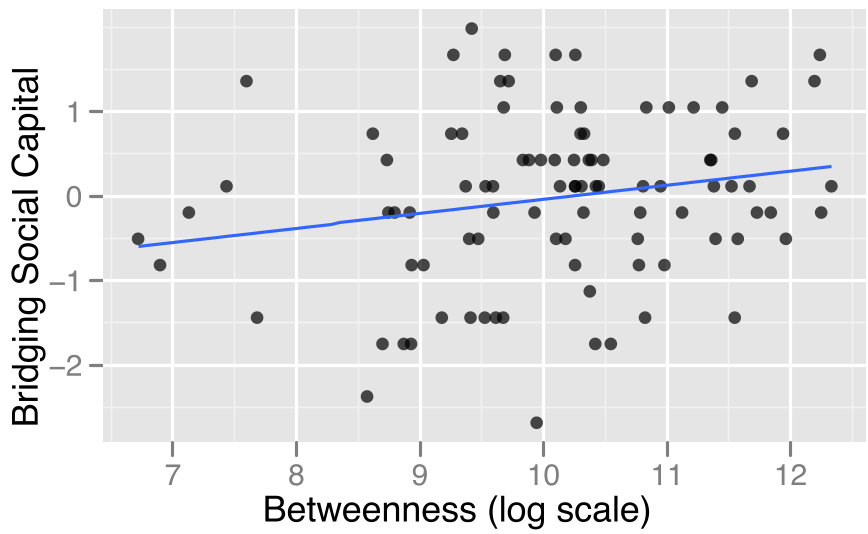 Figure 1: Betweenness Centrality—a measure of how often you act as a "bridge"—shows a clear positive correlation with Bridging Social Capital.
Key Insights: Why Topology Matters More Than Scale
1. Structural Holes are Information Goldmines
The study found that individuals who span structural holes—connecting clusters that are otherwise disconnected—report higher bridging social capital. Interestingly, the number of "isolated friends" (those who know only you in your network) was a significant predictor of access to new ideas.
- The Personality Twist: This effect is amplified for Conscientious individuals. Because they are self-disciplined and achievement-oriented, they are better at "harvesting" the diverse information their unique network position provides.
2. The Introvert's Safe Haven
For Bonding Social Capital, the results were flipped. Higher Transitivity (where your friends are all friends with each other) was particularly beneficial for introverts.
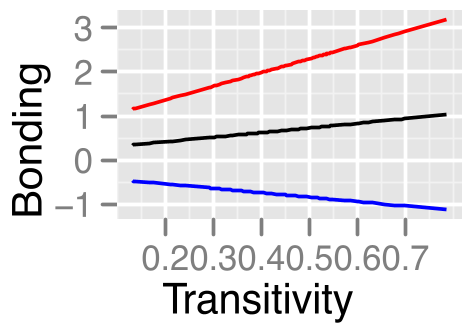 Figure 2: The interaction between network density and personality. For introverts, a tight-knit "clique" provides the emotional security needed for bonding.
3. The "Agreeableness" Paradox
In one of the most surprising findings, individuals low in Agreeableness actually benefited more from isolated friends in terms of bridging capital. This suggests that those who are more skeptical or "fault-finding" may be more effective at leveraging distant, non-redundant ties than those who try to keep everyone in a single, happy circle.
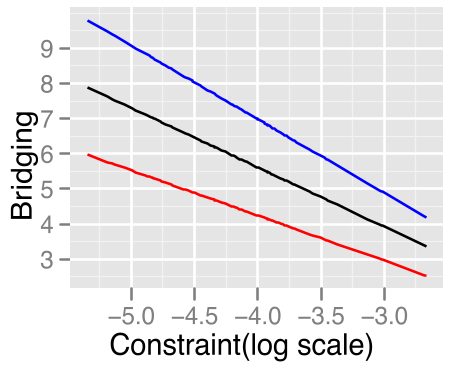 Figure 3: Interaction effects showing how personality traits like Conscientiousness and Agreeableness moderate the value of network constraints and isolated ties.
Critical Analysis & Takeaways
This paper provides a sophisticated "Inductive Bias" for how we should view digital social networks. The core contribution is the realization that personality moderates the utility of network structures.
- For Designers: Platforms should recognize that a "one-size-fits-all" interface (suggesting friends of friends) might actually hurt bridging social capital by closing structural holes. Proposing "diverse" connections might be more valuable for career-oriented users.
- Limitations: The study relies on a relatively small sample (n=95) and the 10-item Big Five inventory, which has lower reliability than longer versions. The self-reported nature of social capital also introduces potential bias.
Final Thought: If you want to expand your horizons, find more "isolated" friends. If you want emotional support, close the loops between your existing friends. But remember: your ability to do either depends heavily on your own personality "OS."