
Resource-Constrained Crowdsourcing: Optimizing Traffic in the D2D Wild
18943_Network Resource Constrained Traffic Allocation for Delay Sensitive Mobile Crowdsourcing.
The paper introduces a resource-constrained traffic allocation framework for delay-sensitive mobile crowdsourcing in Device-to-Device (D2D) networks. It proposes a Mixed-Integer Non-Linear Programming (MINLP) formulation and solves it using a submodular-based centralized approximation and a distributed heuristic, significantly outperforming legacy protocols in cost efficiency.
TL;DR
Mobile crowdsourcing often fails in the real world because devices have limited storage and wireless links have finite bandwidth. This paper moves beyond "infinite capacity" assumptions, formulating a non-linear optimization problem for traffic allocation. By leveraging submodularity, the authors developed a distributed heuristic that delivers high-bandwidth data (like video) with minimal cost and high reliability without needing wasteful message replication.
Context: Why Traditional Routing Fails Crowdsourcing
In an era of 5G and mmWave, we still face "coverage holes." Device-to-Device (D2D) communication is the bridge, but it is fundamentally opportunistic—nodes meet briefly and sporadically.
Most existing Delay-Tolerant Network (DTN) protocols (like Epidemic or MaxProp) focus on reachability but ignore capacity. When a participant tries to upload a 20MB video clip over a fleeting Bluetooth or WiFi link, the link often saturates. Furthermore, users only dedicate a fraction of their phone's storage to background tasks. This paper identifies that storage and bandwidth are not just variables; they are hard institutional constraints.
Methodology: The Power of Submodularity
The authors define the problem as a Mixed-Integer Non-Linear Programming (MINLP) challenge. The goal is to minimize total communication cost while ensuring the expected delivery rate meets a threshold within a delay budget .
1. The Submodular Insight
The core mathematical breakthrough is proving that the delivery rate function is submodular. In plain English: the "marginal utility" of adding a new path to your delivery strategy diminishes as you add more paths.
2. Centralized vs. Distributed
- Centralized Heuristic: Greedy selection of paths with the highest ratio.
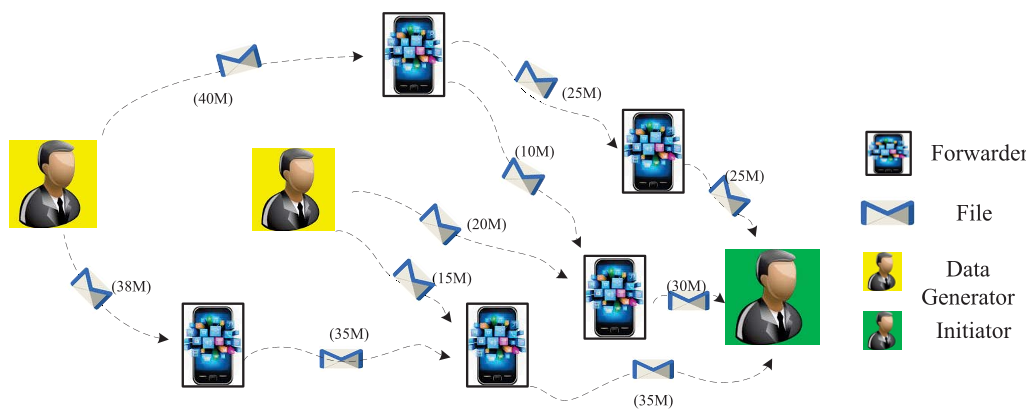
- Distributed Online Heuristic: Nodes make local decisions during "contact events" based on historical encounter statistics, ensuring they don't exceed nodal or link capacities.
Experimental Validation: From Tablets to Traces
The researchers didn't just stop at math; they deployed 21 Dell Streak tablets to students for 21 days.
Key Findings:
- Temporal Patterns: Task completion followed a clear weekly cycle. Weekends saw a performance dip as students scattered, reducing opportunistic contacts.
- Nodal Popularity: Socially "active" nodes served as the most effective relays, correlating contact frequency directly with task success.
- SOTA Comparison: Compared to the RAPID protocol, the proposed "Online" and "Central" algorithms achieved similar delivery rates but at a fraction of the communication cost, because they avoided unnecessary data replication.
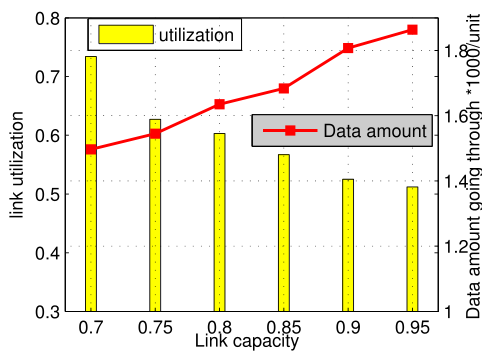 Figure: Nodal popularity vs. Cumulative Received Packets.
Critical Analysis: The Bottleneck is Real
The study reveals an anti-intuitive truth in D2D: higher capacity links often have lower utilization. Why? Because a high-capacity link is frequently "bottlenecked" by a lower-capacity node or link elsewhere in the path. This proves that traffic allocation must be a path-aware decision, not just a local greedy one.
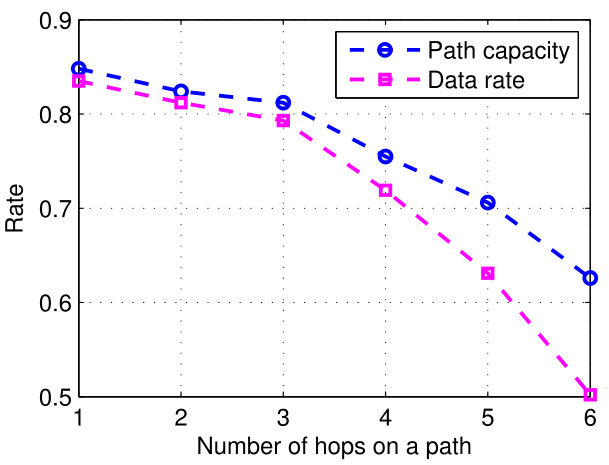 Figure: Comparison of Centralized, Online, RAPID, and Random methods.
Conclusion & Takeaways
This work provides a rigorous framework for D2D crowdsourcing that respects the physical reality of mobile hardware.
- Efficiency over Redundancy: Single-copy multi-path routing is viable and cheaper than replication-based DTN routing when resources are constrained.
- Utility-Driven: Using submodular greedy selection provides a near-optimal performance bound of .
For future crowdsourcing apps—ranging from traffic monitoring to disaster rescue—this methodology offers a blueprint for building "frugal" networks that survive in resource-starved environments.