
Portolan: Mapping the Global Internet from the Palm of Your Hand
Network sensing through smartphone-based crowdsourcing
The paper introduces Portolan, a smartphone-based crowdsourcing system designed for large-scale network sensing. It successfully maps the Internet's Autonomous System (AS) topology and generates high-resolution cellular signal coverage maps by leveraging the ubiquity and mobility of mobile devices.
TL;DR
Portolan is a distributed crowdsourcing platform that transforms ordinary smartphones into sophisticated network probes. By aggregating tiny "micro-measurements" from thousands of users, it can map the hidden backbone of the Internet with higher precision than professional databases and create hyper-accurate cellular coverage maps.
Background & Motivation: The Visibility Gap
Mapping the Internet is notoriously difficult. Large Internet Service Providers (ISPs) treat their topological structures as trade secrets, and traditional "looking glass" servers are too sparse to capture the true user experience. Most network measurement tools are static, expensive, and fail to reach the "periphery" of the network where the users actually reside.
The authors argue that the solution is already in our pockets. Smartphones offer three unique advantages for network sensing:
- Ubiquity: Their sheer numbers provide massive aggregate computational power.
- Mobility: They act as "moving sensors" that observe the network from different vantage points over time.
- Context: Integrated GPS allows for the marriage of network performance data with precise geographical coordinates.
Methodology: The Portolan Architecture
Building a crowdsourced system on mobile devices presents a major challenge: Resource Sensitivity. Smartphones have limited battery and data plans.
The Microtask Approach
To solve this, Portolan uses a modular Client-Server Architecture. Instead of running heavy scans, the server breaks down large measurement goals into "microtasks."
- Control Loop: The server assigns tasks based on the device's location or IP range.
- Resource Efficiency: To avoid draining the battery, the app uses a "Passive Location Provider"—it only records GPS coordinates if another app (like Google Maps) has already activated the GPS hardware.
 The aggregate power of many devices allows for a higher resolution view of the network.
Key Scenarios & Results
1. Internet Topology Discovery
Using a mobile-optimized version of Paris Traceroute, Portolan discovers links between Autonomous Systems (AS). In a trial targeting the Italian Internet space, Portolan discovered 1,117 links.
- The SOTA Killer: When compared against the CAIDA dataset—the gold standard in academic network research—Portolan found that 21.8% of its discovered links were entirely new and missing from CAIDA. This proves that crowdsourcing can "see" connections that centralized probes miss.
2. Cellular Signal Coverage
Portolan collects Received Signal Strength (RSS) data. With over 1,000,000 samples collected, the researchers visualized cellular "dead zones" and performance variations.
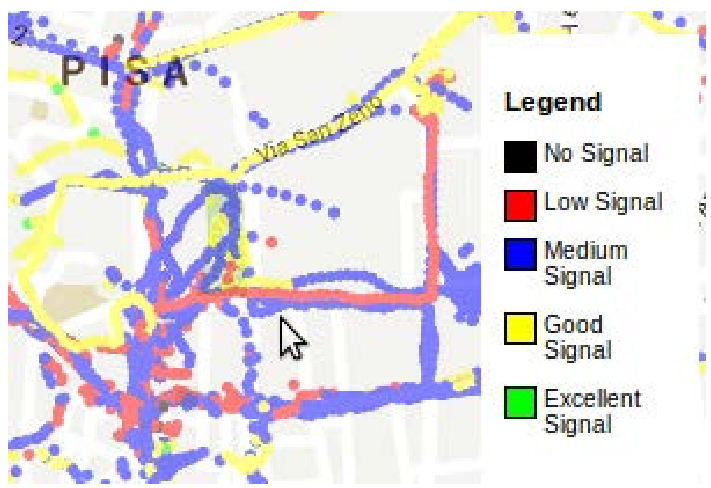 Figure 2: Signal coverage in Pisa demonstrates high-granularity variations that standard carrier maps often smooth over.
Critical Insight: Why Crowdsourcing Actually Works
The "secret sauce" of Portolan isn't just the number of users; it's the diversity of viewpoints. Because smartphones move through basements, office buildings, and rural areas, they capture the "long tail" of network behavior. The project also incentivizes users by providing a suite of diagnostic tools, turning a research probe into a useful utility for the end-user.
Conclusion & Future Outlook
Portolan demonstrates that the future of network monitoring is decentralized. While the original study focused on AS-mapping and signal strength, the authors propose even more ambitious goals:
- Host Geolocation: Using mobile devices as "landmarks" to pinpoint the physical location of servers.
- Net Neutrality Monitoring: Detecting whether ISPs are secretly throttling specific types of traffic (e.g., video streaming).
As we move deeper into the 5G and 6G era, the principles laid out in the Portolan project—low-impact sensing, passive data collection, and microtasking—remain the blueprint for understanding our increasingly complex digital world.