
NetSimile: Extracting the "DNA" of Social Networks for Scalable Similarity
Network similarity via multiple social theories
The paper introduces NetSimile, a scalable and size-invariant algorithm for assessing structural similarity between multiple networks. It maps graphs into a fixed-dimensional "signature" vector using local node features derived from social theories and distribution moments, facilitating tasks like clustering and anomaly detection across disparate networks.
TL;DR
How do you compare the "personality" of two social networks if they share no common users and differ vastly in size? NetSimile provides the answer by converting complex graph topologies into compact numerical "signatures." By leveraging social theories and statistical moments, it offers a similarity measure that is both computationally cheap (linear time) and highly intuitive.
Background: The Identity Crisis of Large Graphs
In graph mining, comparing two networks is notoriously difficult. If you use graph kernels or Frequent Subgraph Mining (FSM), the computational cost explodes. If you use spectral methods (eigenvalues), you might capture the global "vibe" but lose the local structural nuances that define social dynamics.
The authors identify a critical gap: we need a way to compare graphs that is:
- Size-invariant: A small friendship group should be comparable to a massive co-authorship network.
- Node-agnostic: It shouldn't matter if the nodes overlap or have any correspondence.
- Theoretically Sound: The features should reflect actual social phenomena.
Methodology: From Social Theory to Feature Vectors
NetSimile’s magic lies in its two-step transformation: Extraction and Aggregation.
1. The Local Features (The Social "Genes")
The algorithm extracts 7 features for every node, specifically targeting four social theories:
- Social Capital: Degree and neighborhood connectivity.
- Structural Holes: Control over information flow (ego-network edges).
- Balance & Transitivity: Clustering coefficients.
- Social Exchange: Reciprocity and neighbor characteristics.
2. The Signature (The Statistical "DNA")
To make these features size-independent, NetSimile looks at the distribution of these features across the whole graph. It calculates five moments for each feature: Mean, Median, Standard Deviation, Skewness, and Kurtosis. This results in a fixed-size signature vector (7 features × 5 moments = 35 dimensions) regardless of whether the graph has 100 nodes or 100 million.
(Note: This conceptualizes the mapping from local node features to the global moments signature.)
Experimental Results: Proving Intuition
The researchers tested NetSimile against EIG (top-k eigenvalues) and FSM (frequent subgraphs).
Node Overlap Discovery
A standout result was the correlation between NetSimile distance and node overlap. In datasets like DBLP or arXiv, if two networks had a high percentage of shared nodes, NetSimile correctly assigned them a low distance score. Interestingly, the spectral (EIG) baseline showed almost zero correlation, proving that global eigenvalues often miss the "local flavor" that defines a community's identity.
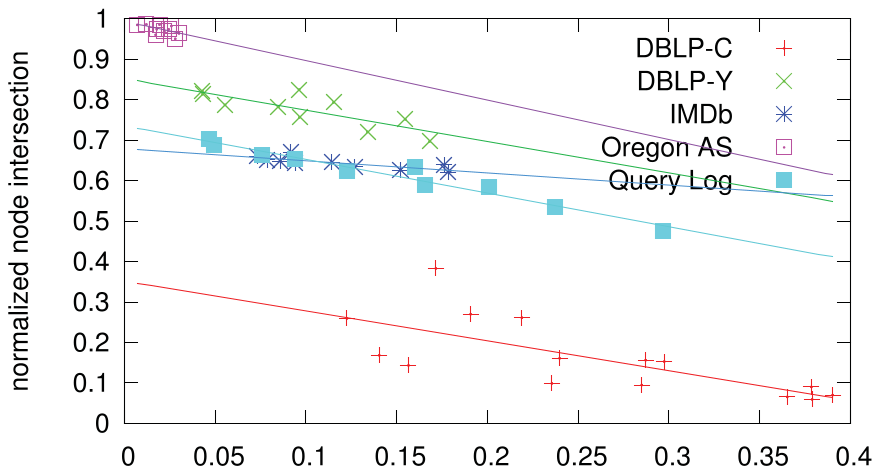 Figure 1: (Left) NetSimile shows a clear correlation between distance and node overlap. (Right) The spectral baseline fails to capture this relationship.
Robustness to Noise
By "rewiring" real-world networks (randomly swapping edges), the authors showed that NetSimile is sensitive to structural degradation. As more edges are rewired, the distance from the original graph grows linearly, demonstrating that the signature accurately tracks the destruction of social structures.
Critical Insight: Why Static Moments Work
The brilliance of NetSimile is its use of moments. While a single mean value (like average degree) tells you little, the combination of skewness and kurtosis captures the "shape" of the network—whether it has "fat tails" (power-law distributions common in social networks) or is more uniform (like a road network).
Limitations
- Feature Selection: The 35-dimensional vector is fixed. While extensible, it may miss specific domain-specific traits (e.g., temporal dynamics).
- Purely Structural: It purposefully ignores node attributes (age, gender), which might be a downside for strictly "social" analysis but an upside for general graph mining.
Conclusion
NetSimile bridges the gap between theoretical sociology and big-data engineering. It provides a "fingerprint" for graphs that is fast to compute, easy to understand, and mathematically robust for tasks like anomaly detection and network clustering. As graph data continues to scale, such "signature-based" approaches will be essential for navigating the complex web of digital connections.