
Structural Social Capital: Is Your City's Network Prosperity's Best Friend or Foe?
Network structure and economic prosperity in municipalities: A large-scale test of social capital theory using social media data
Using data from over 10 million users of a Dutch online social network (Hyves), this study examines the relationship between network structure and economic prosperity across 438 municipalities. It identifies that geographical diversity of ties and low network fragmentation are significant predictors of higher income per capita.
TL;DR
Does the way we are connected determine how wealthy we are? By analyzing 123 million social ties from a massive Dutch online network, researchers discovered that municipalities with "long-distance" friends and less internal social fragmentation are significantly more prosperous. Surprisingly, it turns out that being "too tightly knit" (high network density) might actually be a liability for economic growth.
Background: Beyond Survey Data
For decades, sociologists have argued that Social Capital—the resources embedded in our social relationships—is a key driver of economic success. However, measuring it at the scale of an entire nation has been notoriously difficult. Most researchers rely on surveys asking about "trust" or "club memberships." This study skips the proxies and looks directly at the "digital footprint" of an entire country's social structure using data from Hyves, once the dominant social network in the Netherlands.
The Core Conflict: Bonding vs. Bridging
The research tests several longstanding sociological intuitions:
- Network Closure (Density): The Coleman-derived idea that if everyone knows everyone, trust increases, lowering the "cost" of business.
- Bridging Social Capital: The Granovetter-derived "strength of weak ties" theory, suggesting that connections to diverse, distant groups bring in fresh information and innovation.
- Bonding Social Capital (Fragmentation): The risk that closed, isolated cliques (high modularity) prevent the flow of resources and create an "excess of community" that hampers mobility.
Methodology: Mapping a Nation’s Social Geometry
The authors nested 3.1 million active users into 438 municipalities. They calculated variables for each municipality based on:
- Internal Structure: How many possible friendships actually exist (Density) and how partitioned the city is into separate cliques (Modularity/Fragmentation).
- External Reach: How diverse and geographically far the outward connections are.
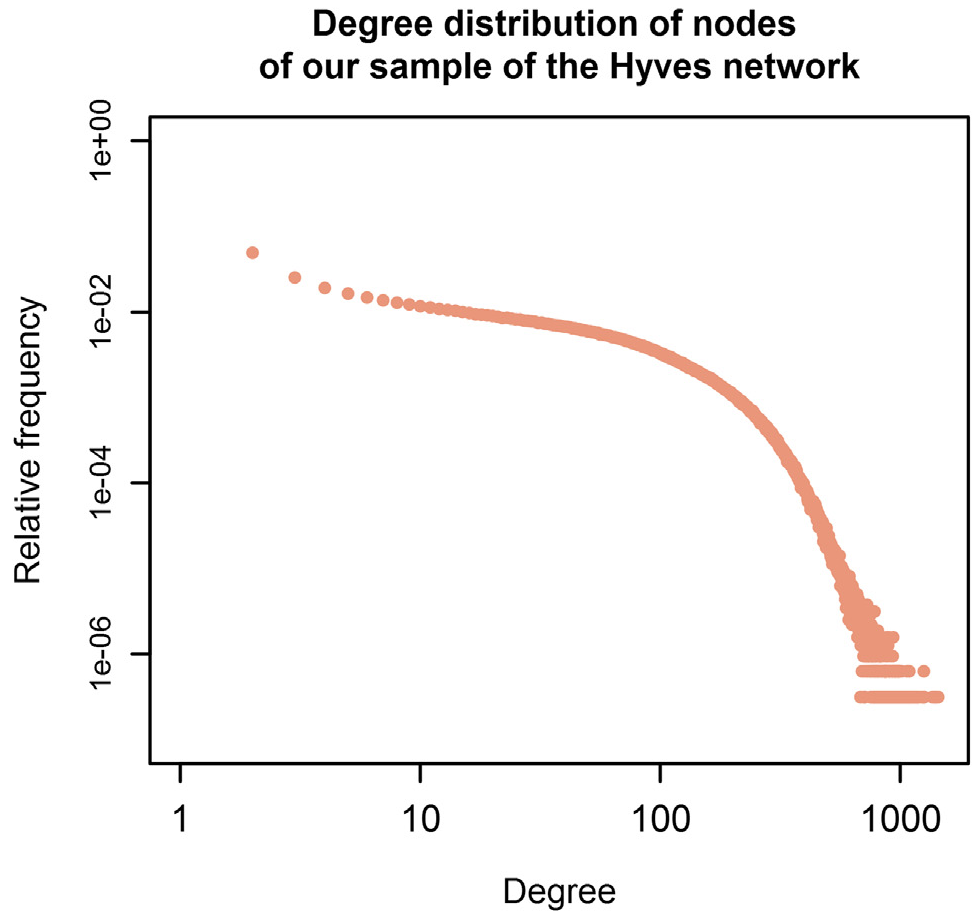 The degree distribution above showcases a fat-tailed nature, typical of large-scale human social networks, where most have few connections but a few "super-connectors" bridge vast gaps.
Key Findings: The Geography of Wealth
The study’s OLS regression models provided striking insights:
1. Distance translates to Decimals
Municipalities where inhabitants have contacts living in distant locations are more prosperous. Geographically "long" bridges are more likely to connect non-redundant information sources, sparking innovation.
2. The Fragmentation Tax
High modularity—where a city is split into several isolated social silos—is statistically linked to lower income per capita. Fragmentation limits the diffusion of job opportunities and expertise within the municipality.
3. The Density Paradox
In a direct challenge to "Communitarian" social capital theory, Network Density was negatively associated with prosperity. In large municipalities, high density might indicate a lack of external "bridging" reach, or perhaps that the mechanisms of reputation and sanctioning (which work in small villages) simply break down and become "noise" in larger urban networks.
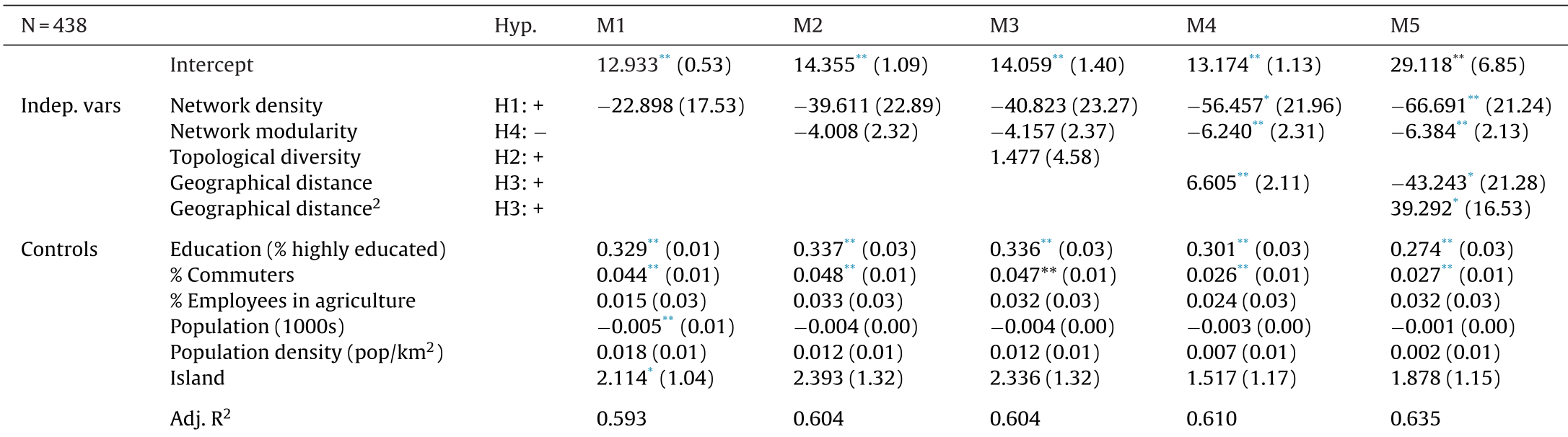 Table 2 shows the progression of models. In Model 5 (the best fit), both network density and modularity show significant negative coefficients (p < 0.05 and p < 0.01 respectively), while geographical distance remains the strongest positive structural predictor.
Critical Insight: Why Does This Matter?
This paper shifts the focus of economic development from "how many friends you have" to "where your city's friends live."
- For Urban Planners: Breaking down social silos (lowering modularity) through integrated public spaces and diverse housing may have a measurable "return on investment" in terms of local income.
- For Technology: It validates the idea that online social networks aren't just "virtual" distractions; they provide a structural footprint that mirrors and perhaps even facilitates offline economic prosperity.
Limitations & Future Work
The authors acknowledge that they cannot prove causality. Does wealth allow you to travel and make distant friends, or do distant friends make you wealthy? Furthermore, the "strength" of these online ties remains unknown. Future research using longitudinal data (tracking changes over years) will be essential to determine if we can "engineer" prosperity by strategically re-wiring a city's social network.
Takeaway: If you want your city to prosper, look outward. The most valuable connections aren't necessarily the ones in your backyard, but the ones that bridge the gap to the world beyond.