
Network Topology-Traceable Fault Recovery: Reinforcing 5G Resilience with RL
Network Topology-Traceable Fault Recovery Framework with Reinforcement Learning
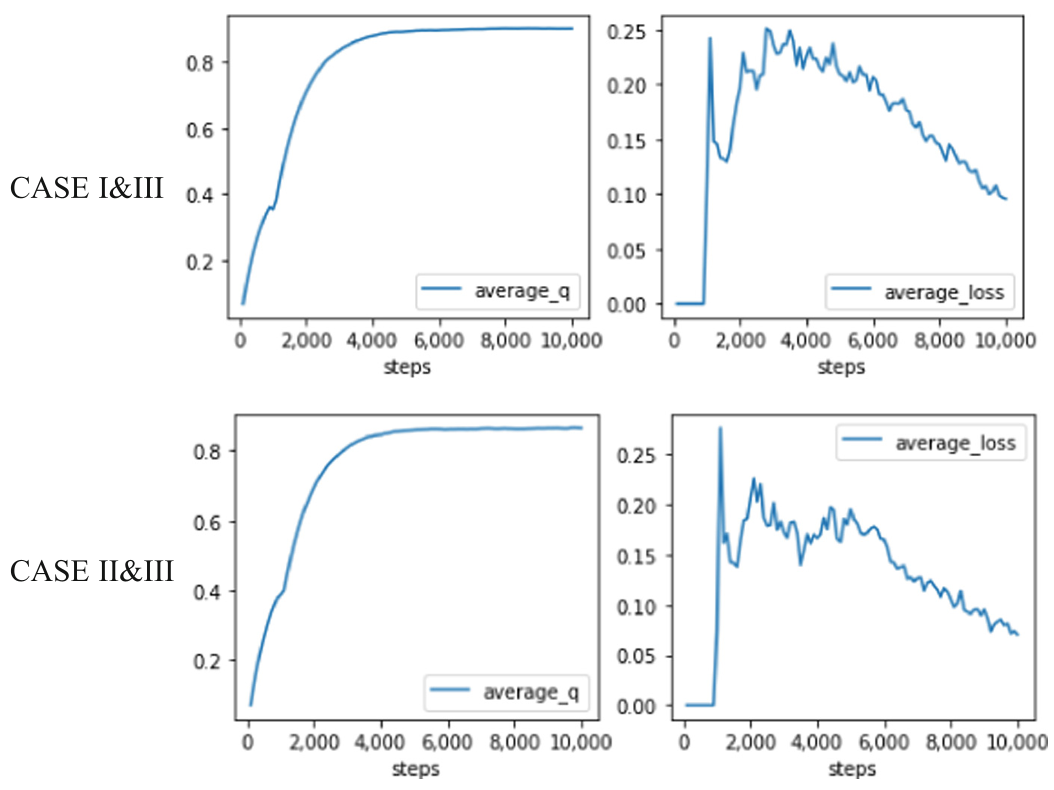
This paper introduces a Network Topology-Traceable Fault Recovery Framework using Deep Reinforcement Learning (DRL) to automate Network Function Virtualization (NFV) operations. The core method utilizes a multi-layer matrix representation to handle dynamic network topologies and identifies optimal recovery workflows, achieving a convergence in action selection within 4,000 steps.
TL;DR
Managing 5G and NFV (Network Function Virtualization) is increasingly complex, often requiring manual updates to automation scripts whenever the network topology changes. This paper proposes a Reinforcement Learning (RL)-based framework that uses a novel multi-layer matrix representation to trace network changes. By training an agent in a simulated environment, the system learns to trigger the optimal recovery APIs (e.g., restarting processes or rebuilding VMs) autonomously, maintaining high accuracy even with dynamic configuration shifts.
The Problem: The "Rigid Model" Bottleneck
In the era of NFV, network functions are decoupled from hardware. While this adds flexibility, it creates a nightmare for automation. Traditional ML models often require fixed-dimension input vectors. If you add a new router or change a link, the model's "view" of the world breaks, requiring expensive retraining.
Existing policy-based approaches (like ONAP) or manual shell scripts are:
- Knowledge-dependent: High reliance on specialist skills.
- Brittle: They fail when faced with "unexpected behavior" or topology updates.
- Costly: OPEX rises as engineers spend time fixing the automation itself.
Methodology: Topology-Traceable Learning
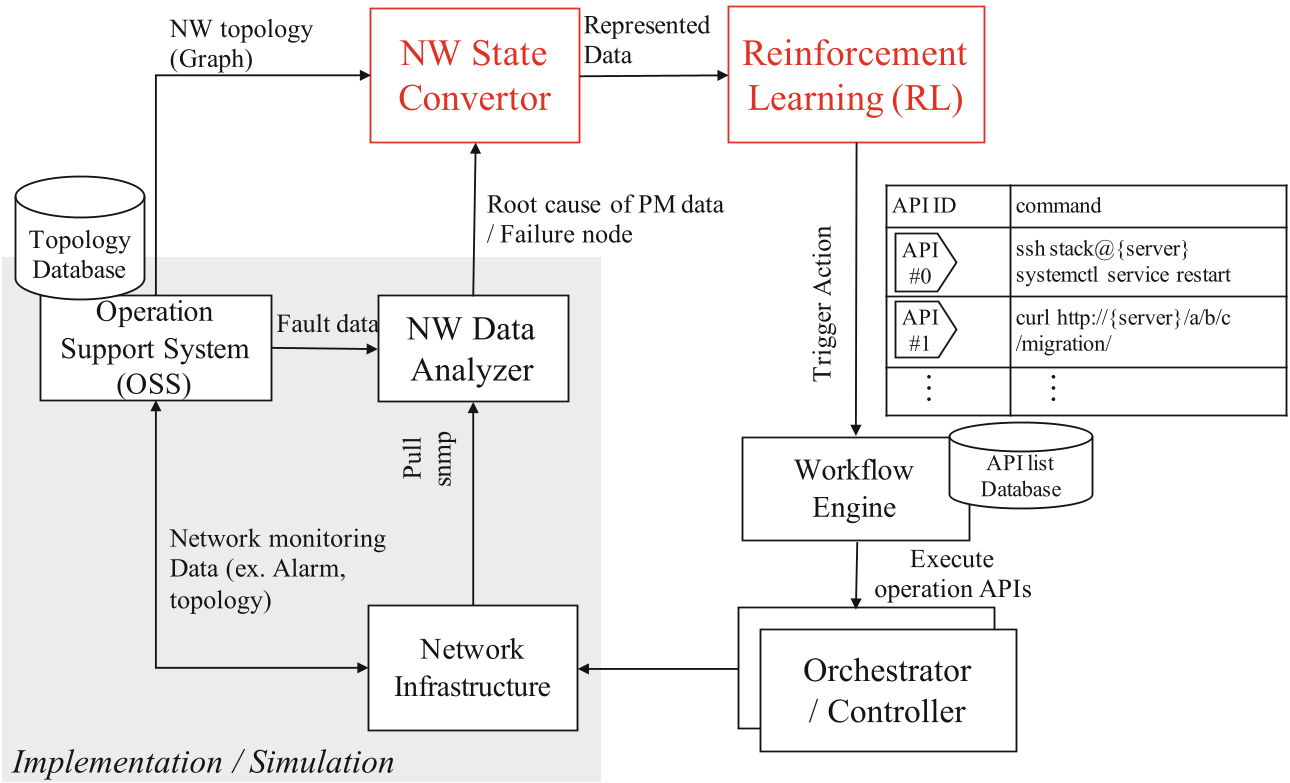
The authors' breakthrough lies in the NW State Converter. Instead of treating the network as a static list of features, they treat it as a dynamic graph.
1. Data Representation (The Multi-Layer Matrix)
To make the network "understandable" for an RL agent, the framework converts the status into two primary matrices:
- Adjacency Matrix: Captures the physical/logical connectivity including interfaces.
- Failure Matrix: Flags the root cause and location of errors (using '1' for failure, '0' for normal).
2. The RL Engine (DQN)
The system uses a Deep Q-Network (DQN) to approximate the optimal action-value function. The agent observes the state (), takes a recovery action () from a library of 20 APIs, and receives a reward () based on whether the network recovers safely and quickly.
Experiments & Results
The framework was tested against three critical failure cases involving CPU/Memory exhaustion and process-level vs. VM-level recovery.
Convergence and Trials
One of the major findings is the "data hunger" of RL. The research notes that while the model converges (Q > 0.8) in about 4,000 steps, this is impossible to do on a live production network due to the risk of service disruption.
- Solution: Use a network simulator (OpenAI Gym-based) for pre-training.
The "Coincidence" Threshold
A critical contribution of this paper is defining how accurate a simulator needs to be. By injecting noise into the failure matrix, the authors discovered a performance "cliff."
- Insight: The framework remains effective if the simulator matches the real-world behavior at least 87% of the time. Beyond 13% noise/divergence, the F1-score drops significantly.
Critical Analysis & Future Outlook
Takeaway
This work moves network automation away from "if-then" scripts toward "goal-oriented" agents. The ability to handle topology changes without manual script updates is a significant step toward Zero-Touch Networks.
Limitations
- Scaling: The study focused on 1-hop observations from the failure node. In massive mesh networks, the state space might explode.
- Sim-to-Real Gap: Achieving 87% coincidence in complex multivendor environments is still a high bar for current network simulators.
Future Work
The researchers aim to explore ways to shorten the training time and develop more sophisticated simulators that can satisfy the "87% rule" across even more complex failure scenarios.
References:
- Miyamoto, T., et al. "Network Topology-Traceable Fault Recovery Framework with Reinforcement Learning."
- ETSI ISG NFV Management and Orchestration (MANO).
- Mnih, V., et al. "Human-level control through deep reinforcement learning," Nature, 2015.