
Decentralization: The Silent Engine of Chinese Microblog Diffusion
Can Network Help Chinese Microblogs Diffuse? Analyzing 118 Networks of Reposts About Social Issues in China
This study analyzes 118 social networks of Sina Weibo reposts to understand information diffusion in the Chinese socio-political landscape. Using Social Network Analysis (SNA), the research identifies that decentralized networks, rather than single dominant opinion leaders, are the primary drivers for widespread information propagation.
TL;DR
In a digital landscape often characterized by strict top-down control and high-profile "Big V" influencers, this research uncovers a surprising structural reality. By analyzing 118 individual repost networks on Sina Weibo, the study demonstrates that decentralization—rather than the dominance of a single opinion leader—is the key catalyst for information reaching the furthest corners of the Chinese internet.
The Motivation: Beyond the "Big V" Myth
In Chinese social media discourse, much attention is paid to "Big Vs" (verified accounts with millions of followers). The assumption is that these hubs are the sole gatekeepers of truth and viral content. However, in a regulated environment where "hubs" are easily targeted for censorship, how does information about social issues—like anti-corruption or the Wenzhou train crash—actually spread? The author, King-wa Fu, posits that we must look past individual actors and analyze the architectural topology of the networks themselves.
Methodology: Tracing the Digital Paper Trail
The study treats reposting as a directed social graph. Using the Sina Weibo API, the researchers reconstructed networks ranging from 100 to over 60,000 nodes.
Key metrics used to define the "health" of a diffusion process included:
- Diameter: The "longest" shortest path between any two users (how far the message traveled).
- Degree (Max): The proportion of the network generated by the single most active user.
- Power-law Exponent: A measure of how much a small group dominates the conversation.
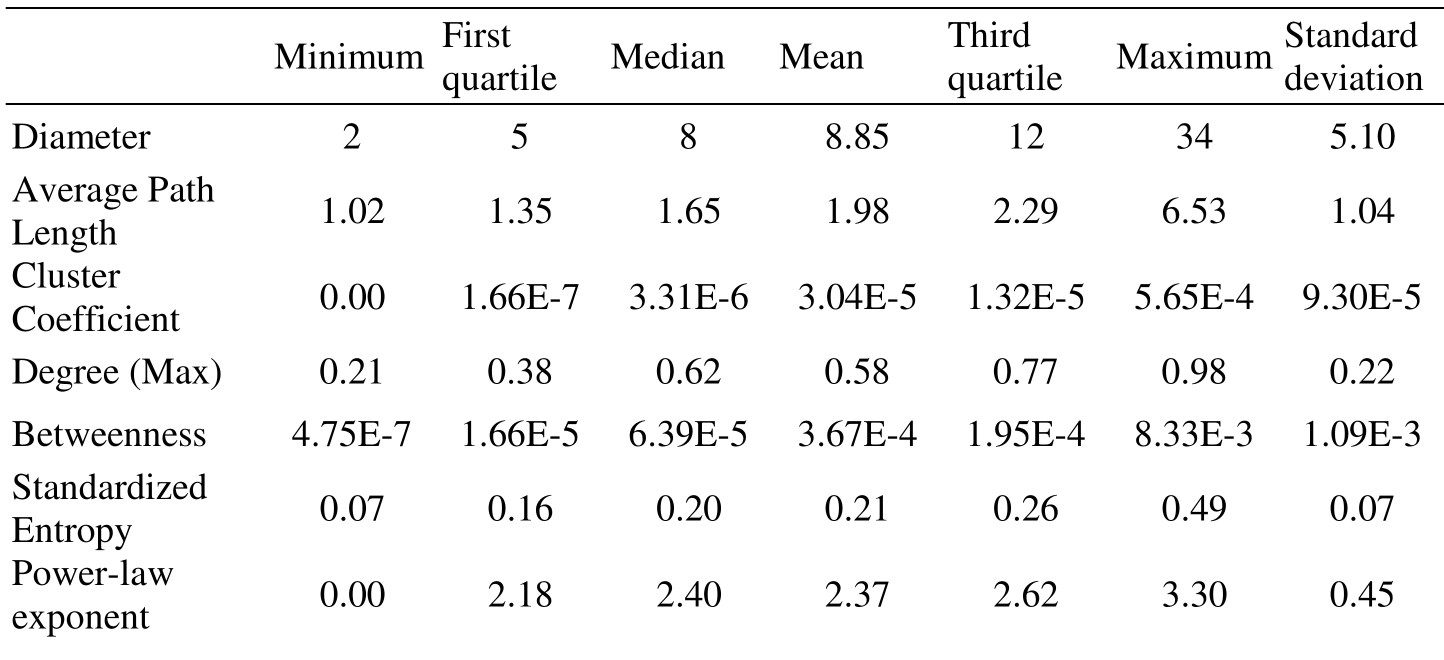 Table 1: Descriptive statistics of the 118 networks, showing a mean power-law exponent of 2.37.
Core Insight: The Paradox of Centralization
The most striking finding of this research is the inverse relationship between the dominance of an opinion leader and the overall reach of the message.
- Centralization Limits Reach: The data shows a strong negative correlation (r=-0.66) between the "Maximum Degree" (the power of the top influencer) and the "Network Diameter."
- The "Multi-Hub" Advantage: When a repost network is decentralized—meaning the "load" of spreading the message is shared by many medium-sized accounts—the information travels significantly further and lasts longer in the public sphere.
- Efficiency: The average path length of ~2 steps across these networks suggests that despite the vast size of the Chinese internet, information remains highly "Small World" in nature, requiring only two "hops" to connect most users involved in a social issue.
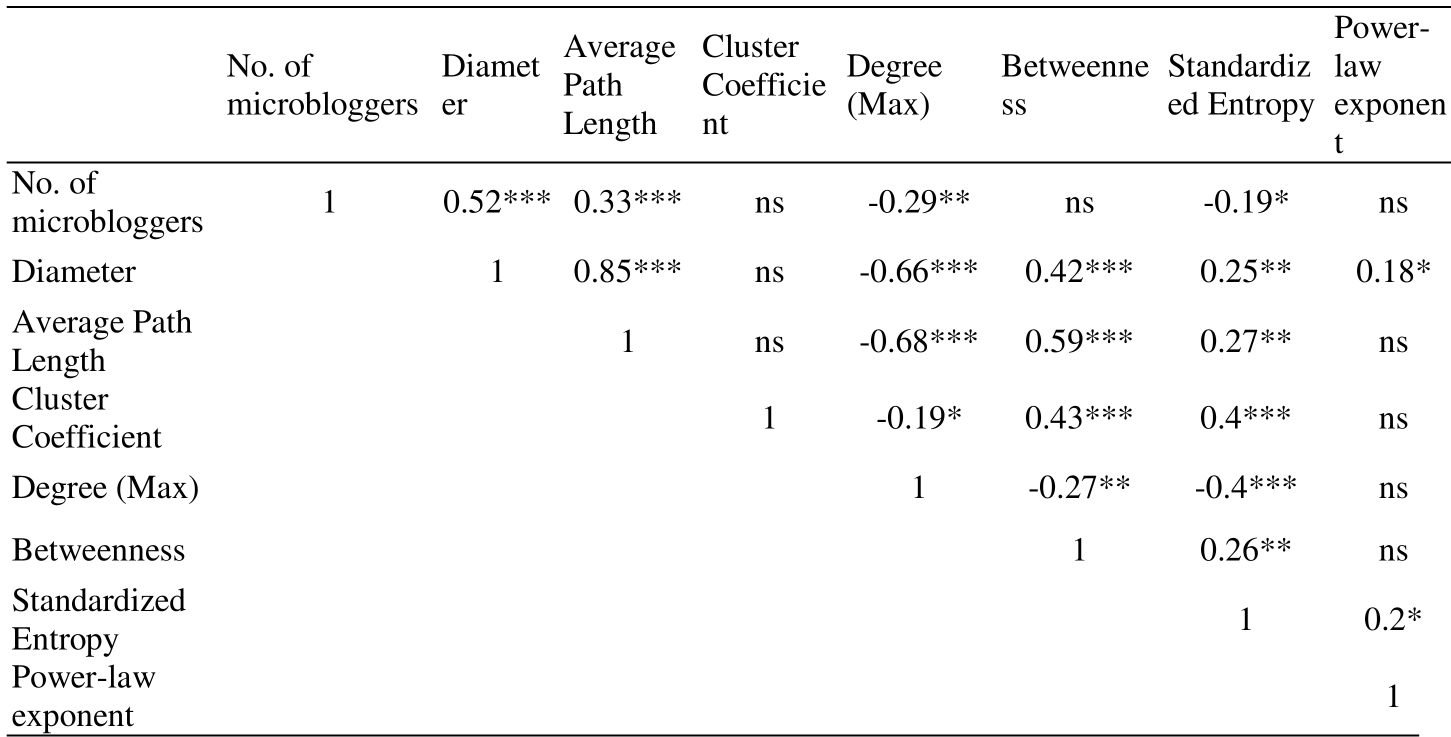 Table 2: Correlation coefficients showing the significant negative relationship between Max Degree and Network Diameter.
Critical Analysis & Conclusion
The study provides a rigorous empirical backbone to the intuition that "crowd-sourced" diffusion is more robust than "influencer-led" diffusion. In the context of Chinese censorship, a decentralized network is harder to "decapitate." When the government targets a "Big V," the network survives if it is decentralized; if it is centralized, the information flow dies with the hub.
Takeaway for Practitioners: For those looking to understand social movements or information operations, the focus should shift from who is posting to how many middle-tier nodes are engaged. The "Medium-V" users are the true architects of information scale.
Limitations: The study was conducted using data when the API was more open. Recent shifts in API access and advanced AI-driven censorship may have altered these dynamics, suggesting a need for a "v2.0" study in the era of more sophisticated digital governance.