
Beyond Sympathy: A Hybrid Neural Approach to Rescuing Situational Awareness from Twitter
8310_A Neural-Based Approach for Detecting the Situational Information From Twitter During Disaster.
The paper introduces a neural-based hybrid framework that combines fine-tuned RoBERTa models with traditional feature-based methods to identify "situational tweets" during disasters. Evaluated across five distinct disaster datasets (English and Hindi), the approach achieves SOTA performance by capturing both deep contextual semantics and low-level linguistic indicators.
TL;DR
Researchers have developed a hybrid framework combining the bidirectional power of RoBERTa with hand-crafted linguistic features to filter "Situational Tweets" from social media noise during disasters. By using Multiplicative Fusion, the model achieves near-perfect F1-scores across multiple disaster types and significantly outperforms standard deep learning architectures like LSTMs and CNNs in both English and Hindi.
Context: The Noise Problem in Crisis Informatics
During an event like the Nepal Earthquake or the Sandy Hook shooting, Twitter is a double-edged sword. While it contains vital data (resource needs, casualty counts), this "situational information" is often buried under a mountain of prayers, opinions, and "thoughts and prayers" posts.
The core challenge is two-fold:
- Semantic Ambiguity: Situational and non-situational info often coexist in a single post.
- Vocabulary Shift: Every disaster brings new locations, hashtags, and slangs that static models fail to recognize.
Methodology: The Fusion of Two Worlds
The authors realized that while RoBERTa is excellent at understanding context, explicit "low-level" features (like the count of numerals or modal verbs) are strong indicators of factual, situational reporting.
The Architecture
The proposed pipeline uses a Multiplicative Fusion strategy:
- The Deep Stream: A RoBERTa-base model fine-tuned on disaster-specific data to capture deep bidirectional context.
- The Feature Stream: An SVM classifier utilizing 11 syntactic/lexical features including subjective word counts, personal pronouns, and intensities.
- The Fusion: The probability vectors from both are multiplied element-wise to produce the final prediction.
Experimental Showdown
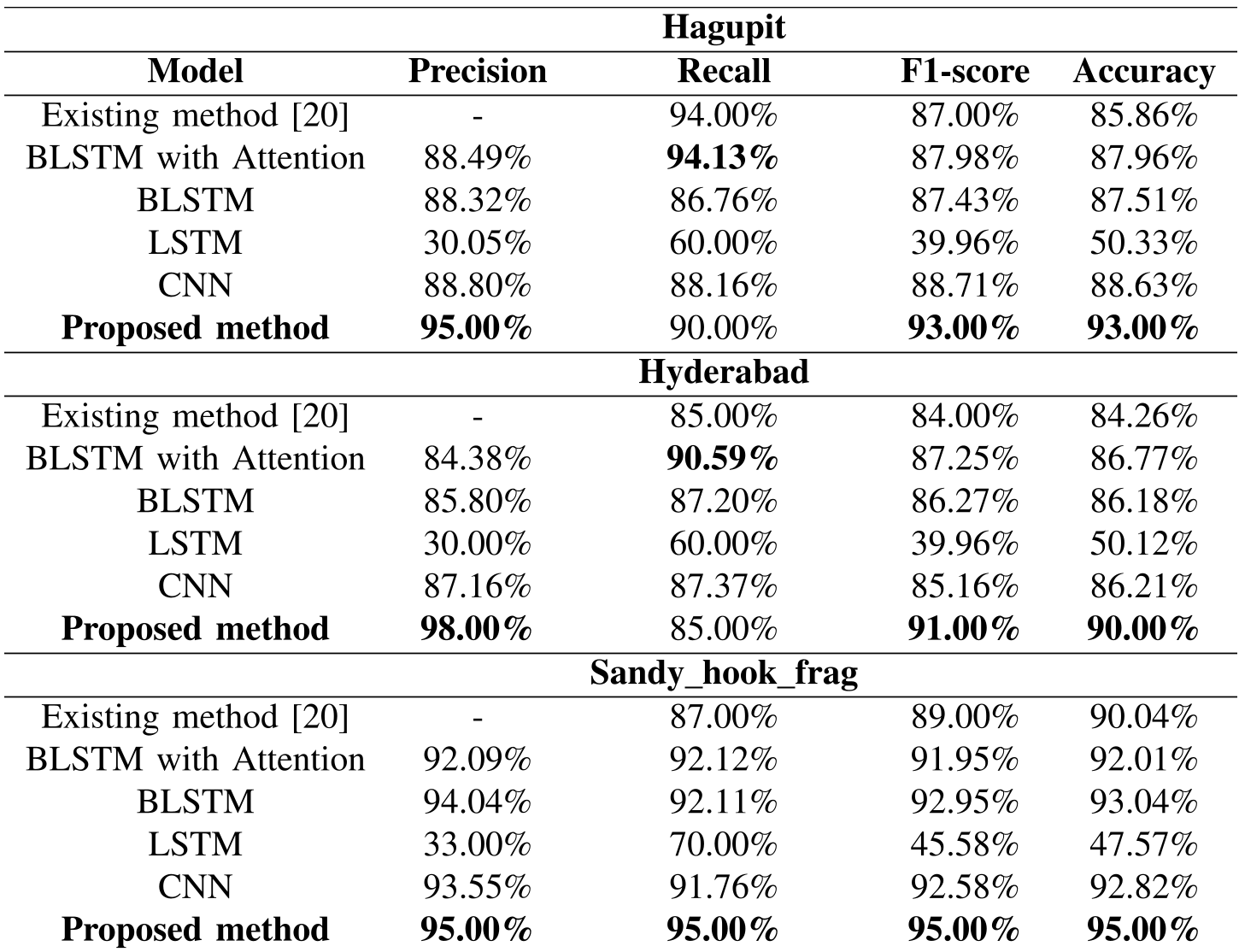
The model was put to the test against several heavyweights: CNN, LSTM, and BLSTM with Attention.
Key Findings:
- Superiority of Hybridization: Across datasets like the Hyderabad blast and Typhoon Hagupit, the proposed method consistently achieved F1-scores above 98%, often beating pure deep learning models by 1-5% in accuracy.
- Cross-Domain Robustness: One of the biggest hurdles in disaster AI is "Cross-Domain" performance—can a model trained on a flood detect situational info in a bombing? The fusion model showed remarkable resilience, maintaining high recall even when the vocabulary shifted significantly.
- Hindi Language Success: For Hindi tweets, the authors used a CNN-feature hybrid, which proved more effective than complex Transformers due to the smaller dataset size, showcasing that "bigger isn't always better" in niche linguistic tasks.
Why It Works: Error Analysis & Insight
The paper includes a fascinating Look-under-the-hood. It notes that standard CNNs often fail due to local feature ambiguity (words like "Hyderabad" appearing in both news and prayers), while LSTMs struggle when the most informative content is tucked at the beginning of a tweet rather than the end.
The BLSTM-Attention mechanism and the RoBERTa-Fusion model overcome this by "weighing" the most influential words, effectively ignoring the noise. However, even this model has "kryptonite":
- Numerals: It sometimes confuses state helpline numbers for casualty counts.
- Sarcasm: Sarcastic political posts often mimic the structure of situational reporting, leading to false positives.
Takeaway for the Future
This research moves us closer to a "Global Disaster Monitor." By combining the "intuition" of deep learning with the "rules" of linguistic features, we can create systems that help humanitarian organizations prioritize aid in real-time. For future iterations, incorporating URL analysis and specialized embeddings for locations/phone numbers will be the next frontier in reducing the remaining error margins.