
Beyond Flat Data: Unifying Social Networks and Neural Computation via Topological Spectra
Neural computation, social networks, and topological spectra
This paper introduces a unified mathematical framework for "Web Domains," linking recursive neural networks with social network algorithms like Google's PageRank. It proposes a novel "topological spectrum" based on the damping factor in PageRank to capture graph structures, proving its utility in solving the graph isomorphism problem for specific graph classes in polynomial time.
TL;DR
Classic neural networks are often "blind" to the underlying topology of data. This paper bridges the gap between connectionist models and social network ranking (like PageRank). By introducing the Topological Spectrum—a permutation-invariant representation of a graph based on its connectivity—the authors provide a mathematical bridge that allows neural networks to "sense" structure and offers a polynomial-time solution to the graph isomorphism problem for a broad class of graphs.
The "Flat Data" Trap
In the early 2000s, most machine learning was performed on "flat" data—vectors where the relationships between samples were ignored. Even today, while we have Graph Neural Networks (GNNs), the fundamental problem remains: how do we extract the "essence" of a graph's shape in a way that doesn't change just because we renamed or reordered the nodes?
The authors argue that traditional Backpropagation spends too much energy learning things like translation invariance because it doesn't understand the graph it's sitting on. Their insight? PageRank isn't just for web search; it's a structural probe.
Methodology: The Damping Factor as a Lens
The core of the paper is the definition of Web Domains. A web domain is essentially a graph where nodes carry state vectors, and information flows through a local map:
The most striking part of the methodology is how they repurpose Google's PageRank equation:
Here, is the damping factor (usually set to 0.85 in search). The authors realize that is not just a vector of numbers; it is a function of . By varying , you get a Topological Spectrum.
- When is small, the rank depends only on immediate neighbors.
- As approaches 1, the rank captures deep, global reachability.
Architecture Visualization
The paper illustrates how traditional Recursive Neural Networks (RNNs) and PageRank can be seen as two sides of the same coin within an "Encoding Network."
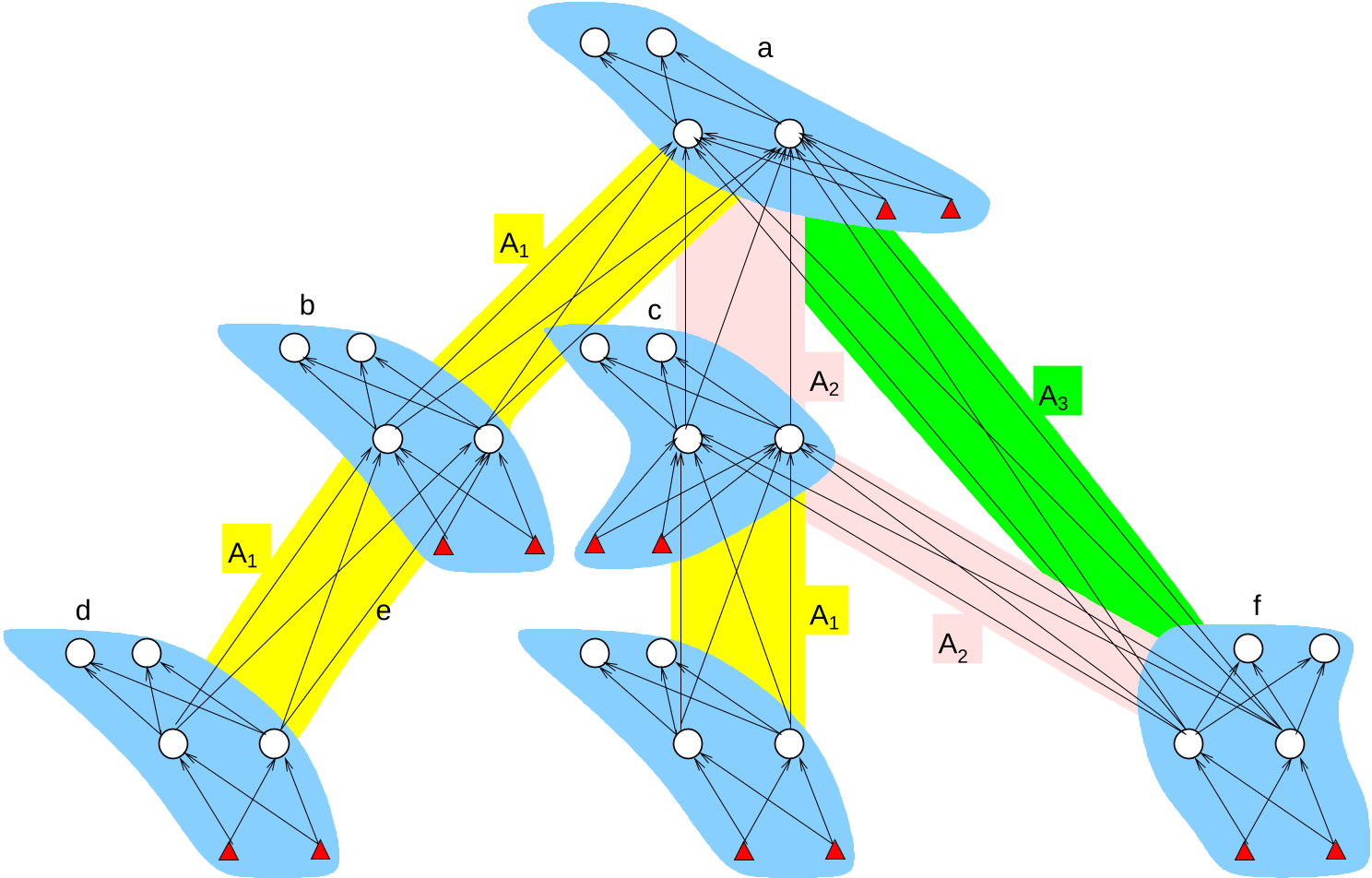 Figure 1: The transition from a structured data graph to an encoding neural network.
Graph Inversion: Can You Rebuild a Graph from its Rank?
One of the boldest claims in the paper is Spectrum Inversion. If you have the rankings for different damping factors, can you reconstruct the original link matrix ?
The authors provide a closed-form matrix inversion:
If the matrix (formed by sampling the spectrum at different values) is full rank, the reconstruction is unique. This is a massive win for Graph Isomorphism. If two graphs have the same sorted spectrum and satisfy the rank condition, they are functionally identical.
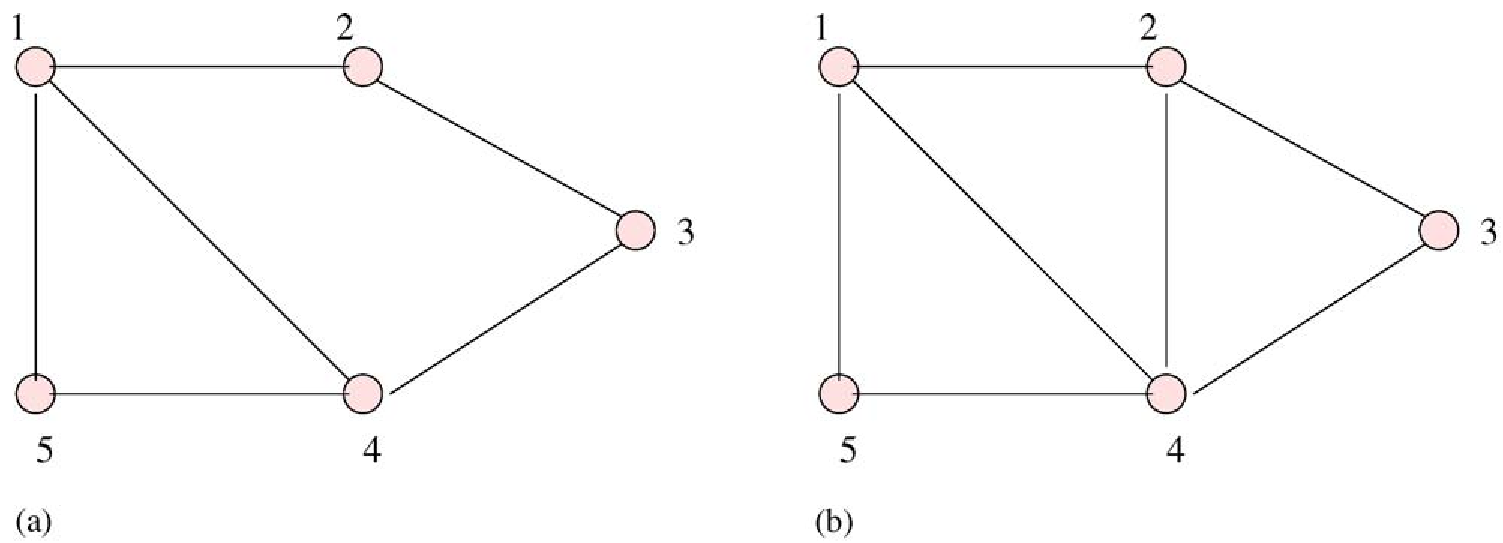 Figure 2: Examples of graphs where the reachability matrix determines whether they can be uniquely identified by their spectrum.
Why It Matters: Deep Insights
- Structural Inductive Bias: Instead of forcing a neural net to learn that "Page A linking to Page B" is important, this framework embeds that importance directly into the state transition.
- Polynomial Graph Isomorphism: Graph isomorphism is notoriously difficult (NP-Intermediate). This paper identifies a "frequently met" class of graphs (where the reachability matrix is full rank) where the problem becomes a simple matter of linear algebra.
- Unification: It shows that the "Authority" of a social node and the "Activation" of a neuron are mathematically isomorphic.
Critical Analysis & Conclusion
This work predates the massive explosion of Graph Convolutional Networks (GCNs), but it provides the theoretical bedrock for them.
Limitations: The primary bottleneck is the "Full Rank" requirement. In highly symmetrical graphs (like circles or lattices), the rankings of different nodes might be identical, causing the matrix to be singular. In these cases, the "Topological Spectrum" cannot distinguish between certain nodes.
Future Outlook: Today, as we build "Graph-of-Thought" reasoning for LLMs, the idea of using PageRank-like spectral properties to weight information flow is more relevant than ever. This paper reminds us that the best way to understand structured data is to look at its "vibrations" across different scales of connectivity.