
Neural Dynamics of Racial Bias: Why Your Brain Syncs Differently to "Same-Race" Pain
Neural dynamics of pain expression processing: Alpha-band synchronization to same-race pain but desynchronization to other-race pain
This study utilizes Magnetoencephalography (MEG) to investigate the neural dynamics of racial ingroup favoritism in empathy for pain. By recording brain oscillations in Chinese adults viewing Asian (same-race, SR) and White (other-race, OR) faces, the researchers discovered that SR pain induces alpha-band synchronization in cognitive and affective networks, while OR pain triggers alpha-band desynchronization in sensorimotor regions.
TL;DR
A groundbreaking MEG study from Peking University reveals that our brains process the suffering of same-race and other-race individuals using entirely different neural "languages." While same-race pain triggers a rhythmic synchronization in emotional and cognitive centers, other-race pain leads to a suppression of rhythms in the sensory-motor areas. This divergence occurs within 200-400ms and directly predicts how much we "feel" the other person's discomfort.
Perspective: Beyond the "Amount" of Empathy
For years, social neuroscience has known about Racial Ingroup Favoritism—the tendency to feel more empathy for those who look like us. Previous fMRI studies showed less activation for other-race (OR) pain, while EEG showed slower responses. However, this study suggests the difference isn't just about "more" or "less" activity; it's about which neural subsystems are talking to each other.
The "Alpha" Secret: Synchronization vs. Desynchronization
The researchers focused on Alpha-band oscillations (9-14 Hz). In the world of brainwaves, alpha power changes tell two different stories:
- Alpha Desynchronization (Mu Rhythm Suppression): This usually means the sensorimotor cortex is "firing up" to mimic or simulate an action or sensation.
- Alpha Synchronization: Often reflects top-down attention, emotional arousal, or internal mental operations.
The Methodology
Participants (Chinese adults) viewed photos of Asian and White faces with either painful or neutral expressions while undergoing MEG. This allowed researchers to see where the activity happened and exactly when.
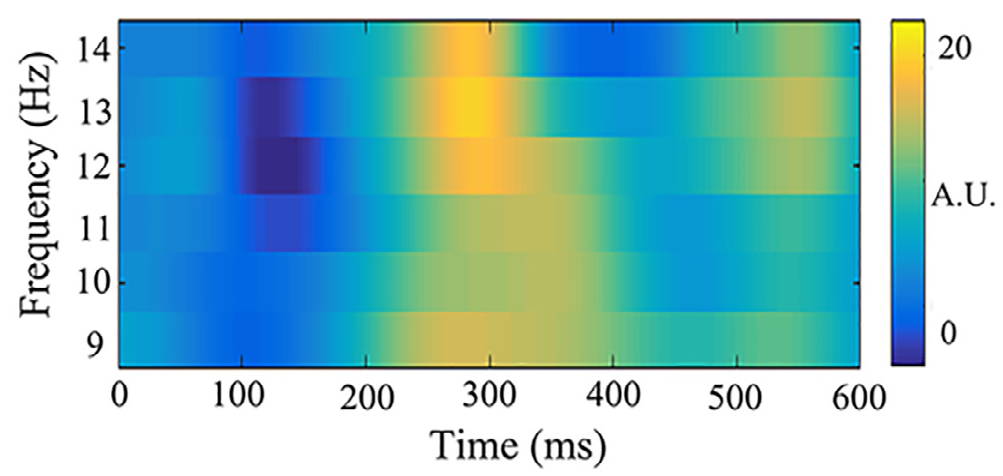 Figure 2: Topographies and source localization showing the Race × Expression interaction in alpha power.
Two Distinct Brain Paths
The study found a striking split in how the brain reacts:
1. Same-Race (SR) Pain: The "Cognitive-Affective" Path
When participants saw Asian faces in pain:
- Alpha Synchronization occurred in the Precuneus, TPJ (Temporoparietal Junction), and Left AI (Anterior Insula).
- Insight: This suggests the brain is engaging in "mentalizing"—trying to understand the internal state of the person—and experiencing high emotional arousal.
2. Other-Race (OR) Pain: The "Sensorimotor" Path
When participants saw White faces in pain:
- Alpha Desynchronization (Suppression) occurred in the Sensorimotor cortex.
- Insight: The brain is physically mimicking the facial muscle movement (motor resonance) but is failing to translate that into deep affective or cognitive empathy.
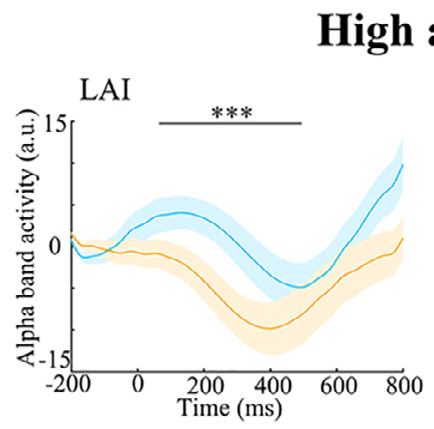 Figure 4: Time courses showing the decrease in alpha power (desynchronization) for Other-Race pain in sensorimotor and insular regions.
The "Disconnect" that Predicts Bias
One of the most profound findings was the Functional Connectivity analysis. In the case of Other-Race faces, the "coupling" or communication between the sensory-motor cortex and the affective center (Anterior Insula) was significantly weakened.
Crucially, the weaker this specific connection was, the less "unpleasant" the participant reported feeling while watching the other-race individual suffer. This suggests that racial bias isn't just a failure of the "empathy center" but a failure of the brain's "wiring" to integrate sensory information into an emotional experience.
Deep Insight & Future Implications
The study demonstrates that racial bias in social behavior (like the clinical undertreatment of pain in minorities) has deep, early-stage roots in neural dynamics.
- The Paradox of Mimicry: Interestingly, we still "mimic" other-race pain (sensorimotor desynchronization), but we don't "feel" it cognitively or affectively (missing alpha synchronization).
- Implicit Attitudes: The study found that even if a person claims not to be biased, their Implicit Association Test (IAT) scores predicted their neural synchronization patterns.
Conclusion
As we move toward a more globalized society, understanding these "hidden" neural pivots is essential. If the bias is a matter of connectivity, perhaps the solution isn't just "trying to be nicer," but engaging in interventions that specifically foster cognitive perspective-taking (TPJ) and affective connection (AI) across racial lines.