
DiffNet: Deepening Social Recommendation via Recursive Influence Diffusion
A Neural Influence Diffusion Model for Social Recommendation
The paper introduces DiffNet, a deep influence diffusion neural network for social recommendation. It leverages a Layer-wise Influence Propagation structure based on Graph Convolutional Networks (GCN) to model how user interests evolve through recursive social diffusion, achieving a performance boost of over 13% compared to state-of-the-art baselines.
TL;DR
While most social recommenders only look at your immediate friends, DiffNet recognizes that influence is a "ripple effect." By using a multi-layer Graph Convolutional architecture, it simulates how preferences diffuse through an entire social network, resulting in a significant 13-15% accuracy jump over prior SOTA models like TrustSVD.
Context: The Static Limitation of Social Recommenders
Classical Collaborative Filtering (CF) suffers from the "Cold Start" and "Data Sparsity" problems—if a user hasn't interacted with many items, the model can't guess their taste. Social recommendation was born to fix this by assuming you like what your friends like.
However, the authors of DiffNet identify a fundamental flaw: Social influence is recursive, not static. Influence doesn't just jump from Friend A to You; it flows from Friend C to Friend B to Friend A, and then to You. Existing models mostly treated social links as a simple regularization term or a one-step auxiliary input, missing the deeper "diffusion" happening in the global social manifold.
Methodology: Simulating the Diffusion Ripple
DiffNet's core innovation is its Layer-wise Influence Diffusion architecture, designed to mimic the recursive evolution of user interests.
1. The Fusion Layer (The Starting Point)
Before diffusion begins, the model must understand the "initial state" of a user. It fuses two types of information:
- Free Latent Vectors: Captured from historical user-item interactions (collaborative signal).
- Attribute Features: Features from user profiles or item descriptions (content signal).
2. Recursive Diffusion Layers (The Engine)
This is where the GCN-like logic kicks in. For every layer , a user’s embedding is updated by:
- Aggregation: Pooling the embeddings of all trusted neighbors from the previous layer .
- Combination: Merging the neighbor influence with the user's own previous state through a non-linear neural network.
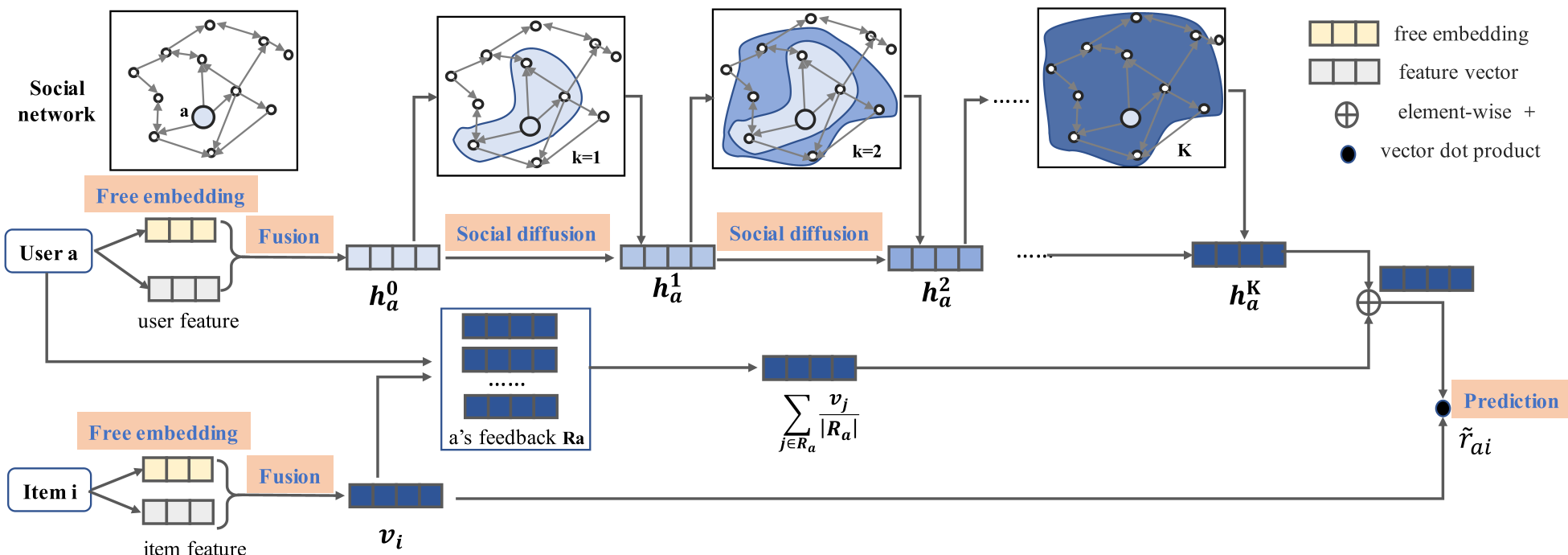 Figure 1: The DiffNet architecture, showing the transition from initial fusion to multi-layered social diffusion.
Experiments: Why "Depth" Matters
The researchers tested DiffNet on Yelp and Flickr. The results were conclusive: recursive modeling wins.
Key Insights from Results:
- Optimal Depth (): Interestingly, performance peaks at 2 layers. This aligns with the "six degrees of separation" logic—going too deep (e.g., ) introduces noise from distant users who share no real correlation with the target user.
- Superiority in Sparsity: DiffNet showed its greatest strength when users had very few ratings, proving that social diffusion is a powerful "imputer" for missing behavioral data.
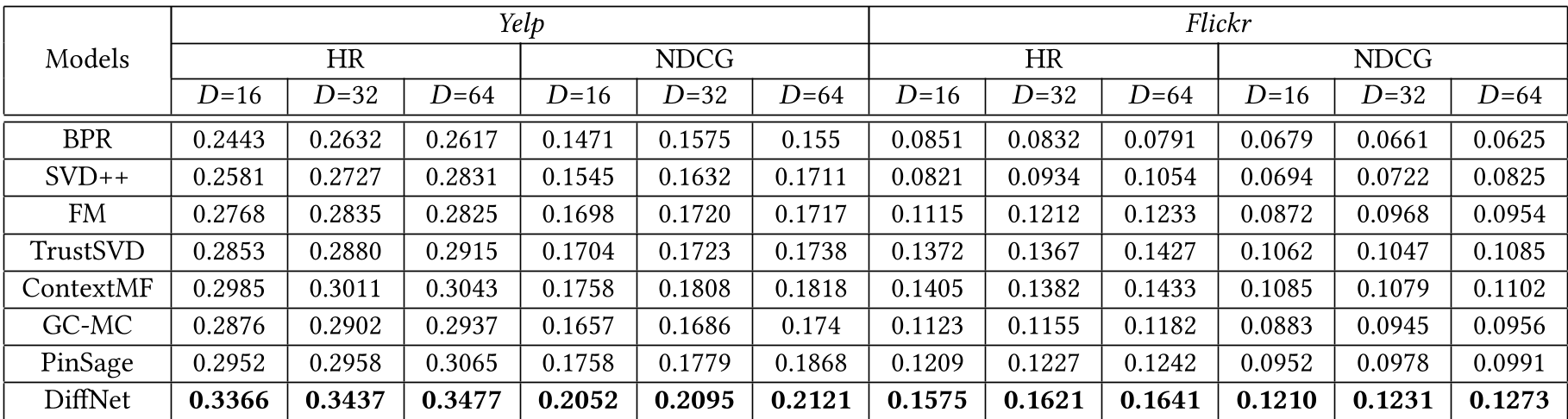 Table 1: DiffNet consistently outperforms BPR, FM, and even other GCN-based models like PinSage across all metrics.
Critical Insight: Collaborative vs. Social
One of the most striking findings in the ablation study was the role of Free Embeddings ( and ). When the authors removed the free user/item latent vectors and relied solely on features, performance plummeted by nearly 80% on Flickr.
This proves an essential academic point: Features are not a substitute for collaborative signals. Even in a social-heavy model, the underlying "collaborative effect" (who interacted with what) remains the bedrock of recommendation accuracy.
Conclusion & Future Outlook
DiffNet successfully bridges the gap between Social Influence Theory and Graph Neural Networks. By treating social networks as a medium for latent interest diffusion rather than just a static graph of neighbors, it provides a more biologically and sociologically plausible way to model users.
Future work in this area will likely focus on Temporal Diffusion—modeling how influence changes over time—and Attention Mechanisms to distinguish between "close friends" and "acquaintances" during the diffusion process.