
Neural Network Job-Shop Scheduler: Bridging Optimization and Heuristics
A neural network job-shop scheduler
2008-01-19
Summary
Problem
Method
Results
Takeaways
Abstract
This paper proposes a Hybrid Intelligent System for Job-Shop Scheduling (JSSP) that combines Genetic Algorithms (GA) with Artificial Neural Networks (ANN). The method uses a GA to find optimal schedules for benchmark problems, then trains a Multi-Layer Perceptron (MLP) to learn the underlying decision patterns, effectively replicating optimization performance with significantly lower computational overhead.
## TL;DR
Researchers have developed a hybrid scheduler that captures the "intelligence" of Genetic Algorithms (GA) within a Neural Network (NN). By treating scheduling as a pattern recognition task, the system achieves near-optimal makespans 3-4x better than standard industry rules, while maintaining the lightning-fast execution speed required for real-time manufacturing.
## The Core Challenge: Speed vs. Quality
The Job-Shop Scheduling Problem (JSSP) is notoriously NP-hard. In an $n imes m$ shop, the search space of possible schedules $(n!)^m$ is astronomically large.
* **Optimization Search (GA, Tabu Search):** Delivers great results but is slow and "black-box"—it doesn't tell us *why* a sequence works.
* **Dispatching Rules (SPT, FCFS):** Fast and simple, but often lead to inefficient machine utilization and bottlenecks.
The authors' insight was: **If a GA can find an optimal path, an ANN can learn the "intuition" behind that path.**
## Methodology: Learning from the Masters
The workflow consists of extracting knowledge from 1,147 optimal solutions of the famous **ft06** (Fisher and Thompson) benchmark.
### 1. Feature Engineering
Instead of raw data, they used domain-specific attributes to represent each operation:
* **Operation Sequence:** Where it stands in the job (First, Middle, Last).
* **Remaining Time:** Total work left for that job.
* **Machine Load:** Identifying potential bottlenecks (Light vs. Heavy).
### 2. The Model Architecture
The system uses a 12-12-10-6 Multi-Layer Perceptron. It doesn't just output a single number; it classifies operations into **Priority Classes** (0 to 5), representing their ideal position in the processing sequence.

## Performance and Generalization
The true test of a scheduler is not just solving the problem it was trained on, but generalizing to new, larger problems.
### Benchmark Success
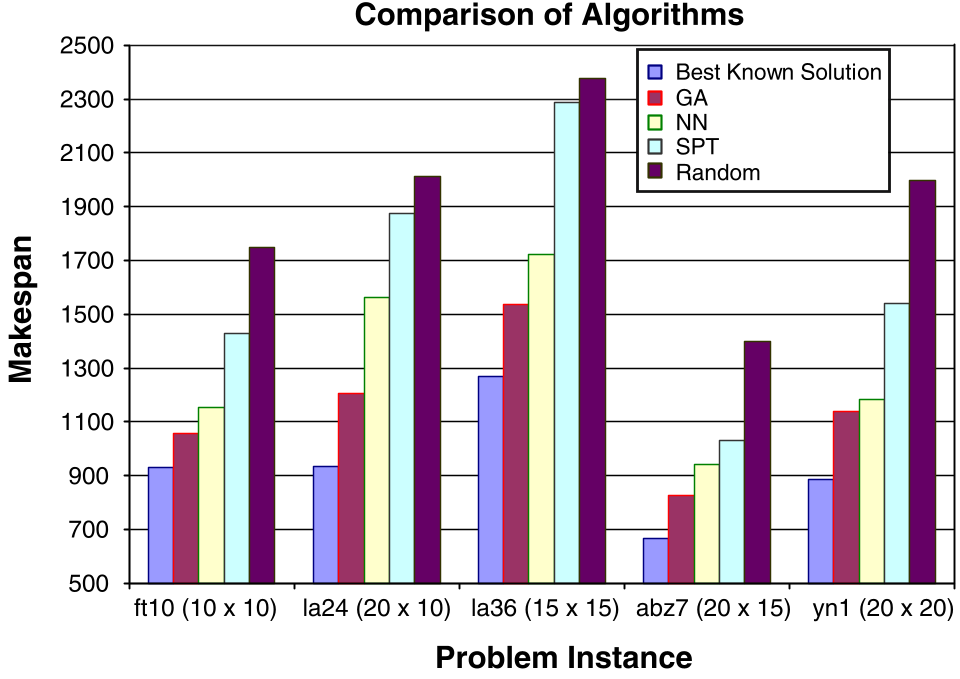
On the original ft06 problem, the NN achieved a makespan of **59**, compared to the optimum **55**. This outperformed every other heuristic tested, including Attribute-Oriented Induction (AOI) and standard priority rules.

### Scaling Up
When tested on larger instances like **abz7** (300 operations) and **yn1** (400 operations), the NN remained robust. While the Shortest Processing Time (SPT) rule saw its error margin explode to 41.56% deviation from GA, the NN stayed within ~13.8%.
## Critical Insights & Analysis
* **Noise in the Data:** The authors noted that the GA often assigns different priorities to the same operation in different "equally optimal" schedules. This creates "label noise," yet the NN was robust enough to find the underlying trend.
* **Size-Invariance:** The most significant finding is that the logic of a small 6x6 shop scales. The features (like Machine Load) are relative, allowing the NN to maintain its inductive bias even as the number of machines increases.
## Conclusion
This research proves that Neural Networks are not just for image recognition or NLP; they can act as high-speed "approximators" for complex combinatorial optimization. For industrial settings where schedules must be recalculated every few minutes due to floor changes, this NN-hybrid approach offers a "best of both worlds" solution: the speed of a rule and the brain of an optimizer.
**Limitations:** The model currently relies on a static classification range. Future iterations could benefit from **Reinforcement Learning**, where the NN learns directly from the makespan reward rather than just mimicking a Genetic Algorithm.