
Neural SSVD++: Bridging Social Context and Deep Learning for Enhanced Recommendations
A Neural Network Model for Social-Aware Recommendation
This paper introduces Neural SSVD++, a social-aware recommender system that integrates social network information into a neural network framework. By extending the classical SVD++ model, it treats social connections as implicit feedback and utilizes multi-layer perceptrons to capture non-linear interactions between users, items, and their social circles, achieving SOTA performance in rating prediction.
TL;DR
Neural SSVD++ is a hybrid recommendation model that fuses the classic SVD++ architecture with the non-linear expressive power of Neural Networks. By re-imagining social connections as a form of "implicit feedback," this model delivers significant accuracy gains (up to 15% MAE improvement) and robustly handles the notorious "cold-start" problem where users have minimal rating history.
Background & Motivation: Moving Beyond Linear Interaction
The "Homophily Effect" suggests that socially connected users likely share similar tastes. While traditional models like TrustSVD and SoRec have integrated this into Matrix Factorization, they are fundamentally limited by the linear nature of inner products.
In the real world, the relationship between a user's social circle and their preference for a specific item is complex and multi-faceted. The authors identified a significant gap: while Neural Networks (NN) were excelling in CV and NLP, their application in social-aware recommendation remained under-explored.
Methodology: The Neural SSVD++ Architecture
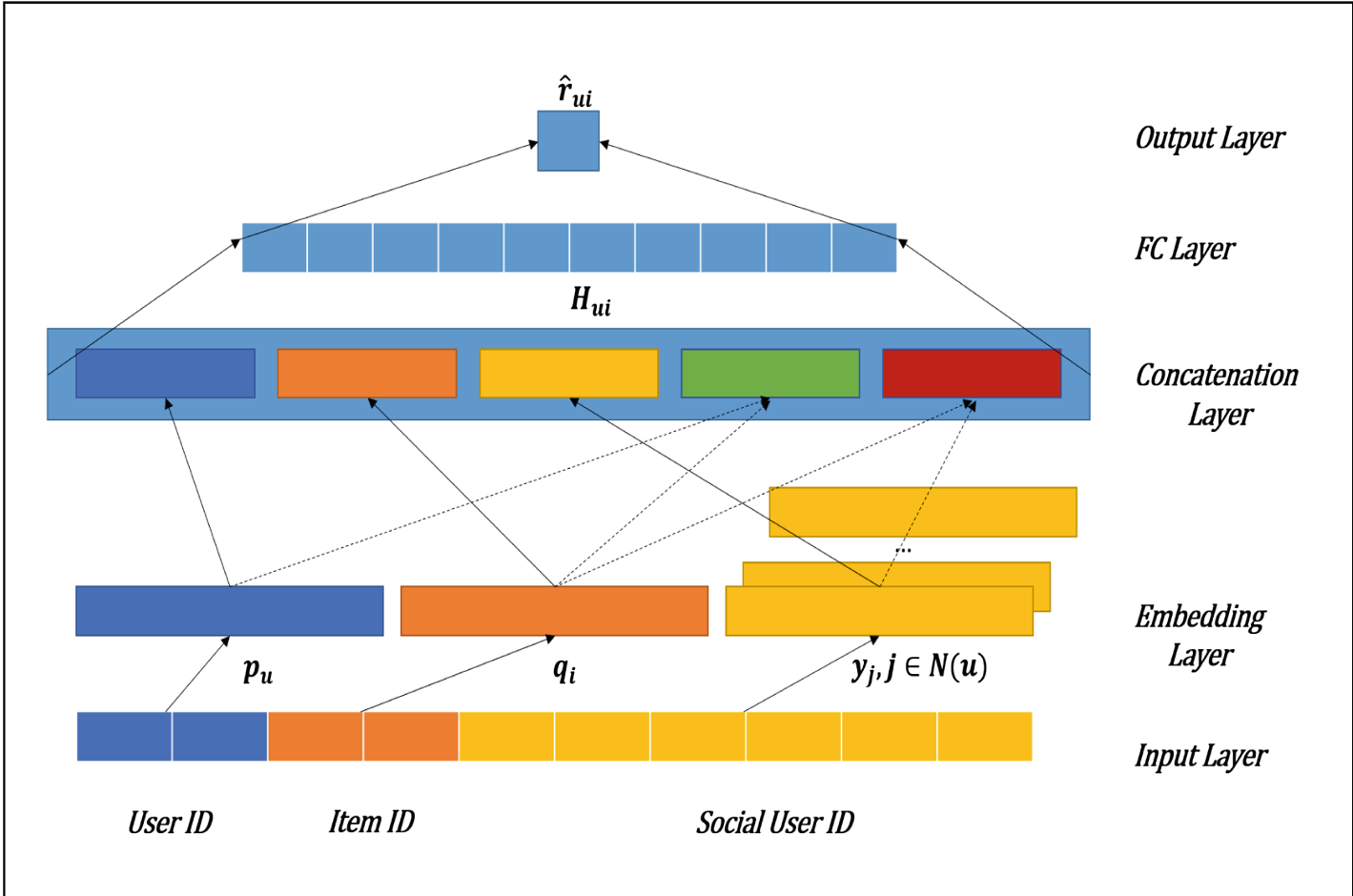
Neural SSVD++ improves upon the SVD++ logic by treating the set of social friends as implicit indicators of interest.
1. Vector Embedding & Social Pooling
Users, items, and friends are mapped into dense latent vectors (). Instead of just summing social vectors, the model averages the embeddings of all users socially connected to the target user, creating a concentrated "social influence" vector.
2. Interaction Layer
The core innovation lies in how these vectors interact. The model doesn't just concatenate; it uses element-wise products () to explicitly model:
- User-Item Interaction:
- Social-Item Interaction:
3. Non-linear Deep Mapping
These interaction vectors are fed into a series of Fully Connected (FC) layers with ReLU activations. This allows the model to learn complex, non-linear mapping functions that simple Matrix Factorization cannot capture.
Experimental Insights
The model was validated on the Ciao and Epinions datasets.
Key Performance Metrics:
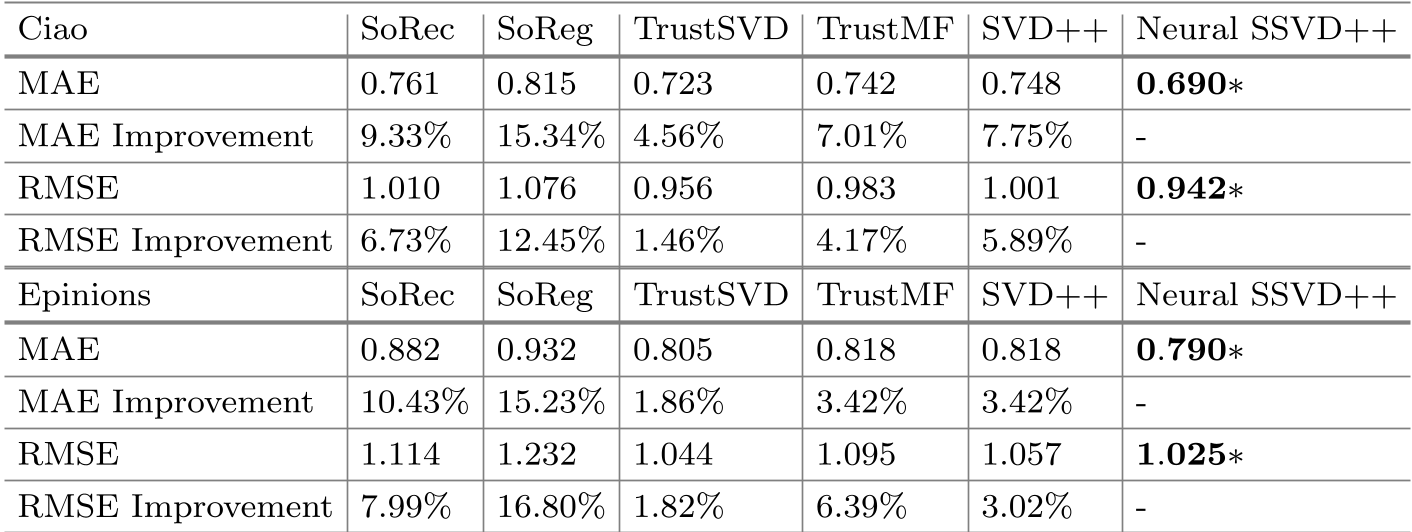
- Superior Accuracy: Neural SSVD++ consistently achieved the lowest MAE and RMSE across both datasets compared to strong baselines like TrustSVD and TrustMF.
- Solving Cold-Start: For users with fewer than 5 ratings, the model showed a marked advantage. The social stream acts as a fallback signal, providing enough context to make accurate predictions even when user-specific data is nearly non-existent.
The "Paradox" of Depth and Width
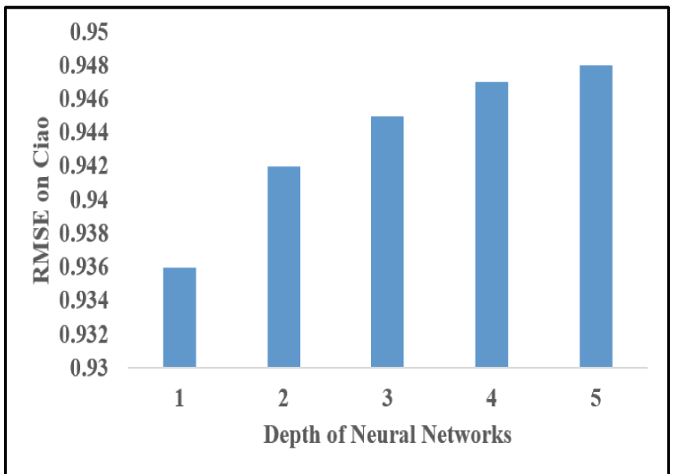
Counter-intuitively, the study found that deeper networks do not always perform better (Fig. 2 in the paper). Increasing the FC layers from 1 to 5 actually led to a slight increase in RMSE, likely due to overfitting on the sparse rating data. Similarly, embedding dimensions reached a point of diminishing returns around 64-128.
Critical Analysis & Future Outlook
Neural SSVD++ successfully proves that neural architectures are highly compatible with social-aware tasks. However, its current limitation lies in the "Social Pooling" method—it treats all friends equally by simply averaging their vectors.
Future Directions:
- Attention Mechanisms: Implementing attention to weigh friends' influences differently (e.g., distinguishing "best friends" from "acquaintances").
- Graph Dynamics: Using Graph Convolutional Networks (GCNs) to capture the recursive structure of social networks, rather than just immediate neighbors.
Conclusion
By harmonizing the structural framework of SVD++ with the non-linear capacity of deep learning, this work provides a blueprint for next-generation recommendation engines that are more human-centric and context-aware.