
Enhancing Social Behavior Prediction: The Synergy of LM Neural Networks and Data Mining
Research on the prediction of user behavior based on neural network
This paper proposes a user behavior prediction model for social networks utilizing an improved Backpropagation (BP) neural network optimized by the Levenberg-Marquardt (LM) algorithm. The study integrates data mining techniques with Mini-batch Gradient Descent (MBGD) to enhance convergence speed and prediction accuracy on diversified social user data.
TL;DR
Predicting what a user will do next in a social network—whether it's checking in at a location or engaging with content—is a complex non-linear problem. This paper presents an optimized neural network approach using the Levenberg-Marquardt (LM) algorithm combined with Mini-batch Gradient Descent (MBGD). The result is a model that converges significantly faster than standard BP networks and provides highly accurate behavioral forecasts.
Motivation: Moving Beyond Intuition
In the era of Web 2.0, social network data is not just "big"; it is diversified and "dirty." Previous attempts at prediction often relied on simplistic statistical models or standard BP (Backpropagation) networks. However, standard BP is notorious for its "snail-paced" convergence and its annoying habit of getting stuck in local minima. The authors recognized that for real-time social dynamics, we need an engine that learns scientifically and converges rapidly.
Methodology: The Core Engine
The researchers didn't just use a "black box" neural network; they refined the optimization logic.
1. The LM Algorithm (The Mathematical "Sweet Spot")
The Levenberg-Marquardt algorithm is the star of the show. It sits comfortably between the Gauss-Newton method (which is fast but sometimes unstable) and the Gradient Descent method (which is stable but slow).
- By using the Jacobian matrix () to approximate the Second-order Hessian, the model gains a "sense of direction" during weight updates.
- The formula allows the model to switch between gradient descent (when is large) and Gauss-Newton (when is small), ensuring stability even when the error surface is complex.
2. Model Architecture and Training
The workflow follows a rigorous pipeline:
- Data Preprocessing: Cleaning "dirty data" from social warehouses and normalizing user UIDs, timestamps, and geolocation sessions.
- Mini-batch SGD: Instead of updating weights for every single data point (too noisy) or the entire dataset (too slow), the authors used small batches to calculate an average gradient, stabilizing the learning process.
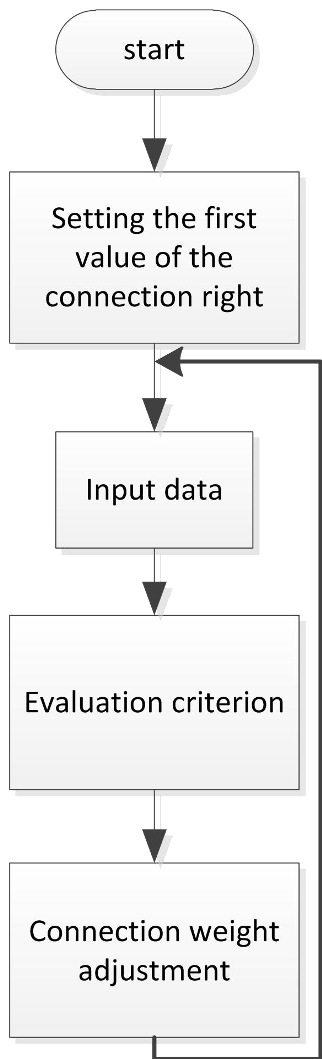 Figure 1: The iterative learning process from input patterns to weight adjustment.
Experiments and Results
The model was validated using K-fold cross-validation on social user data (check-ins, access addresses, etc.). The primary metrics were accuracy and ROC (Receiver Operating Characteristic) curves.
- Convergence: The LM method proved to be dozens of times faster than traditional BP.
- Accuracy: The ROC curves (Figure 5 and 6) indicate a high true-positive rate, suggesting that the model successfully captured the non-linear relationship between historical behavior and future actions.
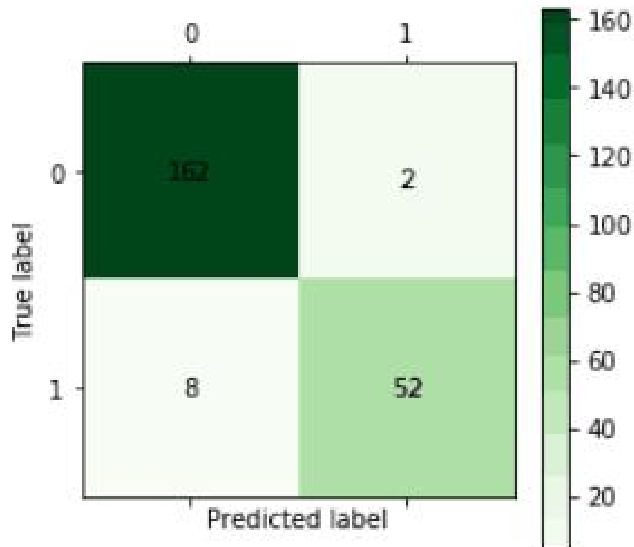 Figure 2: Performance metrics showing the accuracy of the prediction results.
Critical Insight & Future Outlook
While the LM neural network is a powerful "optimizer," the paper honestly notes a critical challenge: Feature Engineering. No matter how good the algorithm is, if the "feature engineering" isn't robust, the model will struggle.
Takeaway for Practitioners: If you are dealing with medium-sized, highly non-linear datasets where convergence speed is a bottleneck, the LM algorithm is a vastly underutilized alternative to standard SGD-based optimizers like Adam. However, for massive-scale social graphs, one might need to evolve this approach into Graph Neural Networks (GNNs) to capture the structural "connections" between users more effectively.
Conclusion
This research bridges the gap between raw social data mining and advanced neural optimization. By refining the "how" of the learning process (via LM and MBGD), the authors provide a template for more scientific and efficient user behavior forecasting.