
Combining Neural Networks and Pattern Matching: A Meta-Learning Approach to Ontology Mining
Combining Neural Networks and Pattern Matching for Ontology Mining - a Meta Learning Inspired Approach
The paper introduces a two-tier meta-learning inspired framework for ontology mining, combining pattern-matching with Recurrent Neural Networks (RNN-GRU). The method, which validates category membership for arbitrary phrases, achieves state-of-the-art performance in open-domain question answering, outperforming traditional knowledge-base methods in coverage.
TL;DR
Researchers have developed a two-tier system that bridges the gap between rigid, high-precision pattern matching and the flexible learning capabilities of Recurrent Neural Networks (RNNs). By using pattern matching to generate "seed" examples on the fly, the system trains category-specific models that can verify membership in virtually any arbitrary category—even complex ones like "Ridley Scott movie"—with 73% accuracy in Question Answering tasks.
Context & Positioning
In the landscape of Knowledge Representation, we face a paradox: manually curated ontologies (like Freebase) are precise but incomplete, while modern word embeddings (like Word2Vec) are broad but lack the logical rigor to distinguish hypernymy ("A is a B") from mere association ("A is related to B"). This paper positions itself as a "on-demand" validator that uses raw text to solve the coverage gap in a way that traditional Knowledge Bases (KBs) cannot.
The Core Challenge: The "Long Tail" of Categories
Why do we need this? Consider the question: "What business was the source of John D. Rockefeller’s fortune?" A standard KB might know "Standard Oil" is a "Company," but it might fail if the user asks for a "City in southern Germany" or a "19th-century oil tycoon." The authors argue that most practical applications require composite categories that simply don't exist in fixed databases.
Methodology: The Two-Tier Strategy
The brilliance of this approach lies in its "Learning to Learn" (Meta-learning) philosophy. Instead of training one massive model for everything, it builds a factory that produces mini-models for specific categories.
Tier 1: The General Pattern-Matching Model
This tier acts as the "Teacher." It uses Hearst-patterns (e.g., "...such as X") and Pointwise Mutual Information (PMI) to find 10 nearly-perfect examples (seeds) for a new category. It prioritizes Precision over Recall—it doesn't care if it misses 99% of "movies," as long as the 10 it finds are definitely movies.
Tier 2: The Category-Specific RNN
This tier acts as the "Student." Once it receives the seeds, it fetches raw text segments from the web where these seeds appear. A Gated Recurrent Unit (GRU) is then trained to distinguish these segments from noise.
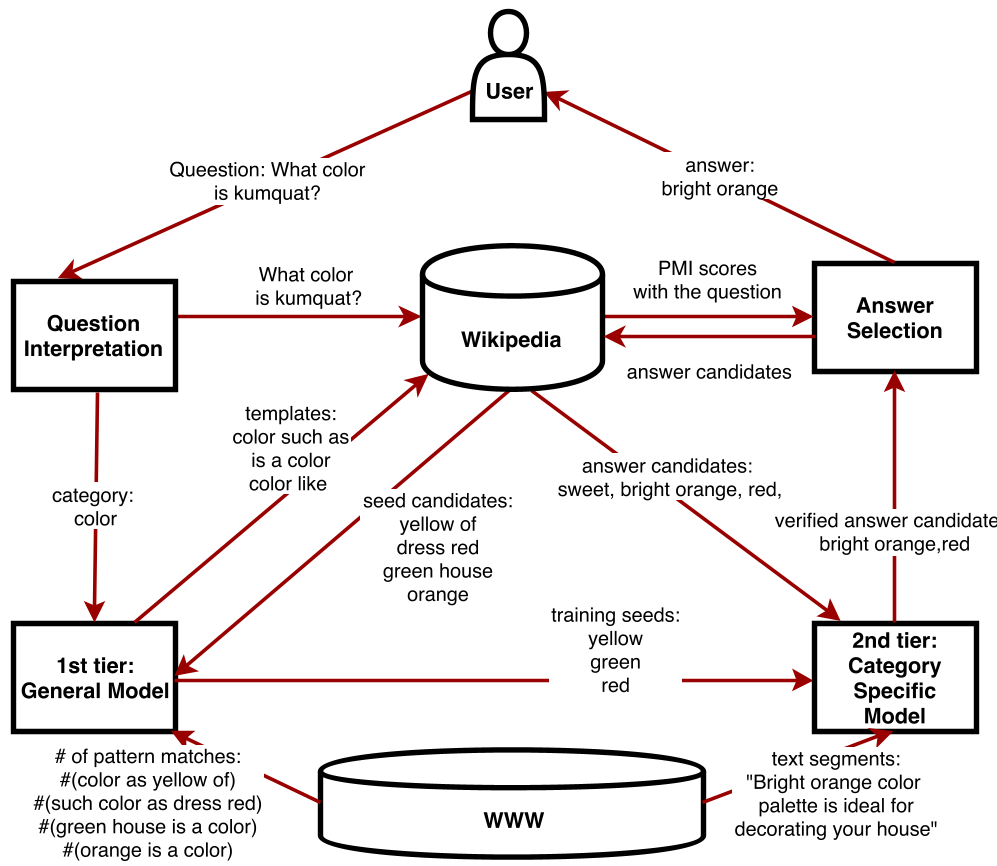 Figure 1: The architecture shows how a specific question triggers the generation of seeds to train a temporary, highly specialized neural classifier.
Experimental Breakthroughs
The authors tested this against traditional KBs and previous SOTA models. The results were telling:
- Coverage is King: While Freebase only covered 26% of the categories found in real-world questions, this two-tier model covered 100%.
- Performance: The system achieved 73% accuracy, significantly outperforming NELL (22%) and MCG (17%) in direct QA comparisons.
| Model | Category Coverage | Answer Accuracy |
|---|---|---|
| Full Configuration (Two-Tier) | 100% | 73% |
| General Model Only | 100% | 49% |
| Freebase | 26% | 24% |
| NELL | 36% | 22% |
Critical Insight: Why Does the Hybrid Work?
Traditional neural networks often "hallucinate" or over-generalize. By grounding the RNN in a pattern-matching tier, the authors provide the network with a high-fidelity "anchor." The RNN's ability to learn "soft" templates allows it to recognize valid category members even when they don't appear in a standard "X is a Y" sentence structure—it learns the contextual flavor of the category.
Conclusion and Future Outlook
This work proves that raw text is a viable substitute for formal ontologies in complex NLP tasks. The fact that the model performs best when it has access to more web data suggests that as we scale our validation corpora, the need for manual knowledge engineering will continue to diminish.
The main limitation remains the reliance on external search engines for text segments. Future iterations could integrate these "Verification Tiers" directly into LLM architectures to verify facts in real-time, effectively serving as an automated "Common Sense" checker.