
Neural Networks for Twitter Sentiment: From Bag-of-Words to Feedforward Architectures
Neural networks for sentiment analysis on Twitter
This paper explores the application of a MATLAB-based feedforward pattern neural network for sentiment classification (positive vs. negative) on Twitter data. By employing standard NLP preprocessing—specifically tokenization, Porter's stemming, and stop-word removal—the authors convert tweets into numerical vectors for binary classification.
TL;DR
This research investigates the efficacy of a feedforward pattern network for classifying the sentiment of tweets. By tackling the inherent "noise" of Twitter data through a rigorous preprocessing pipeline—including tokenization and Porter's stemming—the authors achieved roughly 74% accuracy. However, the study serves as a crucial case study in the limitations of traditional neural networks, particularly regarding memory constraints and the pitfalls of linear dimensionality reduction like PCA in NLP.
Context & Positioning
In the landscape of 2015-era NLP, this work sits between traditional machine learning (Naive Bayes, SVM) and the then-emerging trend of Deep Learning. It moves away from the static "Bag-of-Words" (BoW) model toward a more dynamic neural approach, though it still relies on a vectorization method that is structurally similar to BoW.
The Bottleneck: Why This is Hard
Twitter sentiment analysis is notoriously difficult because of:
- Informality: Slang, misspellings, and character limits break standard grammatical rules.
- Negation: Traditional models often ignore word order, failing to realize that "not good" is the opposite of "good."
- Dimensionality: Every unique word becomes a feature. In a large corpus, this creates a "feature explosion" that can exhaust system memory.
Methodology: The Neural Mapping Approach
The authors utilized a Feedforward Pattern Network via MATLAB. The core of their methodology involves a rigorous transition from raw text to a numerical matrix:
- Preprocessing: Stripping punctuation, mentions (@user), and stop words.
- Porter's Stemming: Reducing words like "waiting" and "waited" to "wait" to shrink the feature space.
- Vocabulary Mapping: Creating a unique dictionary where each word corresponds to a specific index.
- Vectorization: Converting a tweet into a binary vector (1 if a word is present, 0 if not).
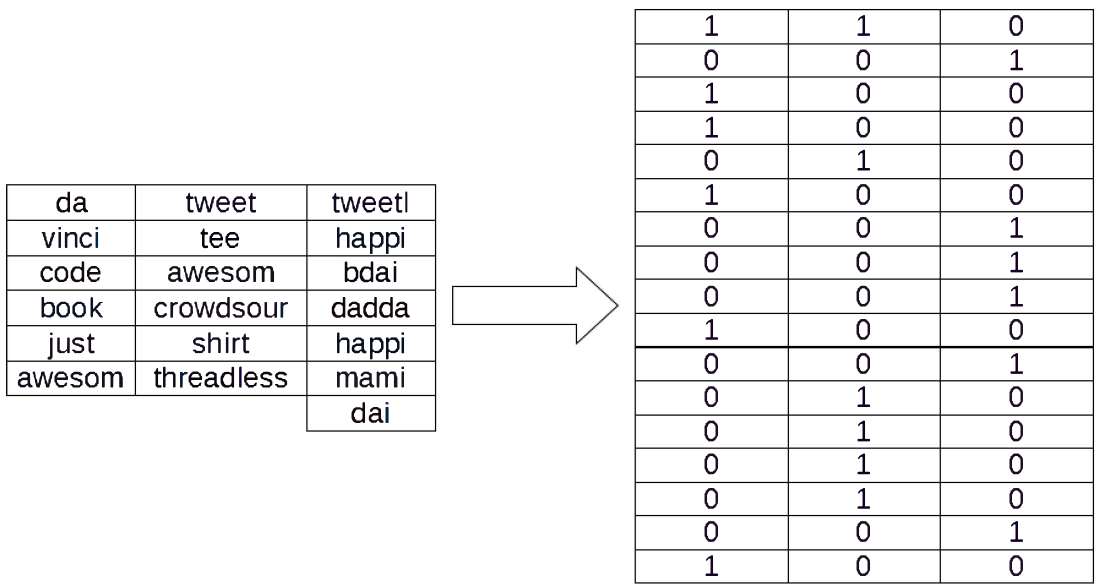 Fig 1. Visual representation of how tweets are mapped into numerical vectors for the input layer.
Experiments and Key Findings
The researchers conducted two primary experiments to test the limits of their architecture:
- The Baseline Test: Using 200 tweets (100 positive, 100 negative), the model yielded a 74.15% accuracy. This demonstrates that even a simple neural network can outperform random guessing in sentiment polarity.
- The PCA Failure: Interestingly, when the authors used Principal Component Analysis (PCA) to reduce the features from 288 to 50 (trying to save memory), the accuracy crashed to 31.04%.
| Method | Accuracy |
|---|---|
| Feedforward (288 features) | 74.15% |
| Feedforward + PCA (50 features) | 31.04% |
This suggests that in short-text environments like Twitter, even "minor" words (the variance captured by lower-ranked principal components) are vital for sentiment context.
Critical Analysis & Professional Insights
As an academic editor, I find the PCA failure to be the most significant takeaway. In many fields, PCA is a "silver bullet" for noise reduction. In NLP, however, this paper proves that linear compression can destroy the sparse signals required for sentiment detection.
Limitations:
- Memory Wall: The authors noted that significantly increasing the tweet count resulted in memory errors. This is a direct consequence of using a "one-hot" style input vector rather than dense word embeddings (like Word2Vec).
- Context Blindness: While better than BoV, a feedforward network with a single hidden layer still struggles with long-range dependencies and complex sarcasm.
The Path Forward
The authors suggest that future work should focus on Recurrent Neural Networks (RNNs) and Recursive Neural Tensor Networks. These architectures are better suited for "structured" data where the sequence of words provides the primary meaning, rather than just the presence of the words themselves. Additionally, incorporating emoticons as distinct features—rather than stripping them as symbols—could provide a massive boost in sentiment signal-to-noise ratio.