
Neural Weight Norm = Kolmogorov Complexity: Why Weight Decay is Optimal Induction
Neural Weight Norm = Kolmogorov Complexity
The paper proves that in a fixed-precision regime, the minimum weight norm of a looped neural network is equivalent to the Kolmogorov complexity of its output string, up to a logarithmic factor. This establishes a formal link between weight decay and Solomonoff’s universal prior, positioning standard regularization as an approximation of the optimal Bayesian inductive bias.
TL;DR
Why does regularization (weight decay) work so well? A new paper from ETH Zürich provides a profound answer: in any fixed-precision system, the weight norm of a network is essentially the Kolmogorov complexity of the data it generates. This means every time you use weight decay, you are performing a computable version of Solomonoff Induction—the theoretical "gold standard" for Bayesian prediction.
Background: The Mystery of Regularization
For decades, deep learning has relied on weight decay to prevent overfitting. Yet, our standard toolkit of learning theory (VC dimension, Rademacher complexity) is remarkably bad at explaining why. These theories focus on the "size" of the function class, but the same network architecture can generalize on real data while perfectly memorizing random labels.
The author, Tiberiu Musat, argues that we should stop looking at function classes and start looking at Description Length.
The "Insight": The Fixed-Precision Collapse
The paper's breakthrough rests on one key observation: Fixed Precision. While theoretical AI often assumes infinite precision (real numbers), actual hardware uses fp16, int8, or bf16.
In this discrete world, all norms (whether or ) collapse into the same thing: a count of non-zero parameters. This "collapse" allows the author to bridge the gap between continuous math (calculus/GD) and discrete math (Turing machines).
Methodology: The Sandwich Bound
The core of the paper is the Main Theorem, which "sandwiches" Kolmogorov complexity between two bounds of neural complexity :
- Lower Bound (Programs → Networks): Any computer program of length can be embedded into a neural network using roughly weights.
- Upper Bound (Networks → Programs): Any network with non-zero weights can be described as a program of length .
 The fundamental relationship: Neural Complexity effectively tracks Algorithmic Complexity.
The Logarithmic Factor is Real
The factor isn't just a mathematical artifact. The author proves it is tight using the "Permutation Example." If a network encodes a permutation, it uses parameters to identify one out of possibilities. Since , the network is "using" that log factor to store structural information in the positions of its weights.
Experiments & Theoretical Implications
By bridging these worlds, the paper derives several heavy-hitting conclusions:
- Solomonoff Matching: The prior induced by weight decay is a polynomial-factor approximation of Solomonoff’s Universal Prior.
- Quantization strengthens the bias: Deeply quantized networks (like 4-bit) implement this "Universal Induction" more directly than full-precision models.
- Generalization Bounds: The author derives a new MDL-style generalization bound where the penalty is .
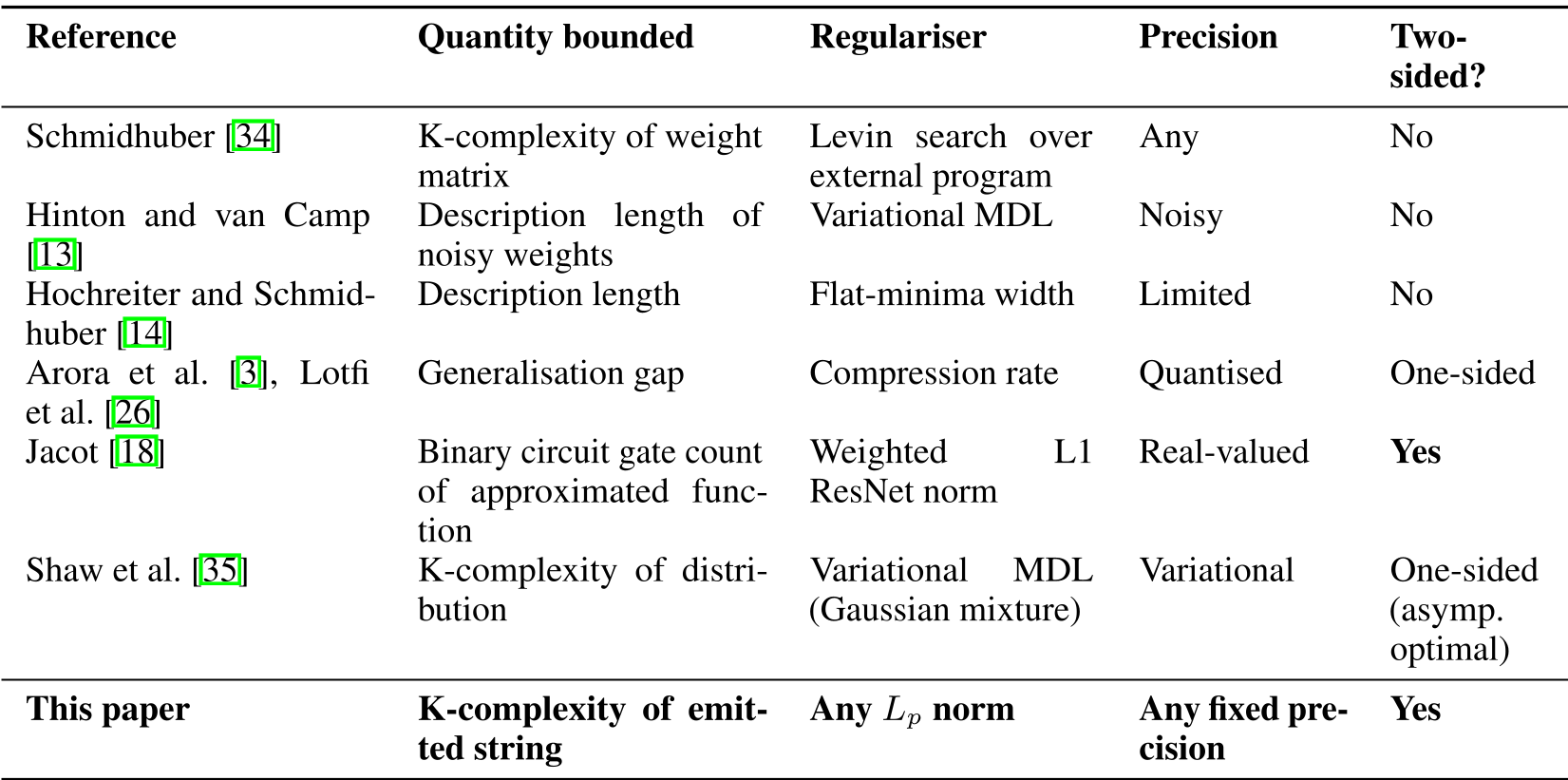 How this work compares to legends like Schmidhuber and Hinton. This paper is unique in providing a two-sided bound for any norm in fixed-precision.
Critical Analysis & Takeaways
Limitations
- Asymptotic Constants: The proof works for large , but the "constants" involved in building a Universal Turing Machine inside a Transformer are likely huge.
- No Empirical Validation: This is a pure theory paper. While it makes testable predictions (e.g., "simple data benefits more from weight decay"), it doesn't run them on ImageNet.
Conclusion
This work elevates weight decay from a "trick to keep weights small" to a fundamental law of information. It suggests that the success of modern Transformers is due to the fact that their training dynamics are implicitly searching for the shortest possible program to explain the data.
If you are training a model today with regularization, you aren't just doing "optimization"—you are performing algorithmic induction.