
Bridging Regulated Logic and AI: Optimized Neural Networks for Medical Claim Adjudication
11691_Neuro-fuzzy CBR hybridization Healthcare application.
The paper introduces an intelligent system designed for medical claim adjudication and fraud detection by combining XML-based rule engines with Neural Networks. The core methodology focuses on optimizing the Hidden Layer Nodes (HLN) in a feed-forward neural network to accurately predict payment results and classify billing anomalies.
TL;DR
This research addresses the complexity of medical claim processing by integrating XML-structured business rules with optimized Neural Networks. By re-evaluating the "Hidden Layer Node" (HLN) selection, the authors achieved a 100% accuracy rate in processing structured medical claims, outperforming traditional heuristic-based configurations.
Background & Motivation: The Chaos of Healthcare Billing
The medical billing industry operates on a massive scale, yet it is plagued by manual errors and fraud. Traditional systems use complex IF-THEN logic (as seen in the provided XML snippets), which are difficult to maintain and scale. While AI seems like a natural fit, applying standard Neural Networks to structured, rule-heavy data often fails because the models are either too simple to capture the logic or too complex to generalize.
The motivation here is clear: How do we map the rigid logic of a billing rule into a flexible, learning-capable neural architecture without losing accuracy?
Methodology: From XML Rules to Neural Optimization
The authors utilize a structured XML schema to represent claims and adjudication rules. This ensures data integrity for attributes like PROCEDURE_CODE and BILLED_CHARGE.
The Core Insight: HLN Tuning
The critical technical contribution lies in the empirical study of the Hidden Layer. The internal architecture of the network is determined by the relationship between:
- ILN: Input Layer Nodes (Features like PIN, Year of Service, etc.)
- OLN: Output Layer Nodes (Payment Result)
- HLN: Hidden Layer Nodes
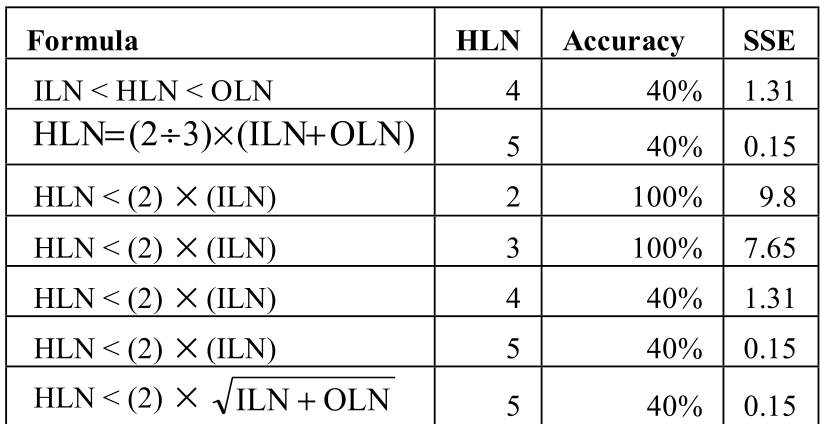
Instead of relying on a "black box" approach, the authors tested various formulas to find the "sweet spot" for neural complexity.
Experimental Analysis: Precision vs. Generalization
The results highlight a stark contrast in performance based on the network's internal structure. In the claim validation task, the study found that:
- Heuristic Success: Formulas like
HLN < (2) * (ILN)achieved 100% accuracy, proving that for structured medical logic, a slightly wider hidden layer is essential to capture the non-linear relationships between billing codes and charges. - Failure of Common Ratios: The commonly used formula
HLN = (2/3) * (ILN+OLN)performed poorly, yielding only 40% accuracy, which would be catastrophic in a real-world financial environment.
Deep Insight & Conclusion
This work demonstrates that "Deep Learning" isn't always about "Deep." In domains like healthcare claim adjudication, where inputs are structured and logic is deterministic but highly conditional, the precision of the hidden layer width is more important than the depth of the network.
Limitations & Future Work
While the accuracy on the test set is impressive, the research relies on a relatively structured XML-to-Neural mapping. In the future, incorporating Unstructured Data (such as doctor's notes or clinical reports) via Natural Language Processing (NLP) alongside this rule-based neural engine will be the next frontier in total claim automation.
Takeaway for the Industry: For AI in FinTech or HealthTech, start with the rules (XML) and use Neural Networks to solve the "fuzzy" edge cases within those rules, rather than replacing the rules entirely.