
NHAD: Taming the Silent Saboteurs—Horizontal Anomaly Detection via Neuro-Fuzzy Logic
NHAD: Neuro-Fuzzy Based Horizontal Anomaly Detection In Online Social Networks
The paper introduces NHAD (Neuro-Fuzzy Based Horizontal Anomaly Detection), a framework designed to identify "horizontal anomalies"—users who exhibit varying behaviors across different sources in Online Social Networks (OSNs). By integrating a self-healing neural model with a fuzzy inference system, NHAD achieves a 99.98% accuracy on benchmark datasets and real-time traffic.
TL;DR
Horizontal anomalies—users who behave like "Jekyll and Hyde" across different social network sources—are notoriously difficult to catch. The NHAD (Neuro-Fuzzy based Horizontal Anomaly Detection) model tackles this by combining the adaptive learning of neural networks with the linguistic reasoning of fuzzy logic. It achieves near-perfect detection (99.98%) while providing a unique "self-healing" mechanism to recover mistakenly flagged users.
1. The "Horizontal" Blind Spot
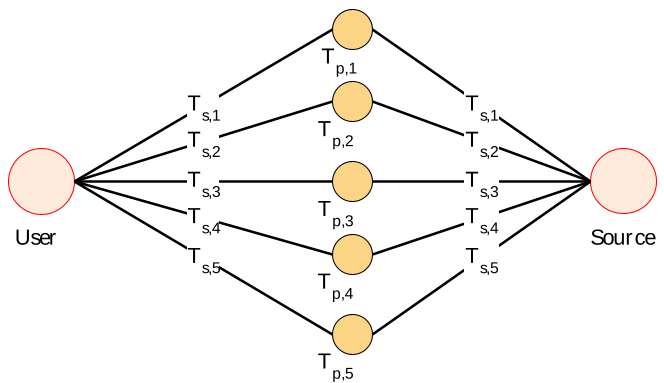
Most security systems in Online Social Networks (OSNs) are designed to spot "vertical" anomalies: a user suddenly sending a million messages or a new account acting like a bot. However, a horizontal anomaly is subtler. It occurs when a user maintains a perfect reputation with Source A but engages in malicious activity (like hit-and-run spamming or accessing unauthorized sensitive data) with Source B.
Conventional methods fail here because they often look at the average behavior or group memberships. If the average behavior is "okay," the silent attack continues.
2. Motivation: Why Neuro-Fuzzy?
The authors identified a gap: existing solutions (like SVMs or Bayesian filters) are often "detect-and-block." They don't account for the nuance of human error or temporary behavioral shifts. NHAD introduces a Self-Healing paradigm.
- Neural Network Logic: Used to manage complex interactions and learn user-weightings (reputation).
- Fuzzy Logic: Recognizes that "trust" isn't binary (0 or 1). It uses categories like low, medium, and high across paradigms like "Reputation Gain" and "Significant Difference."
3. Methodology: The Five Paradigms of Trust
NHAD operates on a reputation graph . The core of the system is the Healing Cost (), a mathematical representation of how much a user deviates from the community norm.
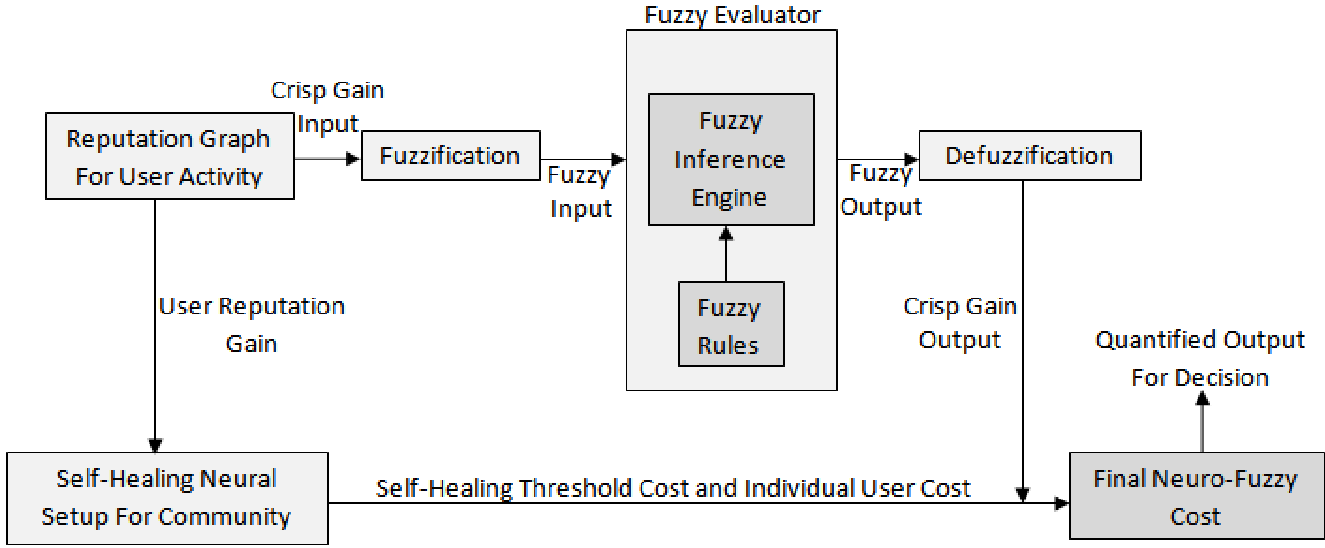
The engine processes five unique paradigms:
- Missing Links: Analyzing deliberate avoidance of specific community sources.
- Reputation Gain: Weighted sum of trust scores across 5 properties (e.g., hits on spam, use of sensitive words).
- Significant Difference: Calculating the statistical deviation () of current behavior from historical norms.
- Trust Properties: Categorizing actions (e.g., out-degree requests).
- Trust Score: Assigning membership values (0 to 1) via a Fuzzy Inference System.
4. The Self-Healing Mechanism
Unlike standard firewalls, NHAD classifies anomalies into "Hard" and "Soft."
- Hard Anomalies (): Immediate eradication. These are high-confidence malicious actors.
- Soft Anomalies (): The system issues a warning and attempts to "heal" the node by restricting specific source interactions. If the behavior persists after three iterations, the user is removed.
5. Experimental Prowess: SOTA Comparison
NHAD was tested against the DARPA’98 benchmark and real-time traffic from Thapar University.
| Approach | Detection Rate | Accuracy | False Positive Rate |
|---|---|---|---|
| Zhanchun et al. (SVM/PCA) | 92.2% | - | 2.8% |
| Ahmed & Mahmood (Co-clustering) | 99.23% | 92.82% | - |
| Proposed NHAD Model | 99.97% | 99.98% | 0.0012% |
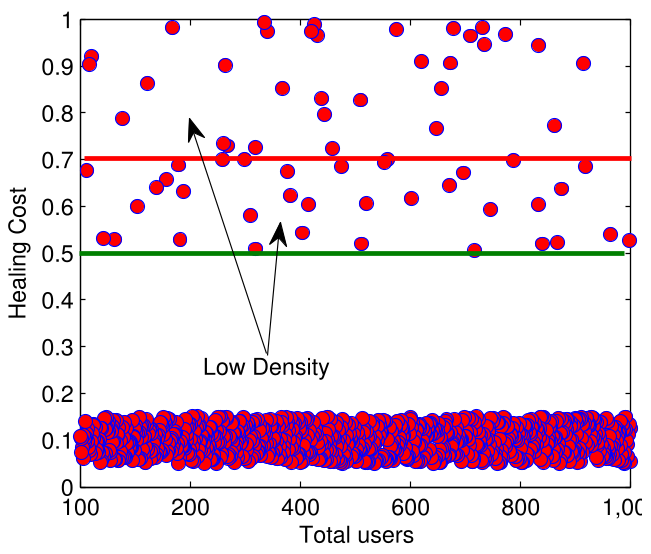 Visualizing "Safe" (0.5) vs "Recoverable" (0.7) thresholds in a simulated community of 1,000 users.
6. Critical Analysis & Future Outlook
Strengths:
- Zero-False-Positive Ambition: The 0.0012% false positive rate is exceptional for high-traffic OSNs.
- Scalability: The computational complexity is dominated by reputation graph formation , which remains efficient for up to 100,000 users.
Limitations:
- Cold Start: The fuzzy rules are currently set empirically. A fully autonomous system would need Reinforcement Learning to tune these rules dynamically as new attack vectors emerge.
Final Takeaway: NHAD proves that "Trust" is the most valuable metric in social networks. By treating anomalies as behaviors to be managed rather than just bits to be blocked, we move closer to a resilient, self-correcting digital society.