
Neurotechnology & AI: Decoding Early Dementia via EEG Signal Complexity
Neurotechnology and AI Approach for Early Dementia Onset Biomarker from EEG in Emotional Stimulus Evaluation Task
The paper introduces a digital dementia biomarker system for early onset prediction using portable EEG wearables and AI. The method utilizes Multifractal Detrended Fluctuation Analysis (MFDFA) to extract signal complexity features, achieving a median classification accuracy of over 90% for discriminating Mild Cognitive Impairment (MCI) from normal cognition.
TL;DR
Researchers have developed a highly portable "digital biomarker" for early dementia by combining consumer-grade EEG wearables with advanced non-linear signal analysis (MFDFA). By testing elderly participants on emotional memory tasks, the system achieved over 90% accuracy in distinguishing Mild Cognitive Impairment (MCI) from healthy aging, offering a scalable alternative to traditional clinical cognitive tests.
Backgound: The Crisis of Subjective Diagnostics
With dementia cases projected to triple in the next 30 years, the medical community faces a bottleneck: final diagnosis is often only confirmed post-mortem, and early detection relies on subjective, "paper-and-pencil" tests like the Montreal Cognitive Assessment (MoCA). While fMRI provides objective data, its cost and lack of portability make it unsuitable for daily monitoring. This paper positions itself as a bridge between AI for Social Good and Digital Pharma, aiming for a home-based diagnostic tool.
The Problem: Noise and Complexity
The core challenge of using wearable EEG (like the MUSE headband) is signal quality. Dry electrodes are prone to noise and artifacts compared to clinical-grade "wet" systems. Simple spectral analysis usually fails because neural signals aren't just linear oscillations; they are "1/f noise" processes with complex, self-affine characteristics.
Methodology: The Power of MFDFA
The authors' "Secret Sauce" is Multifractal Detrended Fluctuation Analysis (MFDFA).
Why MFDFA?
Unlike standard Fourier Transforms, MFDFA is designed to analyze non-stationary time series with long-range correlations. It calculates a "generalized Hurst exponent," which captures the statistical self-affinity of the signal. Essentially, it treats the EEG not just as a wave, but as a complex fractal structure.
Task Design
Participants engaged in two phases:
- Encoding (Training): Learning to judge emotions from video stimuli.
- Decoding (Testing): Applying those learned skills without guidance.
The study hypothesized that the cognitive load during these tasks would modulate EEG complexity differently in MCI patients versus healthy individuals.
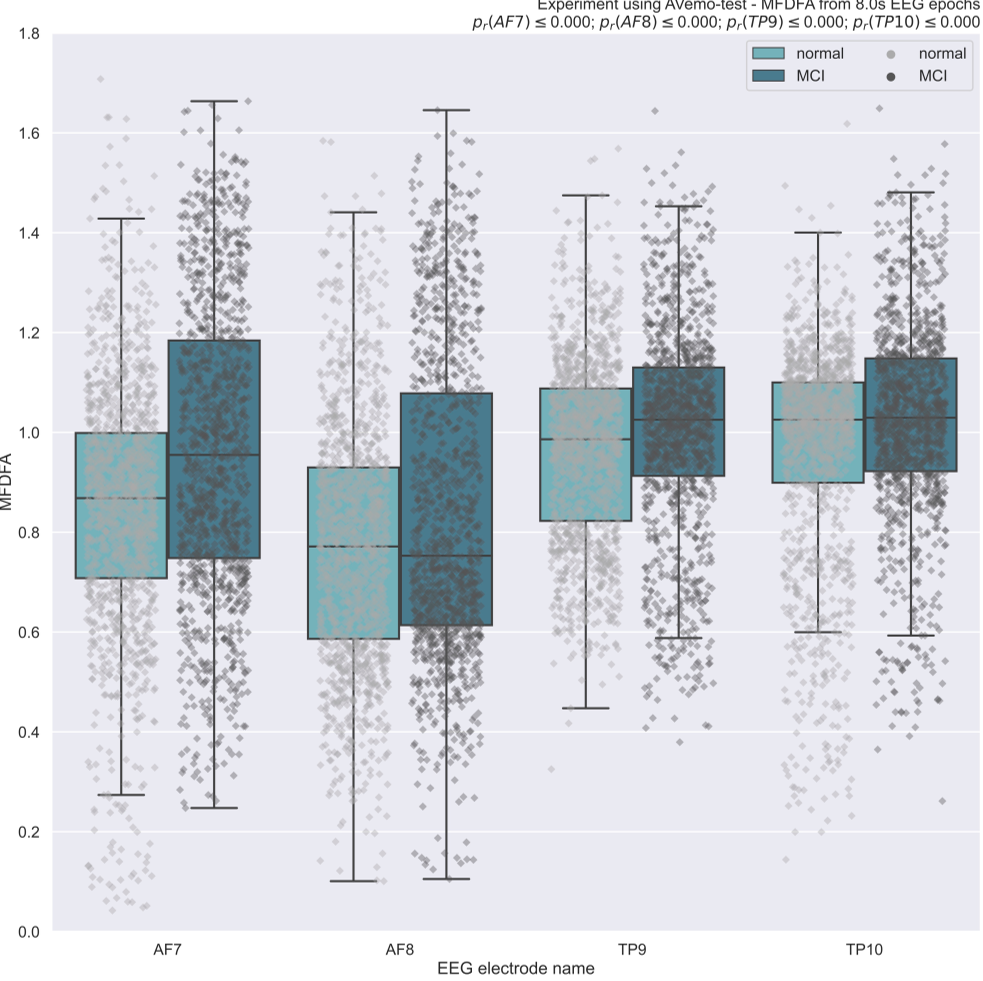 Fig 1. MFDFA feature distributions showing significantly higher complexity scores in MCI subjects at the TP9, TP10, and AF7 electrodes.
Experiments and Results
The researchers tested a variety of ML models, including Logistic Regression, SVMs, Random Forests (RFC), and Fully Connected Neural Networks (FNN).
Key Findings:
- Top Performers: Both RFC and FNN reached 90%+ median accuracy.
- Spatial Significance: The most predictive changes occurred in the temporal and prefrontal lobes (monitored by sensors AF7, AF8, TP9, TP10).
- MCI Signature: MCI subjects showed higher signal complexity. This suggests a loss of neural efficiency or a "noisier" cognitive processing state in the early stages of dementia.
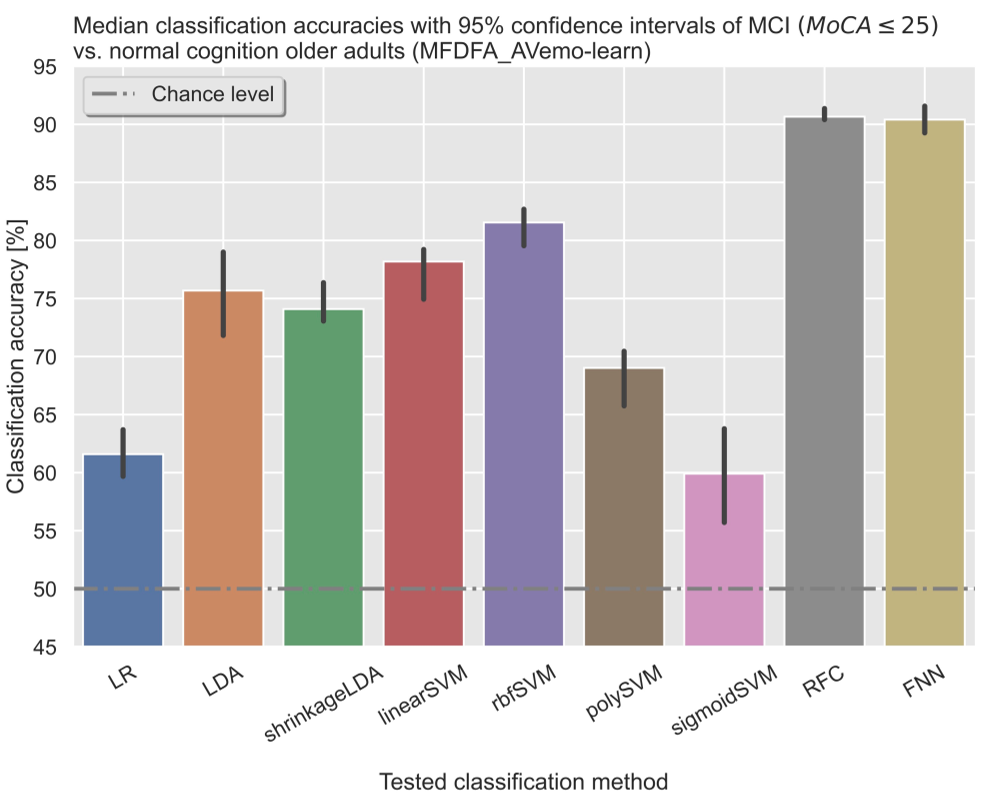 Fig 2. Accuracy of various ML models. FNN and RFC consistently outperform linear models, suggesting that the relationship between fractal EEG patterns and cognitive status is non-linear.
Critical Insight & Future Outlook
The success of this approach lies in the transition from "What is the frequency?" to "How complex is the signal?" By capturing the fractal nature of the brain, the researchers bypassed the limitations of low-cost hardware.
Limitations:
- The sample size (35 subjects) is relatively small.
- The ground truth is still based on MoCA scores, which are themselves "guesstimates."
Future Work: The team plans to integrate fNIRS (functional Near-Infrared Spectroscopy) to monitor blood oxygenation alongside EEG, creating a multi-modal wearable that could potentially distinguish between different types of dementia, such as vascular dementia vs. Alzheimer's.
Conclusion
This research proves that "clinical-grade" insights don't always require "clinical-grade" budgets. By using intelligent signal processing (MFDFA) to extract high-dimensional features from noisy data, we move one step closer to a world where dementia can be caught—and managed—from the comfort of one's living room.