
Beyond the First Hop: Scaling Social Network Anonymization Against Neighborhood Attacks
A New Approach to Manage Security Against Neigborhood Attacks in Social Networks
This paper introduces an enhanced graph anonymization method to protect social network data against neighborhood attacks. It improves upon the k-anonymity framework by replacing DFS codes with an adjacency matrix-based isomorphism test, achieving both higher security levels (handling d-neighborhoods) and lower computational complexity.
TL;DR
Current social network data sharing faces a critical paradox: utility vs. privacy. While k-anonymity is a standard for tabular data, graphs present unique challenges where an adversary’s "local knowledge" of a person's friends can lead to re-identification. This paper proposes a high-efficiency algorithm that protects against advanced adversaries who know not just your friends, but your "friends of friends" (d-neighbors), utilizing a novel adjacency matrix approach that outperforms traditional DFS-based methods.
The Weakness of 1-Hop Defense
Most privacy-preserving models assume an attacker only knows the immediate neighbors of a target. For example, knowing that "Fred" has three specific friends might be enough to find him in an anonymized dataset. However, in the real world, adversaries often have deeper knowledge.
Existing solutions like Zhou and Pei's DFS approach suffer from two major flaws:
- Depth Limitation: They primarily focus on 1-neighborhoods.
- Computational Explosion: They use Depth-First Search (DFS) codes for isomorphism checks. As you try to protect 2-hop or 3-hop neighborhoods, the number of possible DFS trees grows exponentially, making the algorithm crawl to a halt.
Methodology: Adjacency Matrices & Structural Intuition
The authors pivot away from DFS codes. Instead, they use a refined Adjacency Matrix Isomorphism test.
1. Smart Vertex Ordering
Instead of arbitrary matrix construction, the algorithm sorts vertices by:
- Degree: Higher degree vertices are processed first (following the power-law distribution of social networks).
- Label Hierarchy: Using a "Label Set" (e.g., Dentist -> Medical Doctor -> Professional) to generalize vertex data.
2. The Isomorphism Shortcut
The core "Why" behind their speedup is simple: if two graph components are to be identical, their vertices must have matching degrees. By grouping vertices by degree, they reduce the search space from to .
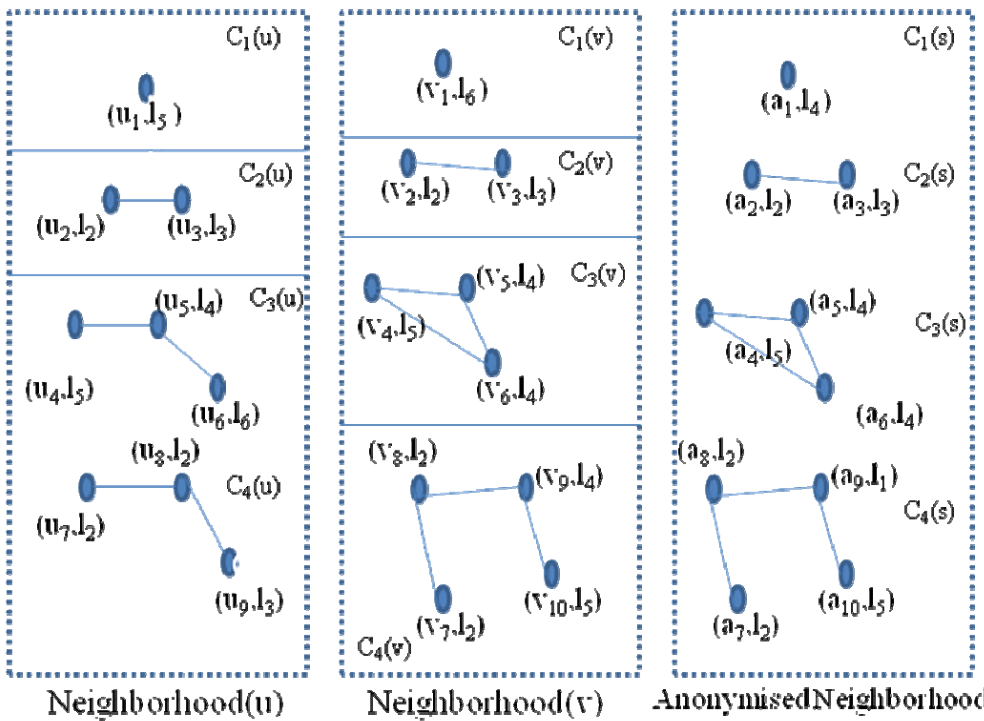 Figure 1: The process of making two distinct neighborhoods isomorphic through edge addition and label generalization.
3. Scaling to d-Neighborhoods
The most elegant part of the methodology is the use of matrix powers. Since the -th power of an adjacency matrix represents paths of length , the algorithm can naturally extend its "anonymization shield" to any distance the user specifies, effectively neutralizing more sophisticated "neighborhood attacks."
Experimental Insights & Efficiency
The authors demonstrate that their approach is significantly faster than the baseline. By sorting and grouping, they prove that the complexity drops drastically.
Key Quantification of Complexity:
- Brute Force: (e.g., operations).
- Proposed Method: (e.g., for a 5-vertex graph grouped by degrees 2, 1, and 2, the complexity is operations).
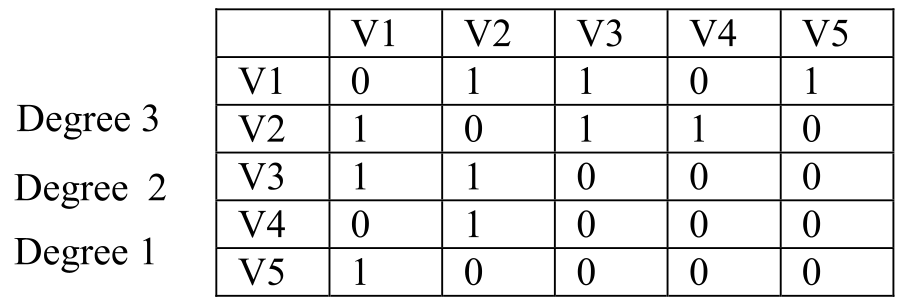 Table 1: Adjacency matrix representation used for the optimized isomorphism test.
Critical Analysis & Conclusion
The value of this work lies in its Pragmatism. By acknowledging that real-world attackers have multi-hop information, it moves social network privacy from a theoretical 1-hop toy problem to a more realistic security model.
Takeaway: The paper proves that structured data (like degree distributions) isn't just a property to preserve—it's a tool to speed up the anonymization process itself.
Limitations: While the time complexity is lower, the paper heavily relies on adding "fake edges" or "fake vertices" to achieve isomorphism. In very sparse or highly specific networks, this could lead to significant Information Loss, potentially harming the utility of the graph for subsequent cluster analysis or path-finding queries. Future work should investigate "Minimal Perturbation" strategies to balance this trade-off more finely.