
Strategies for Optimizing Dynamic Social Network Analysis: A Buffer-Based Perspective
New Approaches for Performance Optimization and Analysis of Large-Scale Dynamic Social Network Analysis using Anytime Anywhere Algorithms
The paper presents a buffer-based optimization for Large-Scale Dynamic Social Network Analysis (SNA) using the "Anytime Anywhere" framework. It focuses on the Type A and Type B scheduling methods to handle edge deletions in closeness centrality computations, aimed at reducing processor idleness and load imbalance in distributed environments.
TL;DR
In the era of billion-user platforms like Facebook and X (formerly Twitter), social networks are never static. This paper introduces a buffer-based scheduling methodology within the Anytime Anywhere framework to handle massive edge deletions. Instead of the costly "stop-and-repartition" approach, the authors propose deferring heavy computations to smooth out processor workloads, ensuring high-performance distributed analysis without the overhead of data migration.
The Bottleneck: Dynamism and Load Imbalance
In large-scale Social Network Analysis (SNA), metrics like closeness centrality are vital for identifying influencers. However, real-world graphs are in a state of flux. Most current frameworks (e.g., Pregel, Mizan) face a dilemma:
- Handle changes immediately: Leads to "stragglers" where one processor is overwhelmed by a local burst of activity while others sit idle.
- Re-partition the graph: Incurs extreme overhead as massive amounts of vertex and edge data move across the network.
The authors identify a critical insight: Graph algorithms are often iterative. We don't need the final answer now; we need a "good enough" answer that eventually converges.
Methodology: The Anytime Anywhere Framework
The core strategy relies on three phases:
- Domain Decomposition (DD): Splitting the graph into community-based sub-graphs.
- Initial Approximation (IA): Independent local analysis.
- Recombination (RC): Iterative refinement through neighbor communication.
The Innovation: Type A & Type B Buffering
To solve the load imbalance, the authors propose two buffer-based schemas for edge deletion:
- Type A (Global Balancing): After identifying which paths are broken by a deleted edge, only a subset of these paths is recalculated in the current iteration. The rest are put into a "buffer." The system ensures that no processor does significantly more work than the average, deferring the "overflow" to future iterations.
- Type B (Local Speed-up): Recalculation is performed only on the processor where the edge resided, rather than globally. This prioritizes getting the change into the system quickly over immediate cross-network accuracy.
 Figure 1: The mathematical constraint for selecting which paths to update to maintain load balance.
Theoretical Insights
The paper provides a rigorous "Case Study" analysis to prove that deferring work doesn't hurt long-term performance:
- Case 1 (Burst changes): If a sudden burst of changes arrives, deferring them across iterations is asymptotically equivalent to handling them at once but prevents system hangs.
- Case 2 (Continuous evolution): For steady-state changes, the buffer-based method remains more efficient because it minimizes the "Maximum Runtime" of any single processor, which is the true bottleneck in synchronous distributed systems.
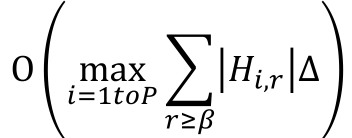 Figure 2: The asymptotic runtime comparison showing the benefits of smoothing the workload over time ().
Critical Analysis & Conclusion
The brilliance of this work lies in its temporal approach to a spatial problem. Instead of moving data to where the power is (re-partitioning), it moves the work to a time when power is available (scheduling).
Key Takeaways:
- Idleness is the enemy: In distributed SNA, the slowest processor dictates the speed. Buffering effectively "chops off" the peaks of computational demand.
- Convergence over Accuracy: For many real-time applications, a slightly delayed global update is better than a system that crashes or stalls under the weight of immediate re-calculation.
Limitations:
- The paper is largely theoretical; while the math holds, real-world network latency and buffer memory limits may create practical hurdles.
- The focus is currently limited to edge deletions; how this handles "edge additions" (which typically decrease path lengths) remains for future work.
Final Vision: This research paves the way for "Fluid SNA" systems that can absorb massive social media shocks—like a viral event—without requiring a total system reboot or expensive data reshuffling.