
LEO Satellite Networks: Modeling the Impact of Earth's Rotation on Handoff Performance
New Cell Residence Time Models for Mobile LEO Satellite Cellular Networks
The paper proposes two new statistical models for Cell Residence Time (CRT) in Low-Earth-Orbit (LEO) satellite networks: a right-truncated gamma distribution for the origination cell and a generalized beta distribution for subsequent (handed-off) cells. These models are the first to effectively incorporate the Earth's rotation into teletraffic performance analysis, significantly improving QoS predictions for mobile satellite systems.
TL;DR
In the rapidly evolving landscape of Low-Earth-Orbit (LEO) satellite communications, traditional terrestrial teletraffic models are failing. This paper introduces a sophisticated mathematical framework using right-truncated gamma and generalized beta distributions to model Cell Residence Time (CRT). By accounting for the Earth's rotation—an अक्सर ignored variable—this work provides a high-fidelity tool for predicting call-blocking and handoff-failure probabilities.
The Finite Support Intuition: Why Terrestrial Models Fail
In a standard cellular network, a "long-tail" distribution (like the Exponential distribution) makes sense because a person might sit in a coffee shop (one cell) for an infinite duration of their call. However, in LEO systems, the "cell" (the satellite's beam) is moving at approximately 27,000 km/h. Even if a user is standing still, the satellite will pass over them in a fixed, finite window of time.
Therefore, any accurate CRT model must have finite support (a hard upper limit, ). Existing literature often oversimplified this as a constant or uniform distribution, which ignores the complex geometry of user location and the critical sideways "drift" caused by the Earth spinning beneath the satellite.
Methodology: Capturing the Earth's "Drift"
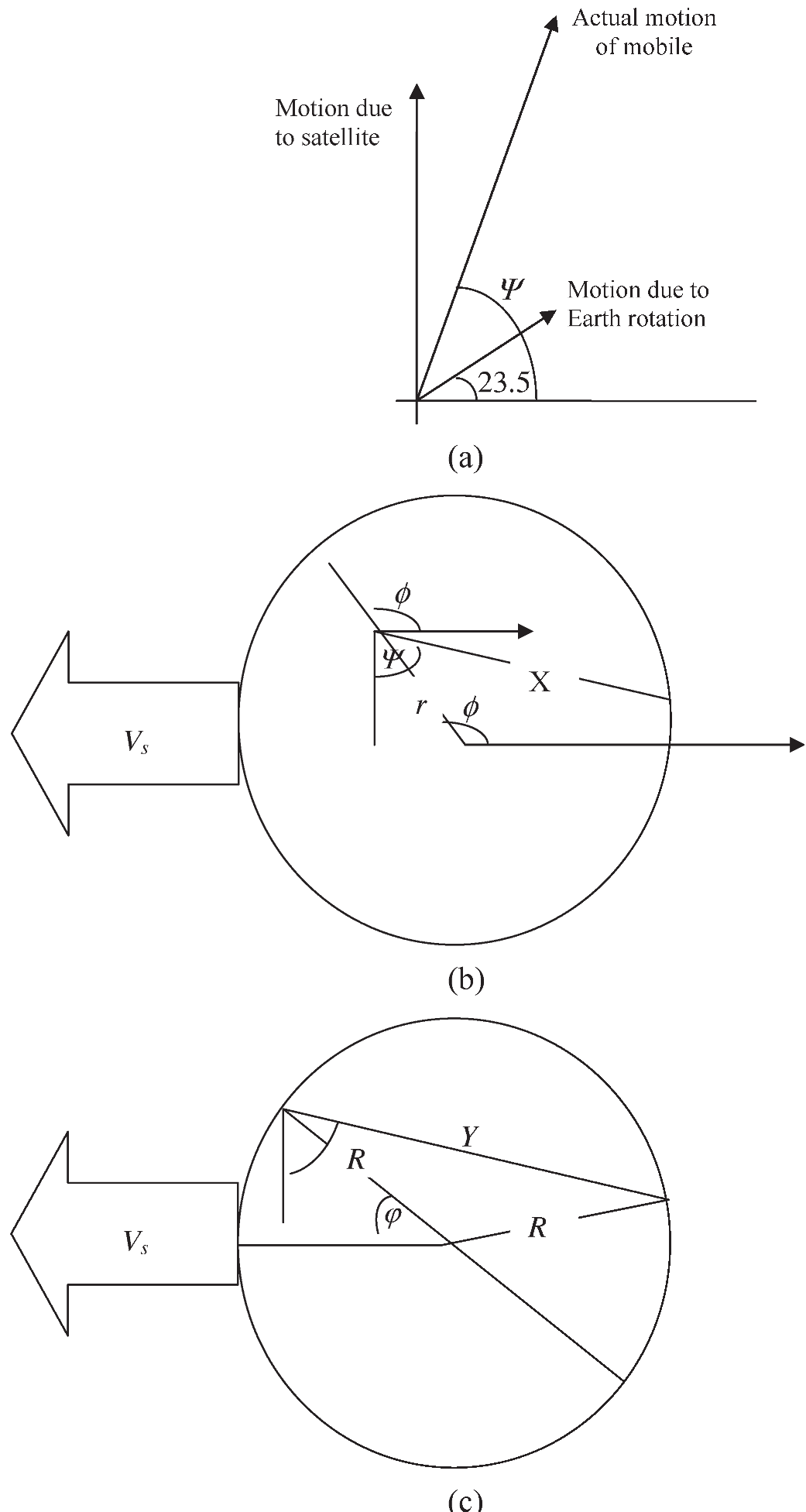
The authors' core insight lies in the modification of the relative velocity vector. In a polar orbit, the effective path of a user across a satellite cell is not a straight line coincident with the orbit, but a resultant vector influenced by the Earth's rotation speed (), which varies by latitude.
1. The Mathematical Anchor
They define the residence time in the first cell () and subsequent cells () as functions of the entry angle , distance , and the modified velocity vector :
2. The Statistical Innovation
- Origination Cell: Modeled by a Right-Truncated Gamma Distribution. This captures the variability of where a user starts a call within a cell while ensuring it cannot exceed the physical pass-over time.
- Subsequent Cells: Modeled by a Generalized Beta Distribution. Since a handed-off call always enters from the edge of a cell, its path distribution is different from a call that starts in the middle. The flexibility of the Beta distribution ( parameters) allows it to be tuned to these specific geometric constraints.
Experiments and QoS Metrics
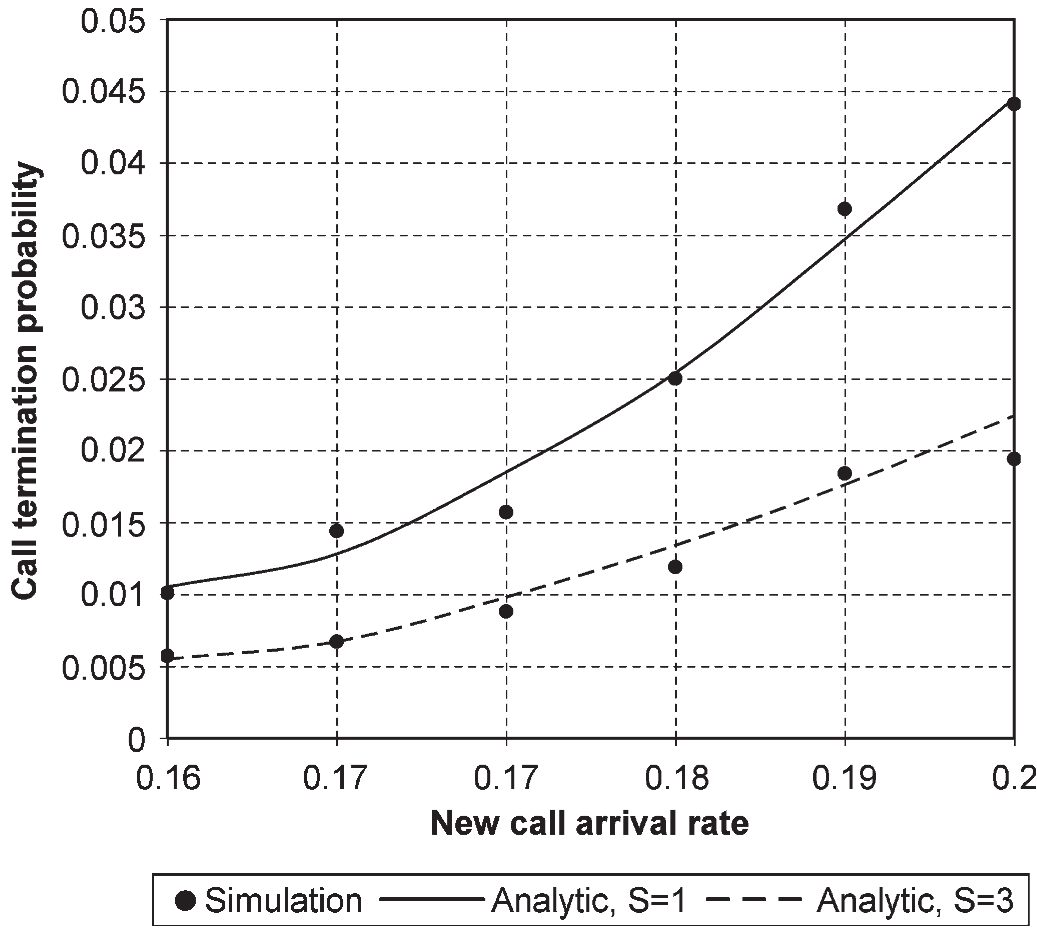
The authors validated their distributions against simulation data using the Kolmogorov–Smirnov test. As shown in the performance graphs, the analytical models (solid lines) perfectly track the simulation results (markers).
Key Insights from Results:
- Impact of Reserved Channels (S): Increasing reserved channels significantly lowers the Call-Termination Probability (), which is critical for user experience, though it slightly increases the blocking of new calls ().
- Earth Rotation Sensitivity: By modeling , the system can now predict performance shifts as a satellite moves from the Equator (high rotation speed) toward the Poles (zero rotation speed).
Critical Analysis & Conclusion
This paper is a significant "theoretical patch" for satellite teletraffic engineering. By moving away from the "memoryless" property of exponential distributions and embracing the deterministic limits of orbital mechanics, it allows operators to more tightly pack users into channels without risking mass handoff failures.
Limitations: The model assumes circular cells and a perfectly polar orbit. In modern "Grid" or "Honeycomb" LEO constellations with inclined orbits, the geometry becomes even more complex (3D spherical geometry), which would be the logical next step for this research.
Future Outlook: As mega-constellations like Starlink and Kuiper scale, these finite-support models will be essential for AI-driven resource allocation and dynamic beamforming strategies.