
Boosting Emotion Detection: A Decomposition Approach to Feature Selection
New Frameworks to Boost Feature Selection Algorithms in Emotion Detection for Improved Human-Computer Interaction
This paper introduces two novel architectural frameworks (FRM1 and FRM2) to enhance feature selection for multi-class emotion detection in speech. The authors utilize problem decomposition (One-vs-Rest and One-vs-One) followed by feature reconstruction strategies to achieve state-of-the-art accuracy using Support Vector Machines (SVM).
TL;DR
Recognizing human emotion via speech is a cornerstone of next-generation Human-Computer Interaction (HCI). However, high-dimensional data often leads to information noise. This paper proposes two frameworks, FRM1 (One-vs-Rest) and FRM2 (One-vs-One), which decompose multi-class emotion detection into binary tasks. By reconstructing feature sets from these sub-tasks, the authors achieved a significant 17.4% reduction in classification error, identifying prosodic and sub-band energy features as the most reliable indicators of affect.
The "Curse of Dimensionality" in Affective Computing
In the realm of Pattern Recognition, more data doesn't always mean better results. Emotion detection from speech involves extracting features like Mel-Frequency Cepstrum Coefficients (MFCC), Linear Predictive Coding (LPC), and prosodic stats.
The authors argue that the bottleneck in HCI is not necessarily the classifier (e.g., SVM or kNN) but the Feature Selection phase. Traditional methods struggle to find a subset that provides high class-separability across multiple emotional states simultaneously.
Methodology: Decomposition and Reconstruction
The researchers moved away from treating the multi-class problem as a monolithic entity. Instead, they proposed a two-step framework:
1. Problem Decomposition
- FRM1 (One-vs-Rest): Breaks an -class problem into binary problems where one emotion is tested against all others.
- FRM2 (One-vs-One): Pairs every emotion against every other emotion, resulting in sub-problems.
2. Feature Construction Strategies
After selecting features for each sub-problem using algorithms like LSBOUND, MUTINF, or SFS, they used two mathematical operators to build the final set:
- SET1 (Intersection): — keeping only features that appear in multiple sub-sets.
- SET2 (Unification): — combining all unique features selected across sub-sets.

Experimental Validation
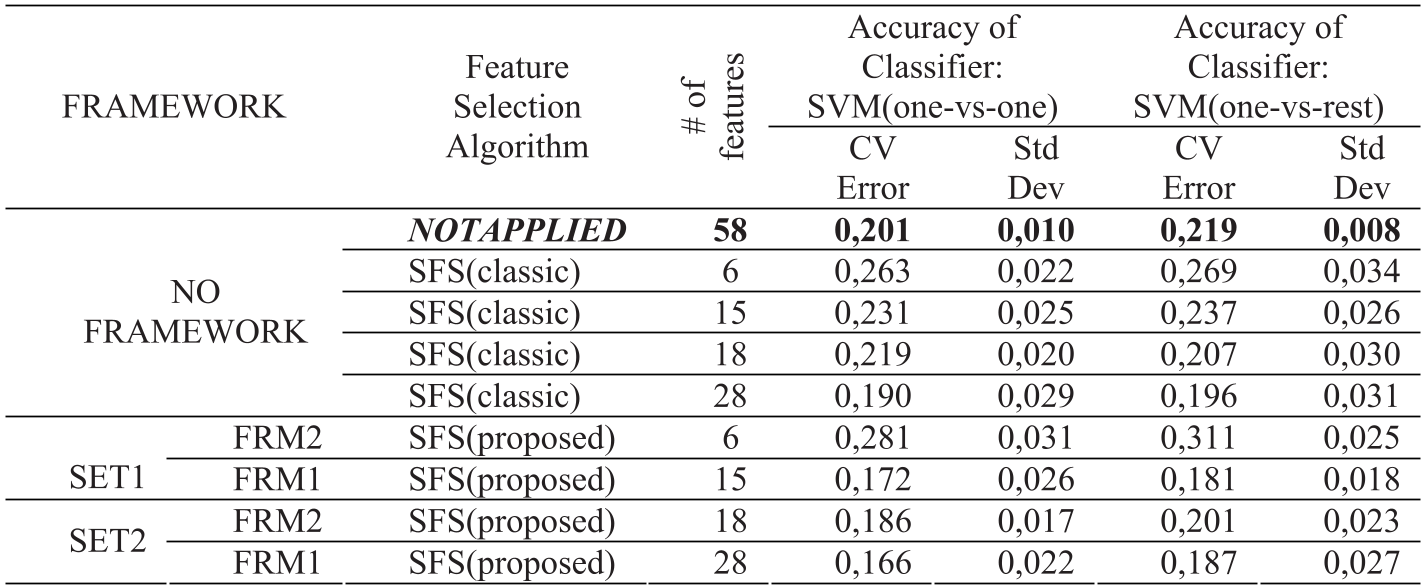
Using the Berlin Emotional Speech Database (EmoDB), the team tested 58 initial features.
Key Findings:
- Superiority of Unification: The "Unification" strategy (SET2) consistently yielded lower Cross-Validation errors than "Intersection," suggesting that a broader collection of class-specific features is better than a restrictive overlap.
- Framework Power: While classical SFS actually increased error rates (the "curse" in action), the same algorithm within the proposed FRM1 drastically improved performance.
- Feature Importance: The frameworks successfully highlighted that Prosodic and Sub-band energy features are significantly more informative than LPC parameters for emotion tasks.
Critical Insight: Why it Works
The physical intuition here is Local vs. Global Discriminability. A feature that distinguishes "Happiness" from "Sadness" might be irrelevant when distinguishing "Anger" from "Fear." By decomposing the problem, the selection algorithms can "zoom in" on the unique acoustic signatures of specific emotion pairs, which are then aggregated to form a robust global feature set.
Conclusion and Future Outlook
The study concludes that SVM (one-vs-one) combined with LSBOUND within the FRM1 framework provides the most reliable architecture for emotion detection, reaching an error rate as low as 0.145.
Future Work: While effective, the computational overhead of decomposing into many binary problems (especially in FRM2) could be a limitation for real-time systems with many classes. Future research should look into adaptive decomposition where only the most "confusable" classes are treated with specific sub-problems.