
Extended Mind Crowdsourcing: Beyond Tasks to Collective Discovery
New Frontiers for Crowdsourcing: The Extended Mind
This paper introduces Extended Mind Crowdsourcing (EMC), a novel framework that leverages the psychological "Extended Mind Hypothesis" to collect implicit human cognition via digital devices. It moves beyond task-oriented crowdsourcing to enable collective discovery of societal behavior and culture, demonstrated through a SOTA analysis of 500,000+ Foursquare check-ins.
TL;DR
The landscape of crowdsourcing is shifting. We are moving away from the era of "Mechanical Turk" style micro-tasks toward Extended Mind Crowdsourcing (EMC). This approach treats our smartphones and social apps not just as tools, but as extensions of our biological cognition. By analyzing how we "externalize" our minds through check-ins and digital footprints, researchers can now decode complex human traits—like personality—on a global scale.
Background: From Tasks to Cognition
In the traditional view, crowdsourcing was a "job." You post a task, a crowd performs it, and you pay them. While effective for labeling data, this model is blind to the rich, implicit intelligence embedded in our daily lives. The authors of this paper argue that we are entering an era of Active Externalism, where the boundary between the mind and the environment (our devices) is blurred.
The Core Concept: What is EMC?
The "Extended Mind" hypothesis suggests that a notebook or a smartphone is part of our cognitive process. Extended Mind Crowdsourcing (EMC) is the systematic collection of data from these "external" parts of the mind.
Unlike traditional participatory sensing, which focuses on raw data (pixels, GPS coordinates), EMC focuses on Human Computation. It looks at the choices humans make—where to eat, when to share, how to interact—as a form of implicit reasoning.
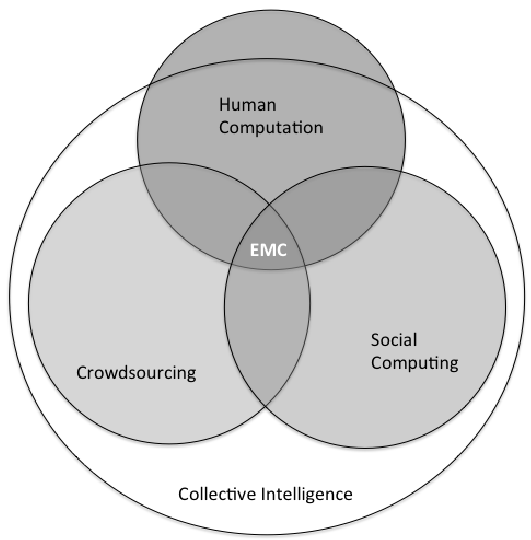
Figure 1: EMC sits at the intersection of Social Computing, Human Computation, and Crowdsourcing, emphasizing discovery over simple task execution.
Methodology: Mining Personalities from Mobility
To prove this concept, the researchers conducted a massive "in-the-wild" study. They used Location-Based Social Networks (LBSNs) like Foursquare as a proxy for the extended mind.
The Big Five Model
The study mapped digital behavior to the Five-Factor Personality Model:
- Openness: Curiosity and spontaneity.
- Conscientiousness: Organization and persistence.
- Extraversion: Sociability.
- Agreeableness: Cooperation.
- Neuroticism: Emotional stability.
The Workflow
- Viral Recruitment: Users opted in and provided access to their Foursquare history via API.
- Implicit Data: Over 540,000 check-ins were analyzed to determine mobility habits.
- Explicit Data: Users took a 44-question personality test.
- Correlation Analysis: The system investigated how high-level traits (like Neuroticism) manifested in physical world behavior (like avoiding crowded "sociable" venues).
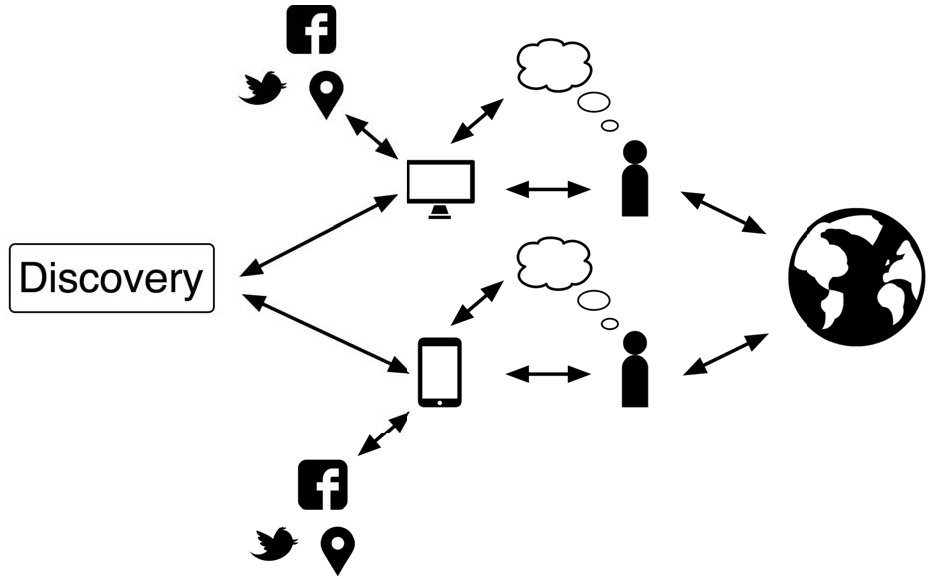
Figure 2: The EMC process flow: capturing the "embodied cognition" of the human-device couple to gain societal insights.
Results: The Digital Signature of the Mind
The experiment yielded fascinating insights into how our internal traits drive our external movements:
- Conscientious individuals visit a wider variety of unique venues, reflecting their organized and thorough nature in exploring environments.
- High Openness strongly correlates with visiting popular and "sociable" venues, seeking out the diversity of human experience.
- High Neuroticism shows a clear negative correlation with visits to sociable locations (), highlighting a digital "avoidance behavior."
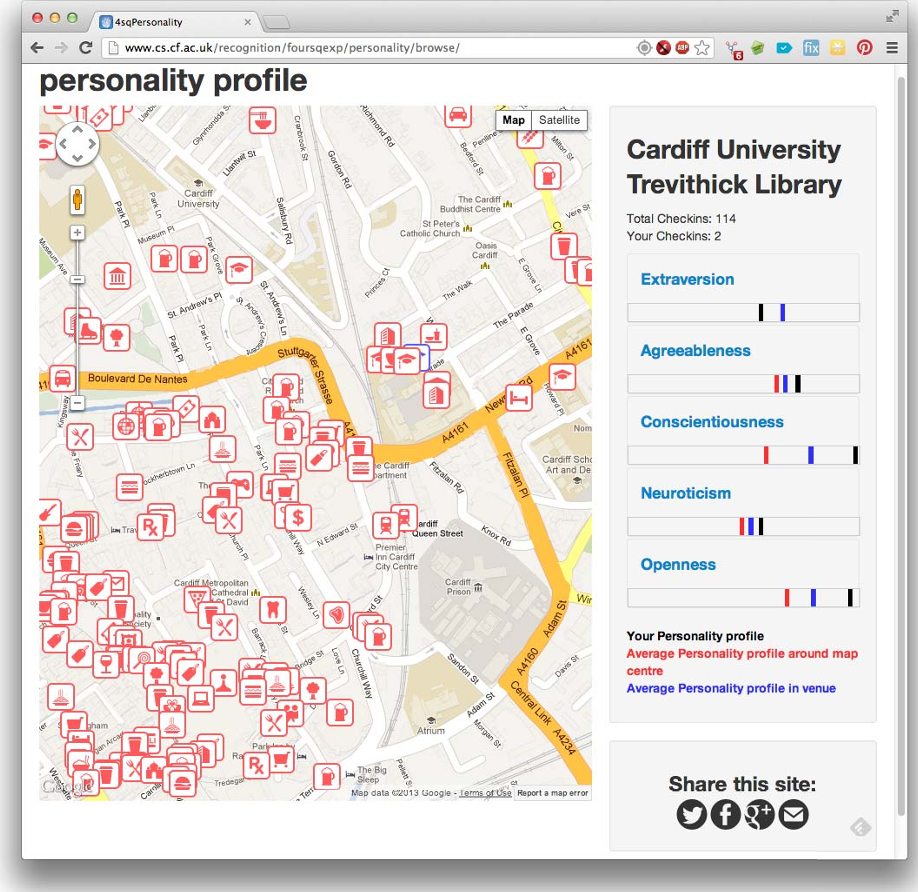
Figure 3: The interface used to provide feedback to participants, showing their personality profile relative to the venues they frequented.
Critical Analysis & Future Outlook
The power of EMC lies in its ability to tackle "Wicked Problems"—social issues that are too complex for a standard algorithm or a simple survey. By aggregating thousands of "extended minds," we can begin to see the "Mind of Society."
Limitations
- Privacy: Accessing the "Extended Mind" involves deep personal data, raising significant ethical hurdles.
- Noise: "In-the-wild" data is messy. Not every check-in is a meaningful cognitive event.
Final Thoughts
This work marks a shift in how we view the human-smartphone relationship. Our devices are no longer just tools for communication; they are sensors for the soul. As we move toward more integrated AI, understanding the "Extended Mind" will be crucial for creating technology that truly resonates with human behavior and culture.