
Resonance in the Digital Hive: Why Mass Media Triggers Online Flaming
A New Model of Flaming Phenomena in Online Social Networks that Considers Resonance Driven by External Stimuli
This paper introduces a novel mathematical model for online flaming phenomena in Social Networking Services (OSNs) by incorporating resonance driven by periodic external stimuli. Leveraging an oscillation model based on the wave equation, it demonstrates that flaming can occur even in networks with real-numbered eigenvalues, a scenario previously considered "safe."
TL;DR
Online "flaming"—the explosive, often hostile escalation of user activity—isn't just a result of toxic network structures. This paper proposes that external stimuli (like mass media) can drive a network into resonance, causing activity to spiral out of control even in "stable" networks. Crucially, the authors identify low-frequency beats in user activity as a measurable "heartbeat" that signals an impending flaming event.
Background: The Social Wave Equation
In academic terms, user interactions in OSNs aren't just random; they behave like waves traveling through a physical medium. Previous research by Aida et al. established the Oscillation Model, where the "tension" between users trying to align their opinions acts as a restoring force.
Until now, the consensus was that flaming only happened when the network's math (its Laplacian eigenvalues) was inherently unstable. This paper breaks that mold by introducing Forced Oscillation.
The Core Insight: Resonance Driven by External Stimuli
Think of a bridge collapsing because soldiers marched across it in perfect rhythm. The bridge isn't "broken" initially, but the frequency of the steps matches the bridge's natural frequency.
The authors argue that mass media acts as this rhythmic step. Even if a social network is structurally "safe" (having only real eigenvalues), a topical news story with an angular frequency close to a network's eigenfrequency will cause the oscillation energy of the users to spike.
Methodology & Architecture
The model uses a Scaled Laplacian Matrix () to handle directed links between users. The motion of user states is governed by:
Here, represents the "diminishment of interest"—how quickly people get bored. If is low (the news is very "sticky" or sensational), the resonance becomes more violent.
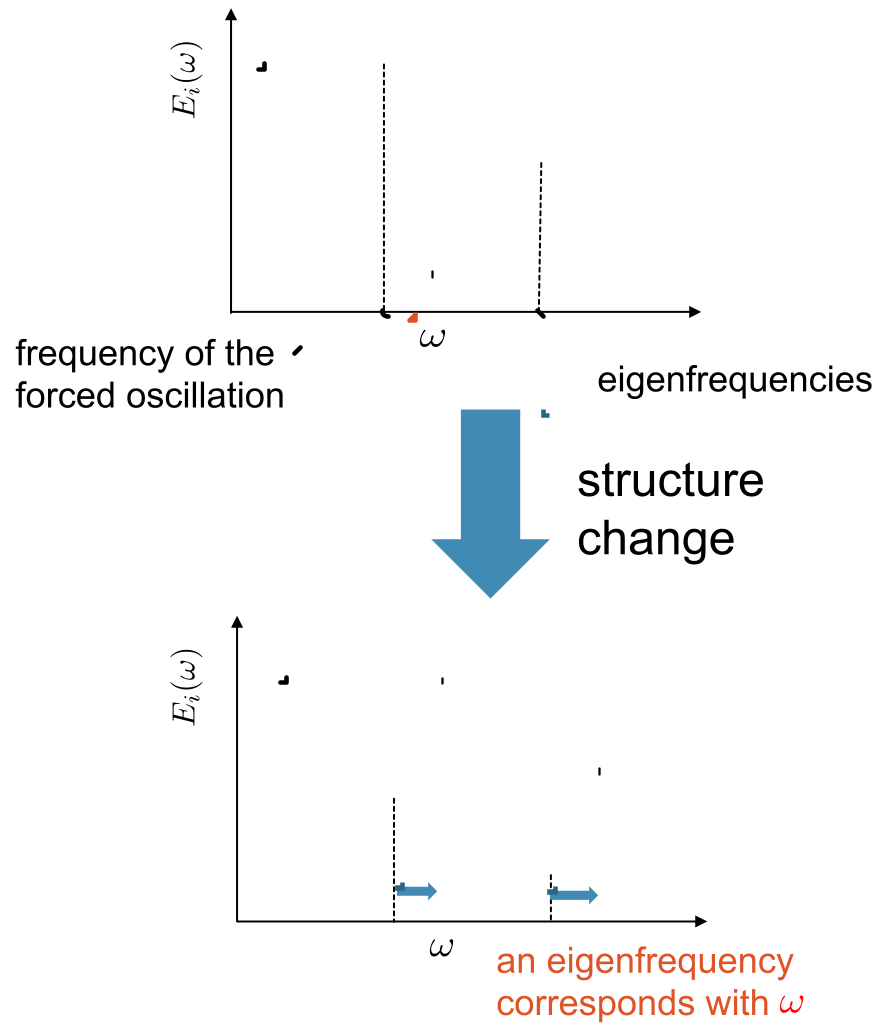 Fig 1: The conceptual shift where external stimuli align network frequencies toward a flaming state.
Identifying the Omen: The Psychology of "Beats"
One of the most profound contributions of this paper is the mathematical derivation of the Omen. Before a full-blown flame occurs, the interference between the network's natural frequency and the external frequency creates low-frequency beats.
Mathematically, when :
The "" term creates a very slow wave. In real-world terms, this manifests as rhythmic surges in posting volume before the final explosion.
Experimental Validation
The authors simulated a 5-node network and tracked the kinetic energy () of users. As the external stimulus frequency approached the network's eigenfrequency, the "beats" became clearly visible.
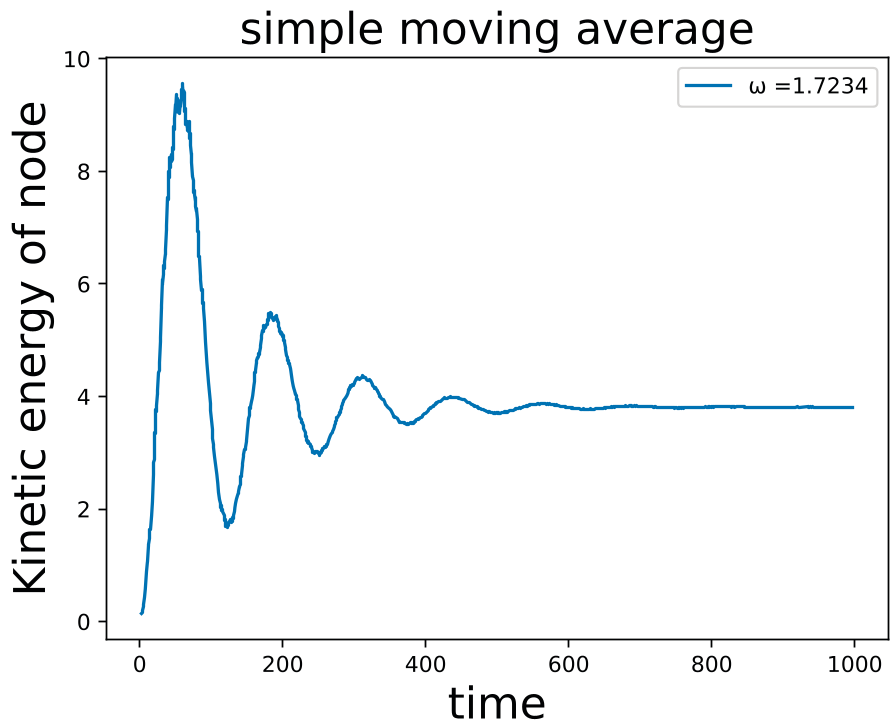 Fig 2: Simple moving average of kinetic energy showing the emergence of low-frequency beats as resonance nears.
The results show:
- Amplitude Increase: The closer the frequencies, the higher the peak energy.
- Frequency Slowdown: The "beats" become longer and slower as the system approaches a critical flaming point.
Critical Insight & Perspective
This research moves us closer to a "NWS (National Weather Service) for Social Media." By monitoring the spectral density of social networks for these specific low-frequency beats, platform moderators could potentially identify "hot topics" that are about to turn into harmful flaming events before they actually peak.
Limitations: The current model assumes a symmetrizable directed graph, which is a simplification of the chaotic, non-reciprocal links found on platforms like X (Twitter) or TikTok. However, as a proof-of-concept for resonance-based flaming, it provides a robust engineering framework that moves beyond simple epidemiological (SIR) models.
Conclusion
The "flaming" of a social network is not just about what is said, but the rhythm at which it is driven by external sources. By understanding the resonance between mass media and network topology, we can better predict and mitigate the real-world damage caused by digital volatility.