
The FA Model: Moving Beyond Preferential Attachment to Simulate Real Social Communities
A New Model for Growing Social Networks
The paper introduces the Friend Attachment (FA) model, a novel growing network mechanism designed to replicate the topological features of real-world social networks like Facebook. By integrating a community-based attachment rule, it successfully mimics high clustering, low path lengths, and heterogeneous degree distributions (Log-logistic and Normal) often missed by standard models.
TL;DR
Researchers have developed the Friend Attachment (FA) model, a new framework for network growth that prioritizes community structures. Unlike the classic Barabási-Albert model that focuses on "the rich get richer," FA recognizes that social connections are often born within localized groups. The result? A model that finally mirrors the high clustering and specific degree distributions found in real Facebook friend networks.
Problem & Motivation: Why Classic Models Fail Social Reality
For decades, the Barabási-Albert (BA) model and the Erdős-Rényi (ER) model have been the cornerstones of network science. However, when applied to the "friend networks" of platforms like Facebook, they fall short:
- The BA Model produces a power-law distribution that often overestimates the number of "hubs" in localized social circles.
- The ER Model is too random, failing to produce the dense "cliques" or communities that characterize human friendship.
The authors observed that social entities don't just connect to the most popular person; they connect to people within their school, workplace, or hobby groups. This "Community-driven" logic was missing from the mathematical landscape.
Methodology: The Logic of Friend Attachment (FA)
The FA model introduces a "dual-track" growth mechanism. When a new person (node) joins the network, their links are formed based on a threshold parameter p:
- Community Attachment (Probability 1-p): The node selects an existing community and forms links inside that group. This simulates joining a specific social circle.
- Random Attachment (Probability p): The node forms links with random users across the entire network. This simulates meeting people outside one's immediate circle.
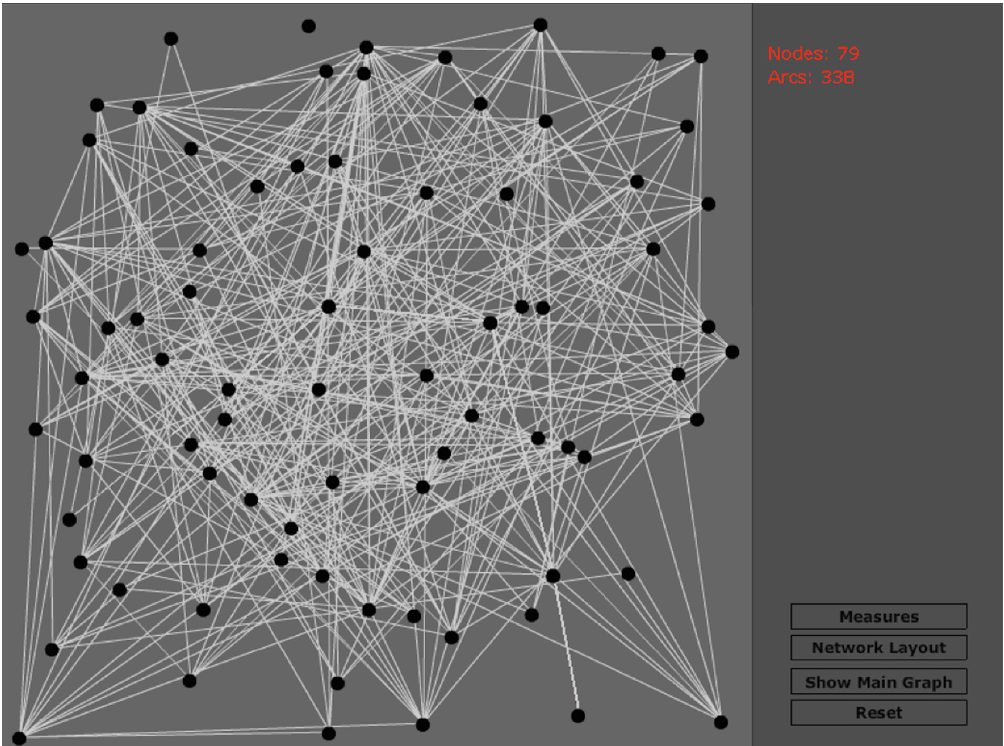 Fig 1: A visualization of a real Facebook friend network and the extraction interface used for the study.
By tuning p, np (max links in community), and n1-p (max links in random), the model can transition between Log-logistic, Normal, and even Power-law distributions.
Experiments: Matching the Topology of Facebook
The researchers tested the FA model against real-world data extracted from Facebook volunteers. They focused on several key metrics: Clustering Coefficient (C), Characteristic Path Length (L), and Node Betweenness (B).
SOTA Comparison: FA vs. ER vs. BA
The results were striking. While ER and BA models deviated significantly from real-world data in terms of clustering and community counts, the FA model stayed within the realistic range.
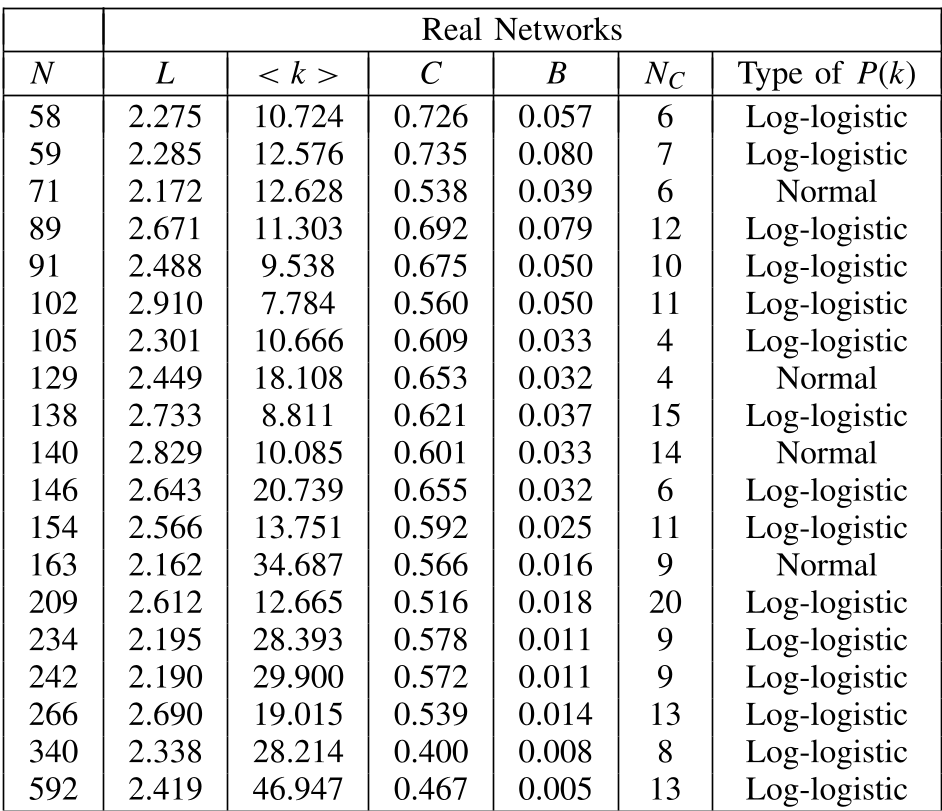 Table 1: Topological features of Real Networks compared to the simulated counterparts.
- Clustering (C): Real networks showed high clustering (~0.6). FA matched this accurately, while ER/BA hovered much lower.
- Community Accuracy: The FA model achieved a much lower Mean Square Error (MSE=5.4) in predicting the number of communities compared to ER (MSE=55.9).
Critical Analysis & Conclusion
The Friend Attachment model succeeds because it treats "communities" as first-class citizens in the growth process. It acknowledges that human social behavior is intrinsically modular.
Limitations
The model's parameters (p, np, n1-p) currently require manual tuning or "trial and error" to match specific real-world networks perfectly. A more automated way to derive these parameters from raw data would be a significant next step.
Future Outlook
This work shifts the focus from global network properties to local community dynamics. It provides a more robust foundation for simulating how rumors spread, how products are adopted, and how social cohesion is maintained in digital environments.