
Beyond Simple Graphs: A Multi-Entity Model for the Facebook Era
A new model for Online Social Networks case of Facebook
The paper proposes a multi-entity graph model for Online Social Networks (OSNs), specifically tailored to Facebook's structural evolution. It moves beyond simple node-edge representations by incorporating private profiles, public pages, and groups, utilizing a community-based topology to achieve a SOTA-aligned clustering coefficient (0.344) and reduced diameter.
TL;DR
Researchers have developed a new structural model for Online Social Networks (OSNs) that moves away from the "one-size-fits-all" node approach. By explicitly modeling Private Profiles, Public Pages, and Groups, and enforcing realistic community density constraints, the model achieves a clustering coefficient 4x higher than traditional random graphs, providing a more accurate substrate for studying viral marketing and information flow.
The Failure of Classical Graph Theory in Social Media
For decades, we relied on models like Erdos-Renyi (Random) or Watts-Strogatz (Small-World) to describe networks. However, Facebook isn't just a random collection of points. Classical models suffer from three fatal flaws when applied to OSNs:
- Homogeneity: They treat every node the same, ignoring that following a celebrity (Public Page) is different from being friends with a classmate (Private Profile).
- Structural Inaccuracy: They struggle to recreate the high "clustering coefficient" (the "friend-of-a-friend" effect) naturally found in human societies.
- Static Connectivity: They often fail to account for "Heavy-Tailed" degree distributions where a few "Hubs" dominate the network.
Methodology: The Community-First Approach
The authors propose a model defined by specific entity archetypes and connectivity rules detailed in their implementation tool, OSNSim.
1. Heterogeneous Node Types
Instead of generic vertices, the model defines:
- Private Profiles: The core users (Bidirectional links).
- Public Pages: Information sources (Unidirectional links).
- Groups: Collaborative hubs (Unidirectional membership).
2. The Logic of Connectivity
The architecture (as shown below) relies on dividing private profiles into Communities (Ci). Each member must maintain a minimum internal link density (), ensuring the "Triadic Closure" property—that your friends are likely to know each other.
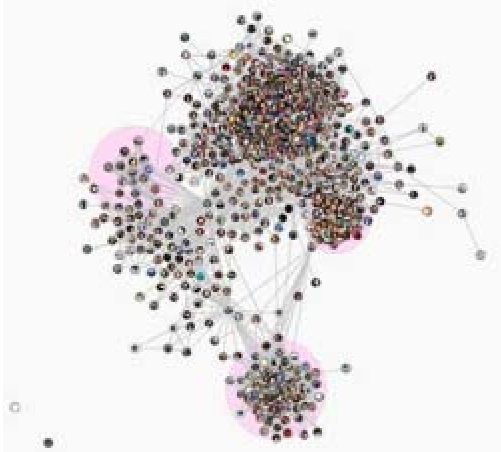 Figure: The visualization shows how the model mimics real Facebook links by creating dense clusters interconnected by a few "bridge" nodes.
Experiments: Crushing the Baselines
The researchers generated an instance of 100 nodes (80 Profiles, 10 Pages, 10 Groups) and compared it against the E-R80 (Random) and SM80 (Small-World) models.
- Clustering Coefficient: The proposed model reached 0.344, compared to the meager 0.08-0.09 of traditional models. This proves the model successfully captures the "clique" nature of real social life.
- Diameter: The diameter fell to 3, which is even tighter than the famous "six degrees of separation," aligning with Facebook's recent internal data suggesting an average path length of 4.7.
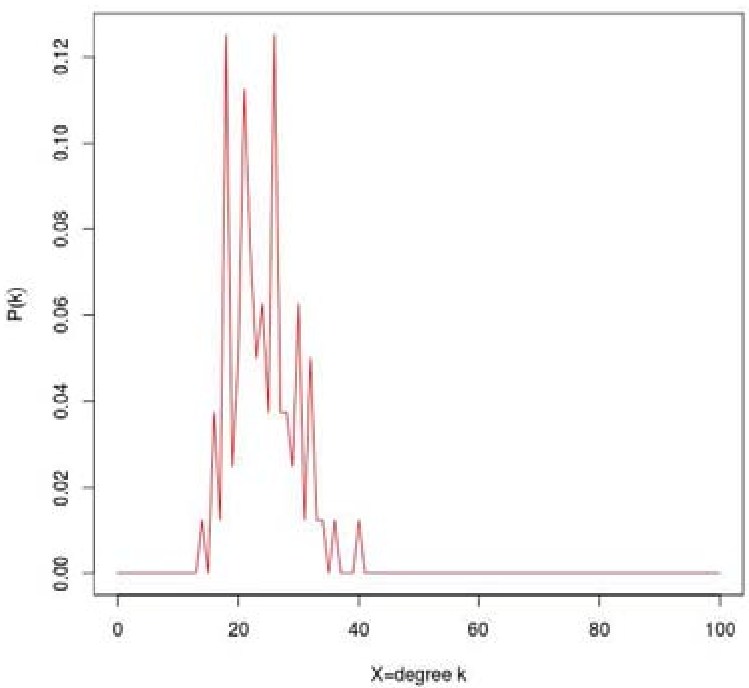 Figure: The distribution of clustering coefficients shows that most nodes in the new model participate in highly-connected local environments, unlike the sparse distribution in random graphs.
Critical Insight: Why This Matters
The real value of this work isn't just in the graph metrics—it's in the simulation potential. Because this model accurately reflects the density of Facebook's communities, it provides a realistic sandbox for:
- Viral Marketing: Calculating how information "jumps" from one tight-knit community to another.
- Privacy Analysis: Studying how information leaks across community boundaries.
- Network Resilience: Evaluating how the removal of "bridge" nodes or "public pages" disrupts the flow of data.
Conclusion and Future Outlook
While the current model uses uniform thresholds for all communities, the authors plan to introduce heterogeneous community sizes and apply the model to other platforms like Twitter and Google+. As OSNs evolve from simple social directories into complex multi-media ecosystems, our mathematical models must become as nuanced as the human behaviors they represent.