
Decoding Musical Affect: A Superior Multilabel Approach to Emotion Recognition
A New Multilabel System for Automatic Music Emotion Recognition
This paper presents a robust multilabel, multiclass system for Automatic Music Emotion Recognition (MER) utilizing the Emotify dataset. By leveraging the Geneva Emotional Music Scale (GEMS-9) and a novel combination of psychoacoustic feature extraction, Kononenko’s discretization, and Correlation-based Feature Selection (CFS), the authors achieved a State-of-the-Art (SOTA) mean accuracy of 88% using a Naïve Bayesian classifier.
TL;DR
Researchers from the University of Rome Tor Vergata have developed a high-precision system for recognizing the multiple, simultaneous emotions induced by music. By refining the Emotify dataset with a 30% consensus threshold and a sophisticated feature discretization pipeline, they achieved a mean accuracy of 88%, significantly outperforming existing benchmarks in the Music Emotion Recognition (MER) field.
Contextualizing the Chords: Why MER is Hard
Music doesn't just trigger one emotion at a time. A single track can be simultaneously "nostalgic" and "calm," or "powerful" and "joyful." Current challenges in MER stem from:
- Subjectivity: Different listeners perceive different moods.
- Simultaneity: The limitation of single-label classification.
- Feature Noise: Raw audio data contains vast amounts of information irrelevant to emotional induction.
The authors address this by adopting the GEMS-9 (Geneva Emotional Music Scale), which categorizes music into nine distinct factors specifically designed for music-induced emotions rather than general linguistic labels.
Methodology: The Power of Pre-processing
The researchers' approach shifts the focus from "bigger models" to "better data representation."
1. Consensus Thresholding
To combat data sparseness and subjectivity, they introduced a consensus threshold. An emotion label is only considered "valid" for a track if the mean positive response among annotators exceeds 30%. This ensures the models are trained on consistent emotional expressiveness.
2. High-Dimensional Feature Extraction & Selection
The system extracts 476 features across four domains:
- Acoustic: Intensity (RMS), Rhythm, and Timbre (MFCCs).
- Psychoacoustic: Loudness, Sharpness, and Timbral Width.
- Melodic: Pitch salience, Tremolo, and Vibrato.
- Statistical: Higher-order moments (Skewness, Kurtosis).
3. Discretization and CFS
The "secret sauce" of this study is the application of Kononenko’s discretization followed by Correlation-based Feature Selection (CFS). This process compresses continuous audio data into discrete symbols using the Minimum Description Length (MDL) principle, effectively "filtering out" the noise before it hits the classifier.
(Note: Refer to Section II-D and II-E in the paper for the algorithmic flow of Discretization and CFS)
Experimental Showdown: Bayesian Victory
The study compared three primary architectures: Support Vector Machines (SVM), Artificial Neural Networks (ANN), and Naïve Bayesian Classifiers.
The results were conclusive: Naïve Bayes + Discretization + CFS emerged as the champion.
| Emotion Category | Accuracy (Discretization + CFS + Bayes) |
|---|---|
| Amazement | 95.45% |
| Power | 95.35% |
| Tenderness | 89.65% |
| Mean Accuracy | 88.00% |
SOTA Comparison
The authors compared their results against previous efforts using benchmarks like OpenSmile and MIRToolbox. Their method showed a dramatic reduction in Root Mean Square Error (RMSE). For instance, in the "Amazement" category, the RMSE dropped from a baseline of 0.99 to a staggering 0.17.
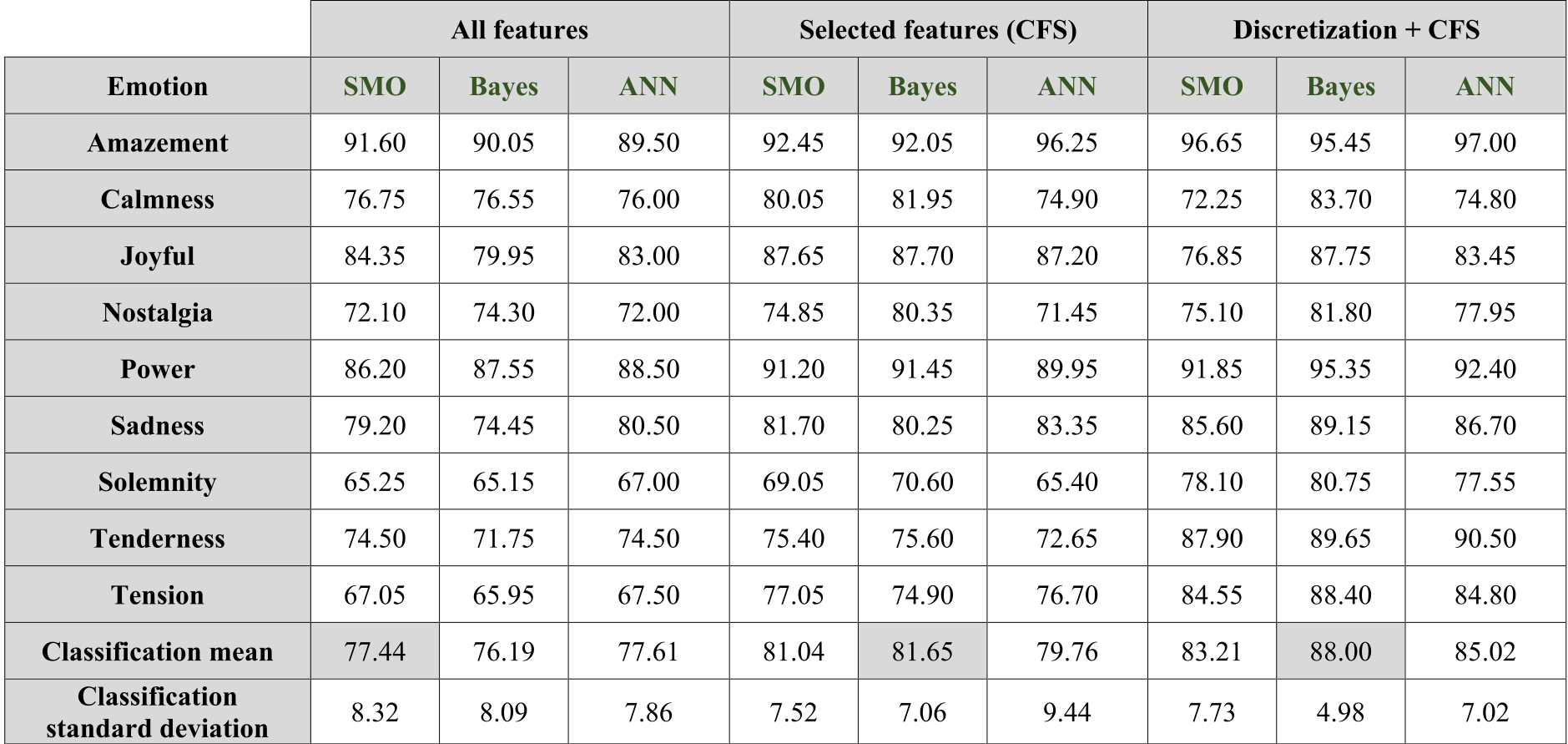 Table 1: Comparison of different classification strategies showing the significant jump in accuracy when discretization is applied.
Critical Insight & Conclusion
While the Multilayer Perceptron (ANN) was expected to perform best, the Naïve Bayesian model's superiority suggests that when features are correctly discretized and selected, simpler probabilistic models can outperform complex neural nets in niche tasks like MER.
Takeaway: This research highlights that the bottleneck in emotion recognition isn't necessarily the neural architecture, but the way we handle the subjective consensus and feature discretization. By treating emotions as overlapping, multi-valued states, we move one step closer to music AI that truly "understands" how we feel.
Limitations: The study utilized MP3 files (lossy compression). While the authors argue this acts as a pseudo-feature selection by masking inaudible data, future work on lossless formats might reveal even deeper psychoacoustic nuances.