
The Hidden Price of a Favor: A New Data-Driven Paradigm for Studying Cross-Cultural Corruption
A New Paradigm for the Study of Corruption in Different Cultures
This paper introduces a novel experimental paradigm using the "Colored Trails" board game to study corruption across different cultures (China, Israel, and the USA) without priming participants. By analyzing game logs from 276 subjects, the authors developed a machine learning model capable of predicting corrupt behavior with up to 80% accuracy based on publicly observable state data.
TL;DR
Researchers have moved beyond surveys to study corruption as it actually happens. Using a specialized board game played in China, Israel, and the US, they captured corruption as an emerging behavior. The findings challenge existing indices (like the CPI) and prove that machine learning can accurately "flag" corrupt exchanges just by looking at public economic outcomes, without ever reading the private "bribe" messages.
Background Positioning
In the world of social science and AI, studying "covert activities" is notoriously difficult. You can't exactly ask someone to be corrupt in a lab—it ruins the experiment's validity. This paper is a methodological breakthrough; it creates a "sandbox" where corruption is possible but never whispered by the experimenters, allowing it to evolve as it does in the real world: behind closed doors and through gradual reciprocity.
Problem & Motivation: The "Priming" Trap
Most previous research suffers from two fatal flaws:
- Subjectivity: Surveys like the Corruption Perception Index (CPI) measure what people think about their country, not what they do.
- Priming: Lab games that have a button labeled "Bribe" aren't studying corruption; they are studying how people play a game with a "Bribe" button.
The authors' intuition was that corruption is a repeated dynamic process. It starts with a conversation, a small favor, and eventually leads to a systematic abuse of power. To study this, they needed a task-oriented environment where the "right" choice for the public is clear, but the "profitable" choice for the individual is hidden.
Methodology: The "Olympic Game"
The researchers adapted the Colored Trails framework into a multi-round procurement simulation.
- The Roles: One Auctioneer (Gov. Employee) and three Bidders.
- The Goal: Bidders must "buy" contracts with colored chips to move on a board. Reaching the goal earns a massive bonus.
- The Twist: The winning bid goes to a "Government" entity—the auctioneer doesn't get a cent of it legally. However, players can send private messages and trade chips.
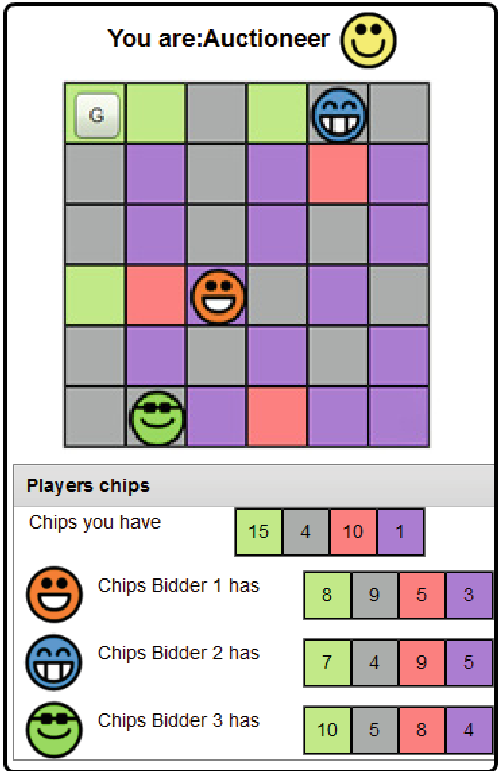 Figure 1: The Auctioneer's view. Success depends on the ability to exchange resources and private messages (Panel b).
Corruption occurred when the Auctioneer deliberately chose a lower bid because they received a private "gift" of chips from a bidder.
Experiments & Results: Cultural Nuances and "Over-Bribing"
The study yielded 276 games across three distinct cultures. The results partially mirrored global indices but offered surprising localized insights:
- China: Highest corruption (56%). Both the auctioneer and the bidder profited.
- USA: Corruption was higher than expected (33%). Interestingly, US bidders often "over-bribed," giving away so many resources to the auctioneer that they didn't have enough left to actually finish the contract.
- Israel: Lower corruption (29%) than the US, despite having a "worse" CPI score at the time.
Predicting Corruption with ML
The team used Decision Trees to see if they could identify "dirty" games without looking at private messages. They found that State Profit (how much the government made) was the "smoking gun." If the state's profit was suspiciously low, the probability of corruption was nearly 80%.
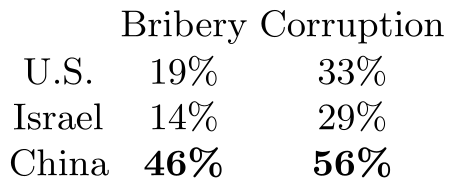 Table 1: Percentage of Bribery vs. General Corruption. Note the discrepancy between the US and Israel.
Critical Analysis & Conclusion
Takeaway
The core contribution is the predictive model. It suggests that in any procurement system, we don't need to wiretap every conversation to find corruption; we simply need to monitor the "economic delta" between the optimal public outcome and the actual result.
Limitations
The study uses students, whose risk-taking behavior may differ from professional bureaucrats. Furthermore, the "punishment" for getting caught was non-existent in this lab setting, whereas real-world corruption carries the threat of prison.
Future Work
The next step is the deployment of Intelligent Audit Agents. By training AI on this game data, researchers can build "Guardian Bots" that sit inside procurement software to flag suspicious bidding patterns in real-time, providing a computational shield against the abuse of power.