
SPNR: Modeling the Battle of Opinions in Rumor Propagation
A new rumor propagation model and control strategy on social networks
The paper introduces the SPNR model, an extension of the SIR epidemic framework tailored for social networks by splitting the infected state into Positive (P) and Negative (N) spreaders. By evaluating the model against real Sina Weibo data, it effectively captures the dynamics of rumor propagation and provides a theoretical spreading threshold based on network topology.
TL;DR
Information in social networks doesn't just "spread"; it competes. This paper moves beyond the simplistic "infected vs. healthy" binary of traditional models by introducing the SPNR model. By splitting the infected population into Positive and Negative spreaders, the authors provide a more granular view of how rumors die out or dominate, validated by real-world data from Sina Weibo.
Problem & Motivation: Why Bacteria Aren't Like Rumors
For decades, researchers used the SIR (Susceptible-Infected-Recovered) model to track rumors. However, viruses don't care about your opinion. In social networks, a user might see a rumor and decide to debunk it (Negative spreader) rather than share it (Positive spreader).
The core limitation of prior work was the homogeneity of the infected state. If you treat a "debunker" the same as a "believer," your model will over-predict the rumor's peak and fail to understand why certain rumors collapse prematurely. The authors' insight is that the mathematical "interference" between these two states is the key to understanding rumor control.
Methodology: The SPNR Framework
The SPNR model introduces four distinct states:
- S (Susceptible): Ignorant users.
- Ip (Positive Infected): Users supporting the rumor.
- In (Negative Infected): Users opposing/debunking the rumor.
- R (Recovered): Users who have lost interest (stiflers).
The "secret sauce" of this model lies in the Transfer Rates (μ). When a Positive spreader meets a Negative one, there is a probability they will change their mind. This creates a dynamic tension that traditional models lack.
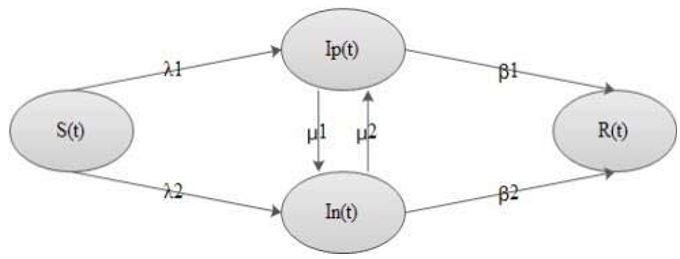 Fig 1: The state transition diagram showing the interplay between P and N states.
The Spreading Threshold
Using differential equations, the authors derived the outbreak threshold: <k>/<k2>. In scale-free networks (where a few hubs have many connections), this threshold tends toward zero, explaining why rumors can explode almost instantly regardless of their initial strength.
Experiments & Results: Sina Weibo Validation
The authors validated their simulation against a real rumor from Sina Weibo. The results (Fig 1 vs. Fig 3) show a striking alignment in how the populations of support and opposition fluctuate over time.
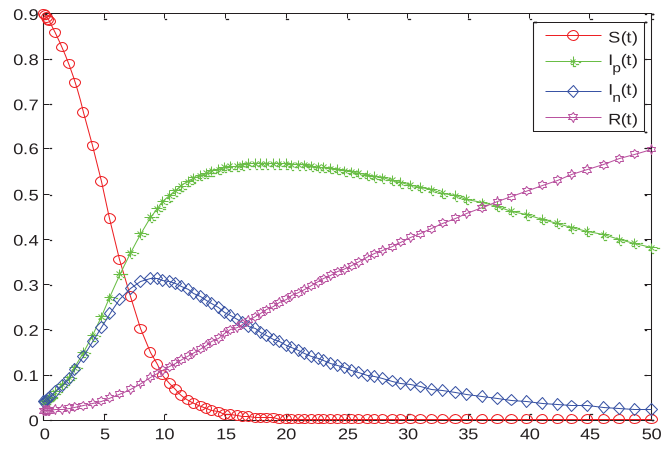 Fig 2: Simulation results showing the rise, peak, and eventual decay of the rumor.
Key Findings from Ablation Analysis:
- Infected Rate (λ) Control: Reducing the infection rate lowers the peak (Mp) but doesn't actually kill the rumor faster. It just makes the "fire" smaller.
- Transfer Rate (μ) Control: This is the "Silver Bullet." By increasing the probability that positive spreaders turn negative, the model shows a sharp decline in both the peak intensity and the total life cycle.
- Immunization (β): Increasing the "stifler" rate (people ignoring the rumor) effectively shortens the life span but has less impact on the initial peak.
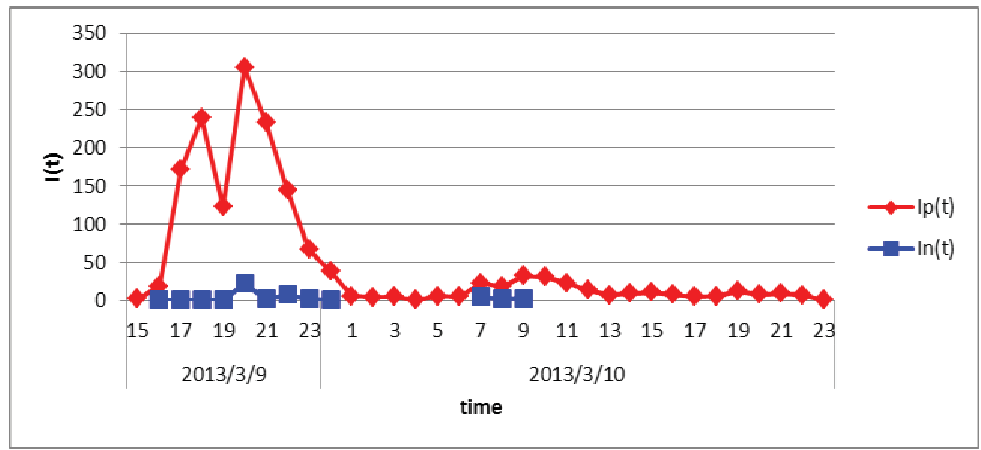 Fig 3: Empirical data from Sina Weibo confirming the SPNR oscillation patterns.
Critical Analysis & Conclusion
The SPNR model is a significant step forward because it acknowledges that information diffusion is a sociological phenomenon, not just a biological one.
Takeaway for Policy Makers: Don't just try to "delete" rumors (lowering λ). Instead, empower the "Negative Spreaders" (increasing μ). Counter-narratives and fact-checking are mathematically more effective at collapsing a rumor's life cycle than simple censorship.
Limitations: The model assumes a static network. In reality, users often "unfollow" or "block" during heated debates, changing the network topology (<k2>) in real-time. Future research should look into adaptive network topologies combined with the SPNR states.