
FOAF: Bridging Psychology and Math to Decode Online Opinion Dynamics
A New Social Network Model of Online Forums
This paper introduces the First-Order-Aging-with-Fitness (FOAF) model, a novel social network framework designed specifically for online forums. By integrating psychological aging factors with individual node fitness, it accurately models the bipartite interaction between authors and commenters, achieving superior alignment with real-world data from PTT and InsideHoops.
TL;DR
Researchers have developed the First-Order-Aging-with-Fitness (FOAF) model, a mathematical framework that finally explains why traditional network models fail to map modern online forums. By injecting "psychological aging" and "node fitness" into the equation, the model accurately mirrors the degree distributions of diverse platforms like PTT (social movements) and InsideHoops (sports), providing a more realistic lens for observing collective human behavior.
The Problem: Why the BA Model Fails the "Internet Test"
For decades, the Barabási-Albert (BA) model has been the gold standard for scale-free networks. It operates on a "get richer" (preferential attachment) logic: the more links a node has, the more it gets. However, the Internet is more ruthless.
In an online forum, an article's popularity doesn't just grow forever based on its current likes; it clashes with temporal decay. A post from three years ago, no matter how popular, rarely attracts new comments today. Traditional models ignore this "aging" factor and individual "fitness" (the intrinsic quality of a post), resulting in scaling exponents that are mathematically sound but realistically wrong.
Methodology: The FOAF Architecture
The authors treat an online forum as a bipartite network of Authors and Commenters. They argue that these two groups follow different psychological rules:
1. Authors & The FOAF Model
Authors are in constant competition. Their ability to attract comments is defined by:
- Fitness (): Intrinsic novelty or quality, modeled via a Beta distribution.
- First-Order Aging: A decay factor where is current time and is creation time.
The attachment probability is expressed as:
2. Commenters & The Fitness Model
Commenters are viewed as autonomous agents. Their "productivity" is modeled using the Bianconi-Barabási model, focusing on their personal initiative (fitness) rather than competitive aging.
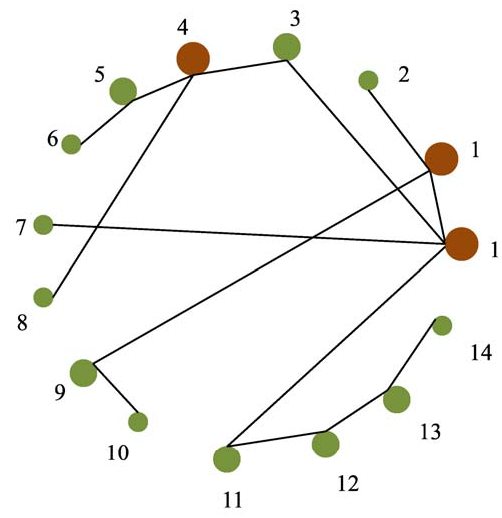 Figure 1: Comparison between (a) the standard BA model and (b) the FOAF model, highlighting how FOAF favors younger nodes to better reflect forum reality.
Experimental Verification: Politics vs. Basketball
To prove the model's universality, the researchers tested it against two distinct datasets:
- PTT (Taiwan): Specifically, data from the 2014 "Cross-strait Service Trade Agreement" protest—a high-stakes, politically charged social movement.
- InsideHoops: A leading NBA forum with a more homogeneous, fan-driven culture.
Key Findings:
- Scaling Exponents: While the BA model predicts an exponent of -3, real forum data sits between -1 and -2. FOAF successfully captures this "flatter" distribution.
- Author Consistency: Interestingly, the behavior of authors (posters) was remarkably similar across both the political movement and the sports forum, suggesting a universal human drive for competition and novelty in digital spaces.
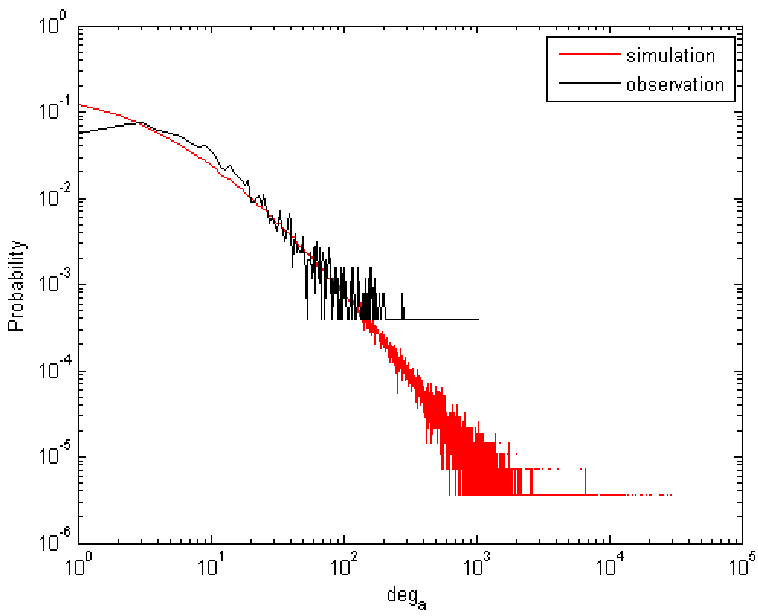 Figure 2: The FOAF model (green line) shows a significantly better fit for author degree distributions on PTT compared to the traditional BA model.
Critical Insight: The "Apathy" of the Public
An intriguing takeaway from the study is the difference in Commenter behavior. The model fit perfectly for commenters on PTT but struggled with InsideHoops. The authors attribute this to "public apathy" vs. "fan enthusiasm." On PTT, the general public acts more like traditional citation nodes (passive), whereas basketball fans are hyper-engaged, repeated commenters, necessitating even more specialized modeling for passionate sub-communities.
Conclusion & Future Outlook
The FOAF model represents a significant shift from "statistical networks" to "behavioral networks." By proving that first-order aging is the governing law of online popularity, it opens the door for:
- Social Movement Prediction: Better identifying which opinions will reach a consensus vs. polarize.
- E-commerce: Refining how "viral" products are modeled in competitive digital marketplaces.
Limitations: The current model struggles with "superstar" nodes (the highest degree peaks), suggesting we need to incorporate a "stopping criterion"—the moment when an author or commenter simply burns out or leaves the platform.
Academic Reference: Ting-Han Fan and Kwang-Cheng Chen, "A New Social Network Model of Online Forums," IEEE.