
Beyond the Silos: Engineering a Distributed and Context-Aware Social Web
Seeking New Social Networking Models How applications will adapt to the upcoming network bandwidth perimeters and impact the Social Web topology
This paper proposes a decentralized, peer-to-peer (P2P) social networking model designed to dismantle "vertical silos" (centralized providers). It introduces a framework combining WebID for identity, UPnP for local device discovery, and VPN/Application Gateways to enable cross-network multimedia sharing.
TL;DR
The modern Social Web is built on "Silos"—centralized platforms that trade user privacy and data ownership for connectivity. This paper from Telecom Italia Researchers argues for a paradigm shift: leveraging Next-Generation Access Networks (NGAN) to transform our home gateways and mobile devices into personal servers. By combining WebID, UPnP, and P2P federation, we can share multimedia directly with friends without ever "uploading" to a central broker.
The Problem: The High Cost of "Free" Social Networks
Traditional Social Networking Services (SNS) act as brokers. To interact, users must subscribe to the same service and surrender their content to a central database. This creates several critical pain points:
- Data Sovereignty: Users lose control over how their data is mined.
- Interoperability: You cannot "friend" someone across different platforms easily.
- Bandwidth Inefficiency: In an age of symmetric 100Mbit links, uploading large files to a cloud just for a neighbor to download them is architecturally nonsensical.
Methodology: The "Social Area Network" Architecture
The authors propose a decentralized layer where the user’s "Smart Home" becomes a first-class citizen of the Social Web.
1. Federated Identity (WebID)
Instead of a username/password for every site, the paper pushes for WebID. You identify yourself via a URL (e.g., https://your-home-server.com/profile#me), backed by an X.509 certificate. This allows for secure, encrypted authentication across the distributed web without a central authority.
2. Bridging Local and Global Discovery (UPnP & VPNs)
Universal Plug and Play (UPnP) is excellent at finding devices within a home (LAN) but fails over the internet. The paper discusses two solutions to "bridge" these islands:
- Network Level: Creating a Virtual Private Network (VPN) between friends' routers, making their home servers appear as if they are on the same local network.
- Application Level: Using gateways like the CLING workbench (a UPnP-HTTP gateway) to proxy resources across the internet.
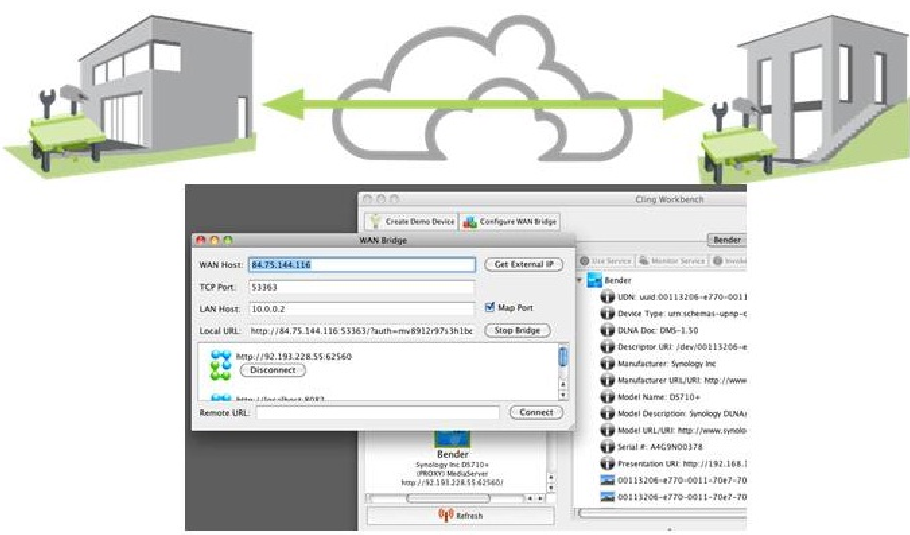 Figure: Federating UPnP islands through application gateways to enable remote content access.
3. Context-Awareness and XMPP
To prevent "information overcrowd," the system uses device sensors to automatically tag content (GPS, time, proximity). XMPP (Extensible Messaging and Presence Protocol) is used as the signaling layer to notify friends when new content or services become available in real-time.
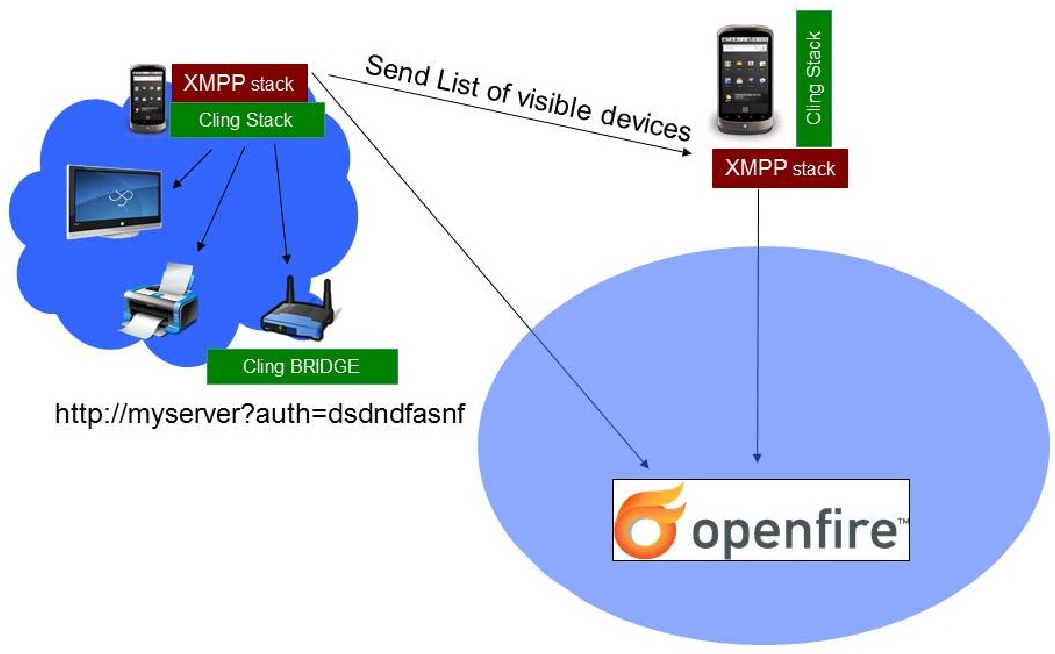 Figure: Using XMPP as the "social glue" to advertise services between active nodes.
Experimental Insights: Seamless Proximity Sharing
The researchers demonstrated a use case where two smartphones recognize each other via proximity sensors. Once "federated," an ad-hoc network is established. Content stored on a user's home gateway becomes immediately accessible to the friend’s mobile device, governed by pre-defined Access Control Lists (ACLs).
This bypasses the "upload" step entirely. The symmetric nature of modern fiber optics (NGAN) ensures that the home server’s upload speed is sufficient to serve high-quality multimedia directly.
Critical Analysis & Conclusion
While the technical foundation (UPnP, XMPP, WebID) is robust, the paper acknowledges that the challenge is not just technical but social and political. Centralized players have a vested interest in keeping their silos closed to maximize data-mining profits.
Takeaways:
- The Technology is Ready: Standards like WebID and federated protocols provide a clear path away from centralization.
- The Hardware is Ready: Home gateways and IoT devices have the compute power to act as servers.
- The Friction remains: The transition requires a critical mass of users and industry-wide consensus on open identity frameworks.
This work serves as a foundational blueprint for what we now call the "IndieWeb" or decentralized social media (like Mastodon or Scuttlebutt), proving that the vision for a self-sovereign social web has been technically feasible for over a decade.